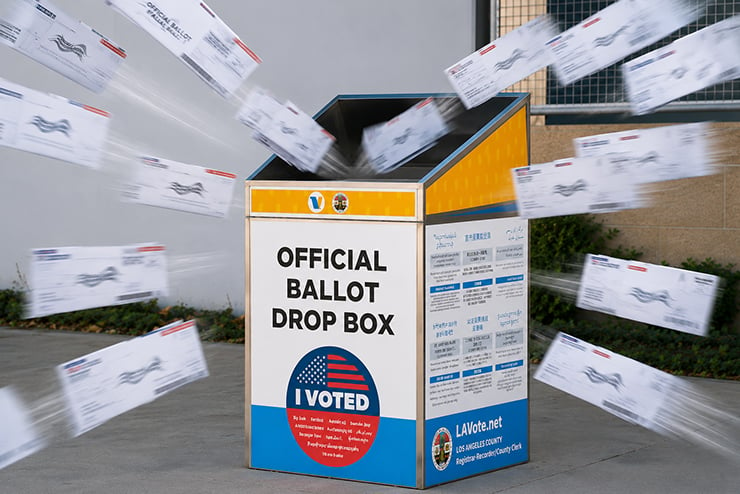
Whether intentional or not, the process of voting in California from registration to the final delivery of the ballot is highly vulnerable to fraud. At several different steps in the process, a dishonest sort can easily take advantage of it. If a security firm reviewed California’s system, it would conclude it’s beyond repair and should be scrapped.
To legally register to vote in California, one must be a U.S. citizen and a California resident. Looks good thus far. However, you may register—and vote—in a language other than English and demand all materials in Spanish, Chinese, Hindi, Japanese, Khmer, Korean, Tagalog, Thai, or Vietnamese. This seems strange considering that, with a few exceptions, to become a naturalized citizen, one must pass an English proficiency test.
It gets worse. In the Golden State, neither voter registration nor voting requires documentation or any real proof of U.S. citizenship. Simply check the box that says you’re a citizen. Doing so is your self-attestation to the fact. There is a threat of punishment under the law—up to three years in county jail—if perjury is committed. However, county registrars of voters are not authorized to verify or investigate the attestations of citizenship. An investigation can only commence if evidence of a fraudulent claim of citizenship is provided to a county district attorney or to the California Secretary of State. Prosecutions and convictions are rare, and jail time rarer still.
It would seem common sense that when voting in person at a polling place, the voter would have to show ID. Not in California. Walk in, give them the name of someone registered, and you get a ballot. This may not matter much because voting at a polling place is becoming a thing of the past.
Mail-in voting in California is on the verge of entirely replacing walk-in, which greatly increases the potential for fraud. In the 1960s and 1970s, fewer than 5 percent of ballots cast were mail-in. In the 1980s, mail-in voting increased from 6 percent to 14 percent, and in the 1990s, from 18 percent to 25 percent. Over the past 25 years, mail-in has increased from 25 percent to a stunning 90 percent.
At different times during these years, California made it easier to obtain absentee ballots, which were originally intended only for registered voters who were elderly, ill, disabled, working overseas, or serving in the military. Those inconvenient requirements, rearing their ugly heads and discouraging people from voting!
In 1978, California became the first state to pass “no-excuses” absentee voting. From then on, any registered voter could obtain an absentee ballot simply by request. In 2016, legislation enabled third parties to collect mail-in ballots and deliver them to polling places or drop boxes. There were no limitations on the number of ballots collected, no restrictions on the relationship between the person collecting and the voter or candidates on the ballot, and no safeguards for the chain of custody. Moreover, ballot collectors could be paid. “Ballot harvesting” then began.
Then, in 2020, with the excuse of COVID, legislation mandated that ballots be mailed to every registered voter in California. In the 2018 state elections, 65 percent voted by mail. In 2020, it was 87 percent. In elections since then, it’s been 91 percent, 89 percent, 81 percent, and 89 percent.
Yet, in 1914, when voting by mail in California was first proposed in an initiative, Proposition 14, it was soundly defeated by voters by 61.5 percent to 38.5 percent. Moreover, Proposition 14 didn’t provide for universal mail-in voting but only for those voters in very specific circumstances. Even with the many restrictions and safeguards in the proposition, the great majority of Californians thought mail-in voting would be far too susceptible to fraud.
Ballot harvesting’s effects were first apparent in California during the 2018 congressional elections. The case of Congresswoman Young Kim is illustrative. Born in South Korea, she moved to Guam to live with an older sister when she was 12. Her parents soon joined her, but then moved the family to Hawaii. She graduated from high school there and then went to college on the mainland at the University of Southern California. She earned a degree in business administration and shortly afterward became a naturalized U.S. citizen.
Kim worked in private industry for several years before becoming an aide to Ed Royce, a Republican state senator. When Royce won California’s 39th congressional seat, Kim continued working for him on the Hill. After 20 years of working for Royce, she was elected to the California State Assembly in 2014. When Royce announced his retirement in 2018, he endorsed Kim to replace him.
Kim appeared to be an ideal candidate for the district, which was moderately conservative, had a fairly large Asian immigrant population, and had a Republican advantage of 5,000 registered voters. In the “jungle” primary (both Republicans and Democrats) of 17 candidates, with the top two advancing to the general, she finished first with 21.2 percent of the vote. Second went to Navy veteran and Democrat Gil Cisneros with 19.4 percent, whose claim to fame was winning $266 million in the Mega Millions lottery in 2010. He subsequently established college scholarship endowments for Latino students.
Kim and the other Republican candidates accounted for 53.3 percent of the vote. Democrats for 46.0 percent. Two American Independent Party candidates had 0.5 percent, and two no-party-preference candidates had 1.2 percent. It seemed likely that Kim would pick up more of these voters than Cisneros. Even without them, she would be going into the general election with a substantial advantage.
At the close of election night in 2018, Young Kim had a comfortable lead of 4,000 votes. Several days later, she still had a comfortable lead, and she traveled to Washington for New Member Orientation. However, batches of harvested ballots were still being counted two weeks later. Defying the odds, they were highly disproportionately in favor of Cisneros, and he edged ahead of Kim. Another week of counting, and Cisneros was up by more than 7,000 votes. The final vote tally put him 7,611 votes ahead of Kim, and he became the representative for the 39th District.
Republicans lost races in a similar fashion in the 10th, 21st, and 45th Districts. Moreover, in three other House races where Democratic candidates had only narrow leads on election night, they pulled away in the weeks that followed, receiving highly disproportionate numbers of mail-in votes. Three seats were flipped in traditionally Republican Orange County. The county’s registrar of voters, Neal Kelley, told a reporter from the San Francisco Chroniclethat individuals came to his office to deposit “maybe 100 or 200” ballots at a time. Ballot harvesting at its finest.
Republicans got the message, at least in Orange County. Whether one likes ballot harvesting or not, it’s part of California election law, and not harvesting means electoral failure for one’s party. With a more motivated Republican party behind her, Young Kim ran again in 2020. She won the jungle primary with 48.3 percent of the vote to Gil Cisneros’s 46.9 percent. In the general election, she was ahead by some 1,000 votes at the close of election night. As ballots were counted over the next three weeks, instead of her lead dramatically shrinking, it remained almost the same. She won by 4,000 votes with 50.6 percent to Cisneros’s 49.4 percent.
California needs its entire voting system reconstructed, starting with voter registration. The voter rolls need to be purged of noncitizens, nonresidents, and the deceased. In August 2025, Assistant Attorney General Harmeet Dhillon of the Department of Justice sent a letter to California Secretary of State Shirley Weber requesting an electronic copy of the state’s voter rolls. The DOJ is authorized to inspect the rolls under the National Voter Registration Act and the Help America Vote Act.
Thus far, California has refused to comply with federal law, citing state privacy restrictions. Moreover, the state says, “There is no evidence of widespread fraud in the state’s elections,” and Democrats and leftist media repeat that denial like a mantra. This raises the question: how can evidence be gathered without first inspecting the voter rolls? The dispute is now before the Ninth Circuit Court of Appeals.
Meanwhile, there’s plenty of anecdotal evidence. In May 2026, Brenda “Anika” Brown Armstrong pled guilty to paying another person to vote. She specialized in registering the homeless, often using her own address as theirs. At election time, this meant she would receive dozens of ballots. Exactly what she did with them is unclear.
Armstrong would also use a homeless shelter’s address. She was not the only one doing this, and shelters, especially in Los Angeles, now receive dozens, and sometimes hundreds, of ballots. In an opinion piece for the New York Post, popular radio talk-show host John Kobylt said, “One shelter had 1,160 voters listed, with 120 beds.” He further stated that “a number of men and women who live on Skid Row have said they were paid to vote for Mayor Karen Bass or Councilwoman Nithya Raman.” Los Angeles’ large majority of registered Democrats should have been enough to keep mayoral candidate Spencer Pratt from proceeding from the primary to the general election, but it seems the left leaves nothing to chance.
One of the most dramatic of the individual cases of fraud was that of Carlos Antonio De Bourbon Montenegro, AKA Mark Anthony Gonsalves, who tried to rig the mayoral election in Hawthorne. The hometown of the Beach Boys and, once upon a time, nearly all-white and middle-class, Hawthorne is now 55 percent Hispanic, 25 percent black, 9 percent white, and seven percent Asian. A third of the population is foreign-born. Latino and black gangs figure prominently in the town.
Allegedly funded and aided by the MS-13 gang, Montenegro ran for mayor, helped along by 8,000 fraudulent voter registrations. If county prosecutors were right, MS-13 would have controlled the city had Montenegro won. Because of California’s one-party rule and concomitant corruption, we half-seriously call the state a Banana Republic. Hawthorne almost became one for real. Montenegro pleaded nolo contendere to three counts of false registration, registering nonexistent voters, and perjury. He was sentenced to 60 days in jail, two years of probation, and 30 days of community service—a mere slap on the wrist that will hardly deter other fraudsters.
Without a thorough investigation of California’s system of registration and voting, it’s impossible to know whether the cases of Anika Armstrong, Carlos de Montenegro, and a dozen more like them are anomalies, or only anomalies because they got caught. I’d like to think the former, but I fear it’s the latter. ◆
Leave a Reply