Some things can’t wait. The National Institutes of Health recommends coroners perform autopsies within 24 hours of death. Urgency matters “because the quality of tissues deteriorates over time.” In order to stave off organ failure, snakebite victims should get antivenin shots within the “Golden Hour,” the first 60 minutes after the attack. Fire insurance claims should be filed before salvage and demolition efforts destroy evidence of economic loss. Liquid concrete in cement trucks will harden and ruin the drum if not poured within 90 minutes.
History books, on the other hand, can wait. More importantly, they should wait. The “tissues” of history—archival records—require time and patience for compilation, assessment, and interpretation. Historians and archivists should work to prevent the careless destruction of documents, just as one who has lost his house to fire should conserve its charred remains. Like contestable insurance claims, accurate histories must ground themselves in contemporaneous documentation. Historical explanations that ignore primary sources devolve into fantastical myths or triumphalist chauvinism. And historians who rush their analyses to meet publishers’ deadlines or to opine on raging political debates risk falling prey to intellectual fads. Their hasty scholarship congeals, like cement at the 91st minute, into ideological polemics.
In short, when the author rushes history, he becomes a partisan hack. Paul Starr is a fine example of an author who has fallen into this trap.
Paul Starr is not technically a historian. However, the Princeton sociology and public affairs professor can’t not know about a historian’s duty to remain ideologically disinterested and chronologically detached from the past. His 1984 book, The Social Transformation of American Medicine, won both the Pulitzer Prize for General Nonfiction and Columbia University’s Bancroft Prize, awarded annually for distinguished works in American history. More likely, Starr does know of the historian’s obligation to remain impartial in pursuit of the truth, and I’ve just fallen for my very own fallacious appeal to authority.
Wellesley College professor Susan Reverby expressed similar doubts about both Starr and his prize-winning book in a September 1984 Isis review. Reverby’s casual read of The Social Transformation duped her into praising it “at first glance.” Nevertheless, after scrutinizing Starr’s argument, she concluded he “overlooked, or carefully avoided, analysis of crucial historical issues.” Among Starr’s sins that Reverby found unforgivable, his failure to consider the “class and gender-specific aspects of human interaction” rubbed the Women’s Studies Program professor the wrong way.
That woke quibble aside, Reverby more substantially accused Starr of cherry-picking evidence to support his argument. For example, a “careful reading” of the 20th-century debates within the American College of Surgeons—which Reverby argued Starr “appears to be aware” of—would have, in her opinion, produced better history. Unlike the Pulitzer and Bancroft committees’ plaudits, Reverby’s faint praise damned The Social Transformation. Even though she hailed Starr’s book as “our best general accounting to date of the growth of physician power,” she ultimately panned it as “barely critical.”
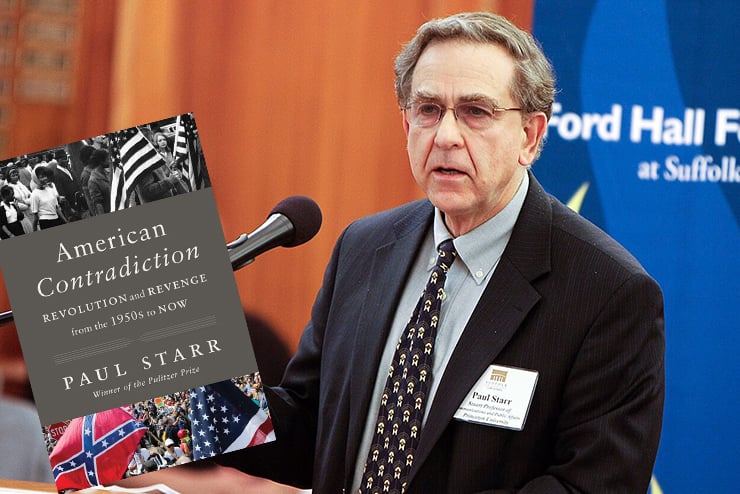
Reviewers should not dismiss Paul Starr’s latest book, American Contradiction: Revolution and Revenge from the 1950s to Now, as “barely critical.” Across 359 pages of tight argumentation, and backed by a formidable grasp of current events and secondary literature, Starr seeks to answer a question that’s clearly been bothering him since November 2016: “How did the country that twice elected Barack Obama then go on to elect Donald Trump?” However, a dispassionate historian eager to avoid the political fray would have first asked, “How did Barack Obama ever get elected?”
That answer still isn’t clear now, eight years later. Journalistic explanations, like David Plouffe’s The Audacity to Win: The Inside Story and Lessons of Barack Obama’s Historic Victory, as well as Game Change: Obama and the Clintons, McCain and Palin, and the Race of a Lifetime by John Heilemann and Mark Halperin, represent history’s first rough draft, since no one reads newspapers anymore. Those hot takes will lose explanatory power over time as historians plumb the archives and come to understand the long-term effects of the Obama phenomenon. In prematurely asking his question about Trump, Starr comes off like a desperate gambler trying to cash in a lottery ticket before the drawing.
At least Paul Starr has more than atoned for Susan Reverby’s “barely critical” accusation. If anything, Starr’s American Contradiction will strike moderate readers as not just “too critical,” but as nothing but critical. He deplores the country’s failure to adjust politically “while the American people changed.” Starr blames “entrenched institutional obstacles,” like the “structural bias” that perverts both the Senate and the Electoral College, along with a Supreme Court “firmly in right-wing hands.” Susan Reverby can now rejoice; race, class, and gender figure prominently in Starr’s version of a revolutionary “rewriting of the American story.” Sadly, his Foucault-like zeal for a radical new history overshadows his thorough research and expertly concise prose.
Revolutionaries hate their pasts. Starr wastes no time in telling us so. On the very first page, he laments, “The United States is still moored to an old version of itself.” In Starr’s world, old equals bad, custom equals superstition, and tradition equals stagnation. He derides our “eighteenth-century constitution” as “the hardest to amend” compared to those of more enlightened democracies. Through frequent reminders, Starr will not let readers forget that Donald Trump lost the 2016 popular vote. He complains that both our gerontocratic Senate and antiquated Electoral College “underrepresent urbanized populations.” Starr praises the bygone mid-20th-century Supreme Court, which did all it could “to advance a revolution in rights, race, and gender.” But now, thanks to the ministrations of Federalist Society philistines who can’t distinguish between Starr’s tenured chair at Princeton and a Barcalounger, the Supreme Court wants to take us back “to a time before women, Black people, and other minorities had a say.” Ugh. Shall we turn to page 2?
Let’s skip ahead in the interest of time. In some ways, Starr’s throwback “race, class, gender” rubric reads like your favorite old classic novel compared to today’s au courant historical works based on intersectionality, decolonial theory, and racial capitalism. But even your favorite old novel eventually gets tiresome.
Starr rarely misses an opportunity to impugn whites. He reels off the characteristics of “conservative identities” like “Christian, morally traditional, [and] patriotic” before oddly noting “and white usually by implication.” Indeed, “In much usage,” according to Starr, “‘American’ implicitly meant someone who was white.” And of course, “Whites especially” enjoyed America’s booming postwar years, much like their ancestors did in “small-town white America.” The suburbia of the 1950s and early television sitcoms had many commonalities; Starr highlights that “white families” prevailed in both. Suburbs served as melting pots “for (white) Americans” as opposed to (swarthy?) immigrants.
Starr’s racial panopticon also surveils his fellow leftists. The women’s liberation movement suffered from a “nearly all white” membership. Meanwhile, Mexican Americans “were committed to upholding a white identity” for themselves lest they suffer “the indignities of Blackness.” But why should these observations surprise us when “until the late twentieth century,” as Starr himself notes, “America was a ninety-ten society … 90 percent white, 10 percent black”?
“Quantity has a quality all its own,” as Stalin supposedly said. Starr’s fixation on race, of which those quotes comprise a small sample, serves to numb readers into submission. If even your skin color presents problems, then just think how corrupt your entire past must be. Race matters most in Starr’s manifesto since “racial resentment” explains Trump’s rise to power, according to one “influential account” he cites. And Starr agrees. Trump won thanks to “racial grievance” stirred up long ago by George Wallace and Patrick Buchanan. Then in 2024, an always-upper-case-B “Black woman,” Kamala Harris, “undoubtedly lost votes because of racism.” Proof? How dare you speak like that to a Princeton professor who founded, with Robert Reich, The American Prospect, “an authoritative magazine of liberal ideas”!
I had originally planned to review American Contradiction in Chronicles’ book review section. When I mentioned its title at one of our staff meetings, our Editor-in-Chief Paul Gottfried enthused, “That sounds like something I’d like to read!” The title initially drew me in as well. Unfortunately, Starr’s narrative is nothing more than a prototypical left-leaning history of postwar America, right up to the Trump era. But after reading the book, I now recognize the bigger lessons conservatives should draw from it.
Yale University Press lists American Contradiction among its “History” selections. Historians explain change over time. They must make clear how the Nazis came to power, what caused the Russian Revolution, and why the United States fought in Vietnam. Moral philosophy belongs elsewhere. The more a historian tells us how much he hates Nazis, the less we know about how they came to dominate Germany. The more a historian praises socialism, the less we understand why Russians revolted in the first place. And the more a historian condemns Vietnam veterans as baby killers, the less we understand why “the best and the brightest” ever had the brilliant idea to mire American draftees in that godforsaken quagmire.
Unfortunately, Paul Starr spends too many pages relitigating the Democrats’ Electoral College losses, harping on race, and bemoaning the Supreme Court—among myriad other topics irrelevant to his initial, albeit premature, inquiry. Right-leaning readers will start the book, then skim it, then dismiss it. Left-leaning readers will start the book, become enraptured by its attacks on pre-woke America, and then tell their friends they must read it. But neither group will be able to answer Starr’s interesting initial question, “How did the country that twice elected Barack Obama then go on to elect Donald Trump?
Neither diatribes nor one-sided arguments belong in historical scholarship. Change over time is complicated and complex. Masterful historians illustrate and explain the truth. The rest polemicize and preach. Good histories should be both balanced and fair to their opponents, not jaundiced and antagonistic. Yale University Press and Paul Starr know better. ◆
Leave a Reply