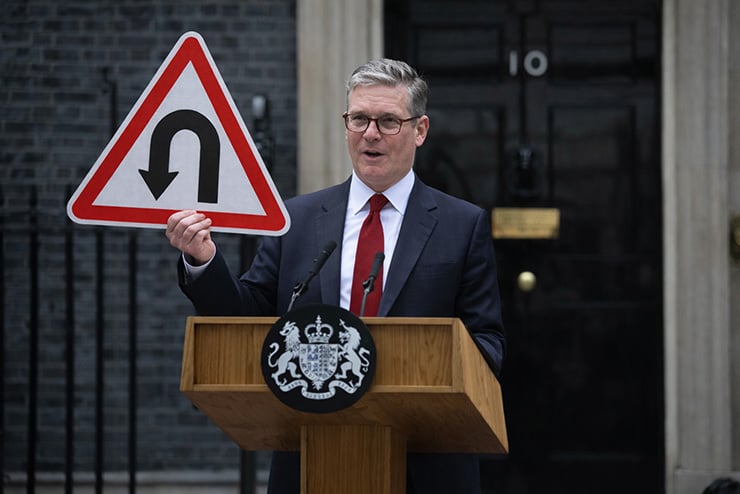
Since becoming Prime Minister in July 2024, Keir Starmer has reversed course on major policies a total of 13 times.
At the top of the list is his backpedalling and apologizing for his May 2025 anti-immigration “Island of Strangers” speech, which signaled the biggest shift in British immigration policy in a generation. And, in late January of this year, he also performed another unofficial U-turn in “standing up to Trump” over Greenland, after it was widely perceived that his previous tactic of “appeasement” had failed.
This constant back-and-forth approach is not unique to Starmer; it was also the strategy of previous British governments under Rishi Sunak and Boris Johnson. In fact, Johnson did it so much that he was dubbed “Mr U-Turn” by the press, for overseeing a grand total of 30 policy reversals. Tory governments would routinely “leak” a policy to the press, observe it playing badly with the public, and then row it back two weeks later. The most ridiculous of these turnabouts was when Rishi Sunak announced in May 2024 that he’d be bringing back national service for 18-year olds (military conscription or compulsory civil service), only to do a complete 180° in June.
These constant U-turns may not be simply hilarious incompetence. It is said that “a system is what it does” (rather than what is says it does); so it is likely they serve a deliberate purpose, such as familiarizing and normalizing a concept with the public through discussion. In psychology, this technique is known as “priming” and “anchoring.”
For example, while Sunak’s proposal was widely ridiculed in 2024, France and Germany have recently introduced limited and voluntary national service schemes. Now, British national newspapers point to the continent, saying that Britain is woefully unprepared for war without similar conscription policies. One might say that the prior U-turn by Sunak primed the public’s receptivity to entertain the prospect of national service. Or, in more stark terms, Sunak put it on the table when previously it had not been on the table.
To use another case study, consider the latest official Starmer U-turn over national digital IDs. Back in July 2024, just days after Starmer had become prime minister, Tony Blair held a conference setting out the agenda for the new Labour government: to pursue a mandatory digital ID policy wedded to the rollout of AI technology throughout the civil service. When Starmer was asked if he’d be doing any of this, he publicly rejected Blair’s proposals. Then, suddenly, in September 2025, the Labour government announced it would, after all, be bringing in mandatory digital ID.
This provoked a media backlash. A petition opposing the move garnered 3 million signatures, which the government acknowledged and then promptly ignored. There had been no debate, and what little public consultation there was seemed to happen after the fact. Then in January 2026, just as suddenly, Starmer appeared to do another about-face, easing requirements for workers to sign up for the digital ID system and making parts of the proposal optional. This was seen as a victory by opponents of digital ID. But the upshot is that a digital ID system is now in place. However “optional” it may now be, it is going to happen, just slower and by stealth. In other words, digital ID is now on the table when previously it had not been on the table.
U-turns are increasingly becoming a tool for perception management by governments in both the UK and the U.S. They float an idea in the media, it proves unpopular, and the government withdraws it. The public breathes a sigh of relief, but what has happened is that they have been psychologically primed to discuss the proposal again in the future. It has become normalized (anchored) in the public consciousness. At a later date, the government adopts the unpopular idea again, measures backlash, and then drops some aspect of it. The public again sees that as a victory, although partial. The original proposer of the idea—whether the government itself or an NGO such as the Tony Blair Institute—is closer to achieving its desired outcome.
Of course, one could argue that these U-turns reflect democratic responsiveness—leaders adapting to public opinion in real time, as polls and petitions demand. Yet this view overlooks how initial announcements often bypass manifesto promises or parliamentary scrutiny, suggesting premeditated testing rather than organic flexibility. Psychologically, it leverages the anchoring bias: an extreme initial proposal makes moderated versions seem reasonable, shifting the Overton Window incrementally.
The political cost of these U-turns is that they make leaders appear weak and indecisive. Starmer has seemed lost and uncomfortable, a ditherer. Sunak frequently looked ridiculous, and Johnson incoherent and buffoonish. However, from the point of view of the permanent bureaucracy, the personal images of these politicians are easy sacrifices. This bureaucracy—civil servants, think tanks, and international bodies—operates on longer timelines, using elected leaders to absorb political heat while their policies edge forward.
I suggest looking beyond the flimflam of individual leaders and focusing on whether an idea is now on the table. What is the trajectory of that idea? Does it keep coming back again? Viewed from this perspective, none of the U-turns of Starmer or other Western leaders are reversals of direction, but rather temporary reprieves for the public to get used to things they will have to accept in the end. ◆
Leave a Reply