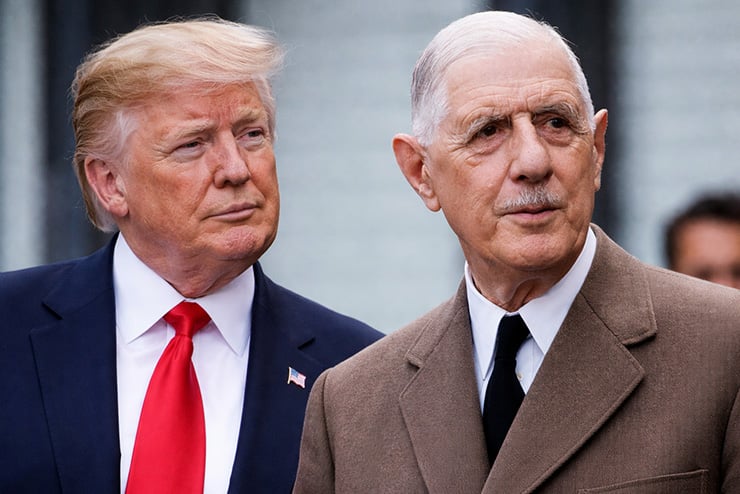
General Charles de Gaulle, arguably the greatest Frenchman of the 20th century, most likely was not the role model for President Donald Trump’s political career. There is no mention of de Gaulle in Trump’s public utterances, not a single reference to him in The Art of the Deal. There are nevertheless, remarkable similarities between those two men’s core values and views, as well as their foreign and domestic policies. Obvious differences of class, education, and temperament notwithstanding, the resemblance is remarkable and should be part of the conservative response to the hysterical reaction of the European political establishment to Trump’s policies and statements over the past year.
Firstly, both de Gaulle and Trump were firm believers in the greatness of their respective countries. Both were determined to restore that greatness after a period of decline. Their tasks were vastly different, of course. De Gaulle emerged to lead the Free French after the national debacle in the summer of 1940, and he faced an uphill struggle for recognition and support even from his nominal allies. Trump’s MAGA movement faced resistance from the entire political, cultural, media, and academic establishment. That they both succeeded in those tasks reflects remarkable stamina and self-confidence in the face of near-impossible odds.
Both de Gaulle and Trump shared the same single-minded pursuit of national interest as the principle of foreign policy making. This included a rock-solid defense of national sovereignty to the detriment of all ideological considerations, and an associated disdain for all supranational institutions and decision-making mechanisms.
De Gaulle favored European integration, but strictly within the framework of L’Europe des patries (“the Europe of the Fatherlands”). He emphasized the need for cooperation between sovereign states to create a powerful, autonomous Europe. This was a vision centered on national identity and the maintenance of veto power, which was inevitably at odds with the federalist concept. De Gaulle believed, and stated often, that his view was more in line with Europe’s character as a continental civilization based on unity in diversity. His famous quip, “How can you govern a country which has 246 varieties of cheese?,” was a witty expression of France’s vast cultural complexity, but it also alluded to the impossibility of the pan-European federalist project.
De Gaulle regarded the nation as the political and cultural entity par excellence—a far cry from today’s European Union apparatchiks who define European identity as “diversity,” “inclusion,” “tolerance,” and “openness.” He rightly feared that references to “Europe” as a political entity would lead to the notion of a superstate ruled by unelected bureaucrats, to whom national differences are dying relics and obstacles to their control.
Tragically, this is exactly what happened to the EU. De Gaulle would be horrified by the monster it has become. He would second Trump’s disdain for the Brussels machine and all its works, and he would share Trump’s contempt for its local subsidiaries, the one in Macron’s Paris naturally included. He would also share Trump’s fear that this anti-Europe, with its rampant immigration, rainbow flags, and hate crimes, is heading straight for civilizational and demographic suicide.
On immigration, race, and national identity, De Gaulle held views that would get him arrested anywhere in the EU today. He would be duly charged with hate speech, racism, and inciting intolerance. One of his quotes is worth repeating in its entirety:
It is very good that there are yellow, black, and brown Frenchmen. They show that France is open to all races and that its vocation is universal. But the condition is that they remain a small minority. Otherwise, France would no longer be France. After all, we are above all a European people of white race, of Greek and Latin heritage, and of Christian faith.
Accordingly, de Gaulle’s immigration policy aimed to rebuild France and rejuvenate its population by carefully selecting “desirable immigrants”—almost exclusively from European countries—and integrating them culturally as future citizens, balancing labor needs with national identity and national interest.
Trump was entirely on de Gaulle’s wavelength when he declared in a Thanksgiving post that he wants to “permanently pause migration” from Third World nations, and promised to expel millions of immigrants who are contributing to the overall social dysfunction in today’s America. Two months earlier, addressing the United Nations General Assembly, Trump declared it was time to end the “failed experiment of open borders.”
The late French statesman would find these demands perfectly reasonable. He and Trump might put the sentiment in different words, but both agreed with the conventional conservative position that a well-ordered society requires a high degree of ethnic and cultural commonality to bind citizens together—in other words, the classic nation-state.
De Gaulle, though notoriously leery of American dominance in Europe, might even support Trump’s decision to help sovereignist parties—such as the National Rally in France—in order to help Europe save itself. He might even quip that it is only fitting for an American leader to return Marquis de Lafayette’s favor, after 247 years, by helping France resist an even more tyrannical regime.
In any event, de Gaulle never shirked from intervening in the affairs of other countries, especially in Africa, to assert France’s interests. His interventions—rarely forceful—relied mostly on economic pressure, cultural soft power, and political patronage (outright bribes to corrupt local leaders included) to ensure that African nations remained in France’s post-colonial orbit. After Algerian independence, he also presided over France’s greater involvement with Arab countries and the Third World.
As for the Western alliance, in 1966 de Gaulle withdrew France from NATO’s integrated military command structure, though it remained a political member. Furthermore, ever wary of any form of multilateral defense arrangement, he attacked no organization more ferociously than the abortive European Defense Community. Trump is also notoriously skeptical of NATO’s continued utility, albeit for different reasons. Differences of strategic context notwithstanding, they would both agree that automatic mechanisms of supranational decision-making on life-or-death matters of war, implicit in Article 5 of the North Atlantic Treaty, are inherently dangerous and incompatible with national sovereignty. Trump even declared, at a NATO summit last June, that the meaning “depends on your definition.”
De Gaulle’s reaction to the Soviet occupation of Czechoslovakia in August 1968 was based on pragmatic realism, akin to Trump’s response to the war in Ukraine. In both cases, there was an interest-based reluctance to allow dubious moral and legal arguments to overrule prudence. It is accordingly worth following the French 1966 model for America’s future relationship with NATO: Quit the integrated military command, let the Europeans manage it as best they can, but remain in its political forum. That would be a brilliant coup—a de facto exit.
De Gaulle would support Trump’s attack on the International Criminal Court (ICC) because he never allowed the decisions of an international organization to supersede national law. In any event, he never cared much for the niceties of international diplomacy. He would be sympathetic to Trump’s invitation to Canada to join the United States, provided Quebec is granted independence. In July 1967, he famously called for a “free Quebec” in a speech from Montreal City Hall. In doing so, he greatly boosted Quebec’s sovereignty movement and caused a major diplomatic scandal. For all his occasional heavy-handedness on the world stage, Donald Trump has never gone that far.
De Gaulle’s approach to international affairs presupposed self-determination, national sovereignty, and independence as the preconditions for a stable global order and balance of power. The same principles guide Trump’s “transactional” approach. To both, the system of supranational decision-making is the antithesis of the system of checks and balances that delineates how laws are made, adjudicated, and enforced.
Neither Gaullism nor Trumpism is a coherent ideology, however. Each, at their core, sought to restore national greatness abroad and unity at home. That mission was diametrically opposed to the divisiveness created by the doctrinaire Marxists’ commitment to class struggle in de Gaulle’s France, or to the deranged left’s relentless cultural revolution in the U.S. today. Interestingly, to facilitate his intended task, de Gaulle reformed the French political system to make it more like the American model, by basing institutions of the Fifth Republic (1959) on a strong executive, in contrast to the French republican tradition, which insisted on the primacy of the elected assembly.
At some level, Donald Trump understands, just as Charles de Gaulle did, that the ideology of universal political and legal culture is the enemy of liberty, as it was once understood in both France and America. The fundamental similarity between de Gaulle and Trump is that they appreciated real national communities and cultures; that they believed some higher Providence had ordained a special mission for their own nation; and that they acted accordingly both at home and abroad, foreign disapproval be damned. That is no mean feat.
The Trump administration, as it prepares to fight the self-loathing political class of Europe, must shrewdly explain its objectives and motives to the European public. The French, a sophisticated and educated people, can appreciate a provocative but cogent argument, even if they disagree with it.
Presenting the French with the notion that Donald Trump is more truly an heir to the legacy of Charles de Gaulle than any of their current leaders—save the demonized Marine Le Pen—would be accompanied by screams of establishmentarian outrage, but it would make an impact. The French need to be told point-blank that, by current standards, both de Gaulle and Trump are “hard-right, nationalist populists,” but that in reality they are surprisingly similar patriotic realists, free from the ideological obsessions taking Europe to the abyss.
It is in the American interest for Trump to discover his Gaullist moment and act accordingly in his forthcoming historic mission in Europe. ◆
Leave a Reply