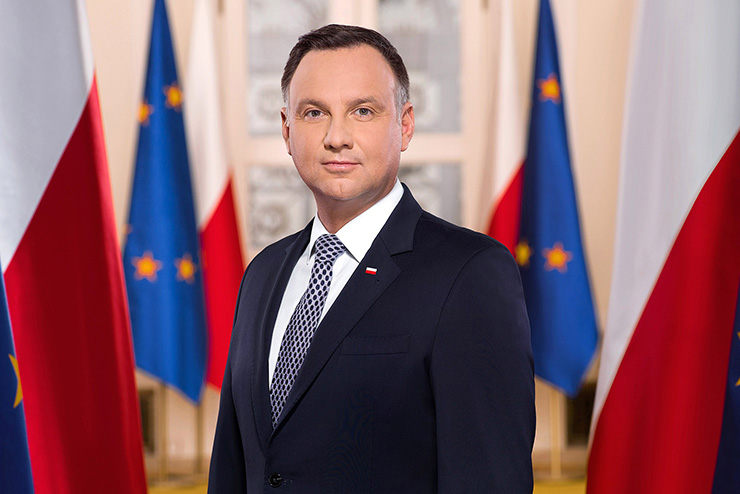
When Andrzej Duda assumed the presidency of Poland in 2015, many Poles hoped he would finally bring the needed clarity, independence, and dignity to Poland’s foreign policy. The hope was that, unlike his predecessor, Bronisław Komorowski, Duda would act on behalf of Poland, not merely as a notary for centers of power outside of it. Now that his two terms in office ended in August, we can say with conviction: He failed.
Not only did he fail to strengthen Poland’s international position, but he also—through lack of initiative—placed Poland in total subservience to the United States, NATO, and Ukraine. Cutting us off from any communication channel with Russia, he has reduced Poland to the role of a pawn in someone else’s Great Game.
Throughout his presidency, Duda has presented no serious strategic concept for Poland’s foreign policy. None of his efforts at regional integration amounted to anything but carbon copies of American projects (such as the Three Seas Initiative). He did not formulate any long-term diplomatic strategy regarding Asia, Africa, or South America—regions vital in the new multipolar world.
Duda’s foreign visits were limited to ritual pilgrimages to Brussels, Berlin, and Washington, with no clear goals and no results, but plenty of smiles and empty declarations. Even during moments of crisis—such as COVID or the war in Ukraine—he did nothing to initiate any independent mediation effort, roundtable, or bilateral opening. He was marked “present,” and that’s all.
Duda, arguably, is the most uncritically pro-American president in the history of post-1989 Poland. His rhetoric and actions show no interest in balancing U.S. influence by strengthening European policy on Polish terms, or through multi-vector diplomacy (as, for example, Turkey does).
During his term, Poland signed military agreements that effectively relinquished control of parts of its territory to the U.S. Army—without public debate. Polish taxpayers now help pay for the American presence over which they had no say and virtually no control. President Duda enthusiastically handed over more than 300 tanks, aircraft, and thousands of tons of ammunition to Ukraine, even though this directly weakened Poland’s own defense capacity.
Equally notable is the increasing subordination of Poland’s intelligence and security structures to American interests, especially after 2022. Under Duda, Poland effectively became a logistical base for CIA operations on NATO’s eastern flank, with no public debate or real political oversight.
As William M. Arkin wrote in Newsweek in a July 2023 investigative piece:
Less than a month after Russian tanks crossed the border on their way to Kyiv, CIA Director Burns landed in Warsaw, visiting with the directors of Poland’s intelligence agencies and putting together the final agreements that would allow the CIA to use Ukraine’s neighbor as its clandestine hub.
This was not an exception but the continuation of a longer trend of submission. The article adds:
Since the end of the Cold War, Poland and the United States, via the CIA, have developed particularly close relations. Poland hosted a CIA torture “black site” in the village of Stare Kiejkuty in 2002-2003. After the Russian invasion of Donbas and Crimea in 2014, CIA activity expanded further, making Poland its third-largest station in Europe.”
There is no stronger evidence that Poland under Duda has transitioned from a sovereign player to an auxiliary of American intelligence operations, often conducted on the edge of legality or beyond it. There was no official announcement, parliamentary oversight, or national consent for this decision.
Such servile Atlanticism, with no conditions or tangible benefits for the Polish state, is not an alliance but political vassalage. As Professor Bronisław Łagowski once noted: “Solidarity-era Poland revels in its role as a pawn in the United States’ open-ended game for dominance over Eurasia.” Duda’s presidency will be remembered as the most vivid illustration of that observation.
The most glaring feature of Duda’s foreign policy, however, has been his unconditional, ideological anti-Russian stance, which has nothing to do with political realism. He has not conducted a single meeting with Russian President Vladimir Putin during his entire decade in office—not even in the relatively calmer years before 2022.
Dialogue with Moscow is not the same thing as befriending it. It is the minimum of rational diplomacy. Even during the Cold War, Western leaders regularly met with their Soviet counterparts. Under Duda, Poland entirely abandoned any form of dialogue with its largest and most dangerous neighbor—a nuclear power, energy exporter, and regional hegemon with which there is a long history of complicated relations.
Because of this diplomatic suicide, Poland was excluded from any meaningful role in the region and ceded all initiative to the U.S., Turkey, China, and Germany.
Since 2022, Duda’s policy toward Ukraine has taken on an emotional tone that is almost absurd for its lack of sober consideration of national interest. He enthusiastically supported the Kyiv government without demanding anything in return—no guarantees for Poles in Ukraine, no recognition of historical truth, no protection of Polish economic interests.
Millions of Ukrainian refugees flooded Polish cities, and many of them were granted rights nearly equal to those of Polish citizens. Meanwhile, the president refuses to address the social and cultural consequences of this phenomenon, or the broader problem of mass legal immigration to Poland.
Instead, we continue to witness a festival of gestures: a speech in Ukraine’s Verkhovna Rada, declarations of “fraternity” and empty promises that he is “fighting for your freedom and ours.” All that was missing was the signing of a formal union or an invitation to Zelensky to live at the Presidential Palace.
Duda’s recent “awakening” on Ukraine, using slightly more critical language, only proves that he either lacked the courage to defend Polish interests when it mattered most, or that he is unable to grasp the most obvious facts—such as Ukraine’s continued support for the public worship of World War II war criminals.
Duda claims to be a conservative. But in practice, he has never opposed the pressure from international institutions to liberalize Poland’s social order. He did not block Poland’s participation in gender-driven conventions. He has not stood against the promotion of LGBT ideology in public institutions by Western-funded NGOs. He has never defended cultural sovereignty in any international forum—even though, as president, he had every right to do so.
Wherever there was an opportunity to show a firm conservative commitment or civilizational resistance, Duda chose silence or hollow innuendo. Instead of a national president, we had a notary of geopolitical liberalism. Other than the Sunday trading ban, his presidency echoes the title of Pat Buchanan’s book, Conservative Votes, Liberal Victories.
Some may argue that, under the Polish system, the president doesn’t conduct foreign policy—that it is the domain of the government, the foreign minister, and the prime minister. This is only partially true. The president holds constitutional powers to represent the state internationally, to sign treaties, and above all, to offer vision and direction. If these functions go unused, it is not because of the system, but because of a lack of will or courage.
Examples from other parliamentary republics show that one can leave a lasting and wise legacy, even with limited executive powers.
Consider first Richard von Weizsäcker, president of Germany from 1984 to 1994. Though his role was mostly symbolic, he spoke with gravity, authority, and moral clarity. His famous 1985 speech marking the 40th anniversary of the end ofWorld War II—calling May 8 a day of liberation, not defeat—was a turning point. It became a foundation for modern German identity and reconciliation. He helped restore Germany’s standing in Europe without using a single executive tool.
A second example is Václav Havel, the first president of the Czech Republic. Though he lacked executive power, his moral authority, intellectual courage, and values made him a global ambassador of Czech democracy and freedom. Havel maintained dialogue with both East and West, opposing both Russian imperialism and Western liberal nihilism. He built bridges—without servility.
A third contemporary example is Michael D. Higgins, president of Ireland since 2011. Though his powers are strictly ceremonial, Higgins can actively shape international discourse—speaking out on issues of globalization, Western imperialism, and climate change, as well as defending Irish identity against EU homogenization. His presidency proves that a head of state can be the voice of the nation he represents and the conscience of a republic, even without direct policy influence.
It can be done. Presidencies of European nations need not be passive, ceremonial, or submissive. They can be separate institutions of national authority that speak, inspire, and defend the dignity of the state. Andrzej Duda did not seize this opportunity.
After 10 years of Duda’s presidency, Poland has no greater agency in NATO (unlike Hungary, Slovakia, or Turkey), no influence in EU politics, no strategy toward Russia, no leverage over Ukraine, and no regional leadership.
We are a frontline state—but not one playing its own game, according to our own interests.
President Duda leaves office as a hail-fellow-well-met, but one lacking vision, courage, and a commitment to Poland’s political sovereignty. He leaves behind a country more dependent, more disarmed, and more diluted than it was in 2015.
History has a way of returning to judge those who failed to meet the moment they were given. And if we can’t count on history, perhaps we can hope for a new generation of Polish politicians—less submissive, more sober, and truly devoted to the national interest, unburdened by Cold War Manicheism about the “noble West” and the “evil East.”
Poland cannot afford another decade of politeness, subservience, and silence among the great powers of this world.
Leave a Reply