For the first time in decades, the British right is on the move and the left is retreating in disarray.
In July 2024, Sir Keir Starmer’s Labour government was elected with a huge majority. Sixteen months later, everyone is asking how long it can last. Always dubious campaign promises to boost the economy, deal with public debt, improve the legal system and healthcare, set higher standards in public life, and tackle illegal immigration have all been proven chimerical. The haplessly drifting Starmer is symbolic of a national systemic infection that has been many decades in the making, but is at last breeding a powerful white-cell reaction.
Twenty-four days after the 2024 election, three little girls were stabbed to death (and six others injured) in Southport, Lancashire, by a 17-year-old British citizen named Axel Rudakubana. He is of Rwandan Christian origin, but possessed Al Qaeda material and had three times been referred to the police for extremist sympathies and violence.
The atrocious nature of the murders aroused powerful public indignation and some anti-immigration protests, because it was rumored that the killer was an asylum seeker. Starmer, a former “human rights” lawyer, came down disproportionately hard on the perpetrators of this disorder, denouncing them more vigorously than the perpetrator. He also unwisely delayed providing information about Rudakubana’s background, which fed suspicions of bias.
Public suspicion of a cover-up about Rudakubana was wholly understandable. For decades, Labour politicians have been engaged in a huge denial exercise—quieting discussion of sexual abuse of hundreds of young, white English girls by mostly Muslim men of Pakistani origin, in northern English cities which had long been administered by Labour. Dozens of rapists had been shielded by their own communal codes of secrecy, but also by police and social services reluctant to investigate what was going on for fear of being accused of racism. With rare honorable exceptions, Labour politicians, both local and national, had been unforgivably dilatory, despite official inquiries going back as far as 2012—stonewalling while prating on about violence against women.
Calls for a full-scale public inquiry were dismissed by ministers, who found it simpler to denounce those who noticed it as “Islamophobes.” In May, Lucy Powell, now the leading candidate for Labour’s deputy leadership, snapped that mentioning the rape gangs was “dog whistle” racism, insisting that those noting it were “blowing a little trumpet.” Starmer ordered a public inquiry, but only after publication of Baroness Casey’s June 2025 National Audit on Group-based Child Exploitation and Abuse ruthlessly exposed several examples of the grossest ineptitude and ideological blindness on the part of local authorities.
The begrudgingly granted public enquiry is already under fire, with the government finding it difficult to find someone to lead it and four of the victims withdrawing from it, on the grounds that the Home Office is obfuscating the issue by broadening the remit to cover all victims of child sexual abuse. “It really is another cover-up, another attempt to water down what this national inquiry should be,” former police detective Maggie Oliver remarked in her just-published book about the grooming gangs, Survivors. Labour is “again trying to muddy the waters and pretend that this kind of offending is not still going on and it is a national scandal,” she wrote.
This is a government all too obviously uninterested in either fairness or freedom of speech—exemplified in the case of Lucy Connolly, wife of a Conservative councilor and mother of a young girl, who posted, then deleted, impassioned tweets calling for vengeance in the aftermath of the Southport stabbings. Her tweets were deeply unfortunate, but comparable to many others that can be found online that attract no attention. Still, the law came down on her unusually severely—at a time when police are widely criticized for not taking real crime seriously. Connolly’s case was taken up by Toby Young’s Free Speech Union and Daily Telegraph journalist Allison Pearson, who felt the 31-month jail sentence meted out to Connolly (who served just over a year) was yet another example of long-running one-sided lawfare against “right-wingers.”
Pearson was herself a recent victim of this lawfare, when anti-Hamas (but not illegal) tweets of her own attracted a Remembrance Sunday morning visit by police. Tony Blair’s government had introduced the concept of such “non-crime hate incidents” into law in 2000, and Labour’s direction of travel has stayed the same under Starmer’s leadership, as might be expected from a man who was photographed in his office in Parliament “taking the knee” in honor of George Floyd. However, he may be impelled to change course on “non-crime hate,” as the College of Policing is expected to issue a report in December recommending the police stop recording such incidents.
Despite public criticism, the government is still considering the introduction of a broad new definition of “Islamophobia” into law, even after Baroness Casey spelled out the inherent dangers of such loaded terminology. The government’s anti-radicalization program, Prevent, even classifies concerns about mass migration, or “cultural nationalism,” as a potential sign of “terrorist ideology.” Labour must take almost all the credit for a neurotic cultural climate under which a 12-year-old girl named Courtney Wright could be sent home from her Warwickshire school for wearing a Union flag dress.
The war in Gaza has exacerbated bitter divisions within Labour, whose party establishment is petrified of being accused of anti-Semitism (as Jeremy Corbyn had been). Even now that Britain has recognized the Palestinian state, it continues selling arms to Israel—alienating not only Labour’s large Corbynite wing, but even more importantly, the party’s burgeoning Muslim bloc.
There are 21 seats in England where more than 30 percent of voters are Muslims, and a further 43 where the Muslim population is between 15 percent and 30 percent. In the 2024 election, four seats that were once solidly Labour went to independent Muslim candidates. Huge pro-Palestinian demonstrations in English cities were policed noticeably more lightly than marches organized by the anti-immigration, anti-Islam activist Tommy Robinson, which fed perceptions of policing double standards under the premiership of “Two-Tier Keir.”
Not all the government’s many problems are its fault, or within its power to fix quickly. But something about which they could do something quickly, if they wished to, are the small boats that cross the English Channel almost daily from France, which is almost awash with the weight of economic migrants and “asylum seekers.” Between 2018 and August 2025, 179,214 migrants crossed this way. This is only one form of immigration, and not even the major one, but its continuation encapsulates Labour’s inability or unwillingness to do what needs to be done.
Illegal arrivals are protected by international treaties, most pertinently the European Convention on Human Rights, a nebulously open-ended document drawn up in 1950 in a fit of perhaps understandable ideological incontinence, and introduced into British law by Tony Blair in 2000. If allowed to remain in the UK, they can then seek “family reunification,” which allows real or alleged family members to join them. Even when new arrivals are not allowed to remain, a battery of well-funded activist-lawyers and NGOs then usually swings into action, launching legal challenges which, even if ultimately unsuccessful, are hugely expensive and time-consuming.
The government, with its large parliamentary majority, could withdraw from the Convention, or at least interpret its provisions flexibly in a way that better reflects today’s realities (the legal doctrine known as the “margin of appreciation”). But Starmer and others are emotionally involved with the Convention, which appeals to the windy Whiggishness that lurks within many otherwise stolid Englishmen. Labour’s expressed policies are shallower. “Smashing the gangs” is their favorite phrase, as if more people-smugglers will not simply come along to replace any whom the government manages to stop.
More recently, Labour announced a “one in, one out” agreement with France (in which one legal migrant applicant is accepted for every illegal migrant who is expelled), which will clearly make no substantive difference, even assuming France keeps to the deal.
All small boat arrivals become the responsibility of the British government, which generously uses taxpayer money to accommodate them in hotels at an estimated daily cost of £5.7 million (US$7.6 million). This has sparked many public demonstrations, most famously in the normally quiet Essex town of Epping, where the Bell Hotel housing illegal migrants was beset by protestors, including a group of good-humored pink-clad ladies singing and dancing congas, who were inevitably dismissed as far-right racists by liberal monomaniacs.
In a less-than-convincing attempt to be seen as fiscally prudent, the Labour government is now seeking to move migrants from hotels into “houses of multiple occupancy” during a time of chronic housing shortages, as well as into old military bases around the country, including rural areas. A fitting symbol for this is Fort Blockhouse at Gosport, Hampshire. It is England’s oldest coastal fort, with sections dating back to the 1430s, which once fought off French bombardment—but may now be surrendered unfought to other foreign powers.
The UK population is predicted to grow by 7.3 percent between now and 2032—an extra 4.9 million people onto an already overcrowded island—an increase entirely attributable to immigration. The white British are projected to become a minority by 2063—a disconcerting prospect even for a deeply-rooted people unused to thinking of itself in reductive racial terms.
What makes the present situation so volatile is that the Conservatives are no more popular than Labour. The revolving door, two-party politics that have stultified Westminster since 1945 may finally have run out of road. Nigel Farage’s Reform Party has just five Members of Parliament, but it dominates the political agenda and spurs widespread public discussions, most importantly on immigration.
Farage’s energy and focus—and, crucially, the fact that he cannot be blamed for the countless errors of the Conservative/Labour duopoly over so many decades—have driven him and his party to the top or near the top of all polls, despite his and his party’s manifest lack of experience in government. There is now a real possibility that the Prime Ministership could be his in the not-too-distant future—a contingency that would have seemed astonishing just a few years ago.
The Conservatives cannot be written off, but it is difficult to see how they can recover, as even their most impressive figures are implicated in their party’s abject failures. An especially egregious example was the secret 2023 decision to grant 24,000 unvetted Afghans asylum in the UK, details of which only emerged in July 2025, when a rare “super-injunction” to prevent anymedia discussion of this fact was lifted. This program is rumored to have cost up to £7 billion (US$9.4 billion) and was especially aggravating to public opinion because of the disproportionate involvement of Afghan nationals in many criminal activities, including sexual violence.
Reform’s ascent has brought the usual challenges faced by insurgent parties suddenly faced with the prospect of having to translate amorphous and often inconsistent protest votes into specific policies. The party’s support comes not just from former Conservatives, but also former Labour supporters, whose priorities are not identical. Farage, his deputy Richard Tice, and many others come from a “Thatcherite” tradition—believers in business, low taxation, personal responsibility, and a small state. In contrast, other Reformers are more communitarian and supportive of social safety nets. This dichotomy will increasingly show contradictions and divisions, as policies for power get pieced together.
Both wings of the party will, however, agree on Reform’s latest policy announcement: to remove Indefinite Leave to Remain (ILR) status from hundreds of thousands of immigrants. ILR, which was introduced in 1971, is the primary route to obtaining UK citizenship, and can be obtained in many different ways: by having lived in the UK for five years, having family in the UK, holding a work visa, being a Commonwealth citizen, being a refugee, and for so many other reasons that ILR could also stand for Infinite Legalistic Rationales.
Many who have ILR status draw benefits. In July, 213,666 people with ILR claimed monthly welfare income checks. Reform wants to tighten up ILR’s criteria by setting a five-year renewable work visa subject to higher salary thresholds (and additional income thresholds for bringing dependents), requiring higher standards for English language proficiency, and strict rules for determining “good character.”
Any incipient ideological disagreements will sometimes be sharpened by Farage’s often abrasive persona. Every party with which Farage has been involved has been plagued by sometimes virulent factionalism, which cannot all be blamed on the many other strong-minded personalities so common on the British right. Since the election, Reform has lost two MPs, who now sit as independents—one because of perceived financial irregularities, the other (Rupert Lowe) because he criticized Farage’s “Messiah” style.
There were other factors in Lowe’s case, including possibly social class (Lowe is more “upper class” than Farage)—but, most importantly, Lowe’s greater outspokenness on immigration, steadily outpoured on X to a large personal following. Reform has, however, also regained one MP, to bring their numbers back up to five, after the sitting Conservative MP Danny Kruger defected in mid-September. This was a major blow to Conservative leader Kemi Badenoch’s already limited credibility, as Kruger is regarded as a serious thinker.
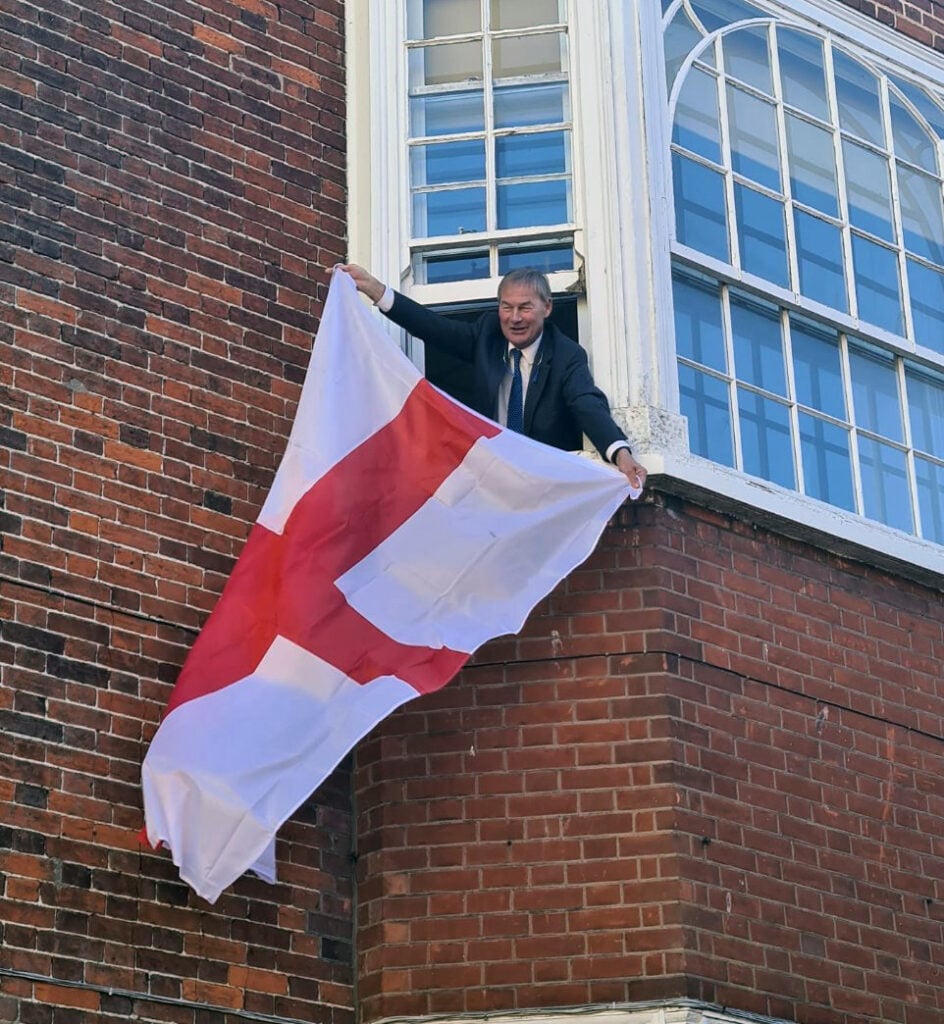
Rupert Lowe subsequently founded an organization called Restore Britain—a mass membership, nonpartisan group that asks members to vote on topics that are in the news, and ultimately help formulate a “Great Repeal Act” to, in his words, “slash immigration, protect British culture, restore Christian principles, carpet-bomb the cancer of wokery, fight lawfare, empower individual enterprise, and plenty more.”
Lowe promises to conduct and fund investigative journalism, private prosecutions, and judicial reviews into corruption, cover-ups, and government wastefulness. A lone MP’s wishlist might not be taken seriously, but Lowe has had successes with polling exercises on Gaza, the rape-gangs, Lucy Connolly, and most recently getting hundreds of thousands to call for offshore detention and mass deportations of illegal migrants. He has also attracted the support of Elon Musk, who had previously backed Farage.
Another casualty of Reform infighting is the businessman Ben Habib, who was removed as a co-deputy leader just after the election, ostensibly for comments about refugees. Habib now has his own party, Advance UK, with some 35,000 members, whose inaugural conference in Newcastle went ahead in late September, despite the venue canceling at the last minute after being pressured by the Labour council.
Advance UK may take some of Reform’s support, because Habib now allies himself with Stephen Yaxley-Lennon, also known as Tommy Robinson, from whom Farage distances himself fastidiously. Robinson is certainly divisive. He is a founder of the English Defence League, an anti-Islamic street-activist organization, and he has been imprisoned several times for various reasons, some political. As recently as May, he was in prison for contempt of court after breaching an earlier court order forbidding him from showing a film about a Syrian asylum seeker.
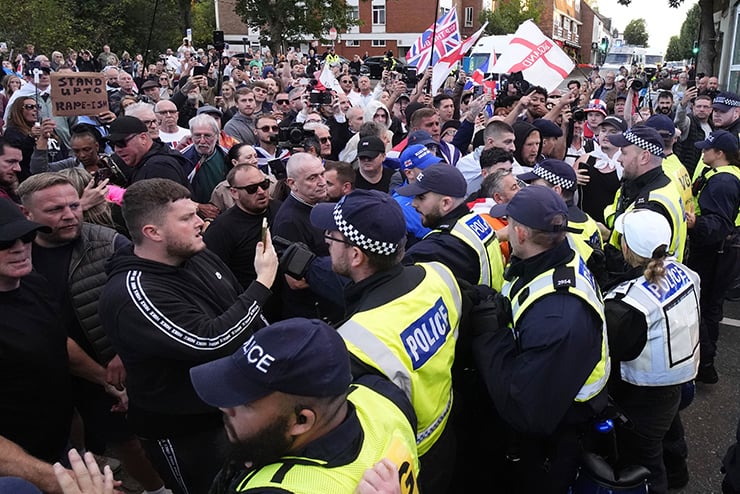
But he has persisted, building up a large following, mostly of working-class social conservatives of a kind less easily reachable by Farage’s more middle-class Reform Party. He was notably among the first to raise the subject of the Northern rape-gangs. He has recently attracted the backing of a group of well-known broadcasters, like Laurence Fox and Katie Hopkins, who spoke alongside him at the huge “Unite the Kingdom” rally that took place in London on Sept. 13, which was also addressed by the patriotic girl Courtney Wright (now 13 years old), several European parliamentarians, and Elon Musk (by video link). The rally, a sea of national flags and Christian symbols, attracted a crowd conservatively estimated at between 110,000 and 150,000, making it the biggest by far of several such rallies organized by Robinson, and far outnumbering the 5,000 or so counter-protestors.
This rally is but part of a wider and deeper feeling of embattled Englishness, as seen by the spontaneous campaign known as “Raise the Colours,” during which St. George and Union Jack flags pop up across the country, fluttering from lampposts, painted on walls and roundabouts, and draped over the white cliffs of Dover. When torn down by councils, they are replaced. A respected academic and former government adviser, David Betz of King’s College London, has said that the UK is “explosively configured” for civil war within five years, because of “asymmetric multiculturalism” and the “destruction of legitimacy” caused by open borders, the grooming gang scandals, and a highly politicized judiciary.
For the first time in many years, the British right is on the move, and the left is frightened and retreating in disarray. All serious thinking is now being done on the right, and it is the left which is reacting dazedly to events over which they have little or no control. This does not mean the left is incapable of lashing out, but they are clearly on the back foot.
Starmer is now imposing digital ID cards on the grounds that they will stem illegal immigration, but when Tony Blair attempted this decades ago, the proposal was easily defeated. Digital IDs will never be acceptable to many Britons, and there is no evidence that they will work any more than they do in other European countries that already have such cards.
Behind the political parties and street activities lie a plethora of conservative and nationalistic media channels, platforms, and publications fizzing with ideas and a confidence not seen on the British right since the 1980s. As well as the old standard-bearers of conservatism—the Daily Mail, Daily Telegraph, and Spectator—now, too, there is Unherd, the Critic, the Mallard and the Pimlico Journal, plus many other right-of-center X accounts and Substacks from gifted writers, such as Ed West. There is also the hugely important presence of GB News, a counterbalance to the notoriously biased broadcast media—a round-the-clock forum for news and views that not long ago would have been confined to the farthest fringes of the right. The right is not united, but for the first time in decades there is realism and determination.
During the Labour conference in late September, all guns were turned on Reform UK, which was plainly seen as the party to beat. Starmer railed at Reform’s ILR policy as “immoral” and “racist,” saying that it could “rip the country apart”—even as his Home Secretary wooed those “racists” with talk of tightening up ILR’s standards. Chancellor Rachel Reeves spoke of business instability that would allegedly be caused by a Farage-led government, an attempt to put an “objective” or “practical” gloss on Starmer’s moralistic spasm. It will be years before the next general election, but Labour strategists are clearly panicking.
The influential academic Matt Goodwin addressed Labour rhetorically in a recent newsletter:
“What did you expect?… Did you honestly just expect the British and the English people to remain silent, to take the abuse, the lies, the gaslighting, and just let you get on with it? That the people would just allow their nation, their home, to be completely overturned and redefined and say nothing? Do you not know them at all?”
It looks like Labour did—and does not.
Leave a Reply