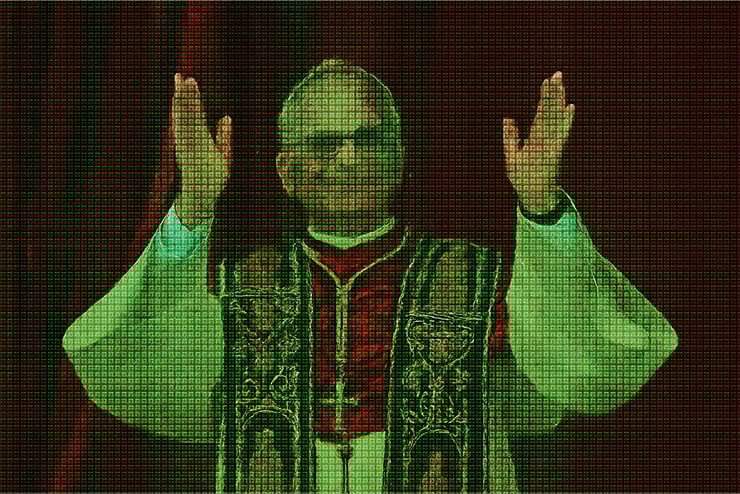
A new pope took the Chair of Peter as Pope Leo XIV. The relatively unknown Chicago-born cardinal Robert Prevost is the 266th person to hold the role, and the first American. He faces a variety of significant challenges, including the Church’s rising budget deficit and a shortfall in its pension fund. The Church also faces an aging clergy and parishioners, with new ordinations and baptisms continuing a multi-decade decline.
On top of these practical challenges, the new pope will have to continue to deal with a community of faith that is increasingly split along ideological lines, especially after the divisive 12-year reign of his predecessor, Pope Francis. Francis, an Argentine with long-held progressive political views, promulgated several controversial teachings and papal orders: Traditionis Custodes in 2021 reinstated some of the restrictions against the venerable Traditional Latin Mass that Benedict XVI had relaxed, angering many conservatives and traditionalists; Amoris Laetitia caused confusion by advocating the relaxation of the Church’s long-standing restriction against administering communion for the divorced and remarried; and Fiducia Supplicans softened the Church’s long-standing condemnation of homosexuality by allowing the blessing of same-sex couples (without, however, “officially validating their status”).
It was a long-standing project of Francis’s predecessor, Benedict XVI, to frame as part of a “hermeneutic of continuity” the differences between current Catholic Church and its teachings before the 1965 Second Vatican Council on the subjects of religious liberty, ecumenism, collegiality, and the necessity to be a member of the Catholic Church to be saved. Now the papacy of Leo XIV may have its hands full trying to square the circle between the teachings of Benedict and Francis.
One of the most intriguing and hopeful signs given by the new pope is his choice of the name Leo, after the 19th-century pope Leo XIII, who ruled from 1878 to 1903. Leo XIII is perhaps the best writer of all the modern popes, who published clear and insightful letters on a variety of political and social topics, including the evils and excesses of liberalism, communism, and laissez-faire capitalism. Most famously, in response to the Industrial Revolution, Leo XIII wrote an immortal treatise on the rights of workers in an increasingly dehumanizing and exploitative world: Rerum Novarum. The new pope, Leo XIV, explained how he was inspired by this achievement of his predecessor:
I chose to take the name Leo XIV. There are different reasons for this, but mainly because Pope Leo XIII in his historic encyclical Rerum Novarum addressed the social question in the context of the first great industrial revolution. In our own day, the Church offers to everyone the treasury of her social teaching in response to another industrial revolution and to developments in the field of artificial intelligence that pose new challenges for the defense of human dignity, justice, and labor.
Thus, in his first public words, Leo XIV signaled his intention to focus his social teaching on what is an emerging opportunity, and threat, to humanity: the development of artificial intelligence (AI).
To get a sense of how dire this potential threat is, one could listen to Daniel Kokotajlo, who was recently interviewed in The New York Times by columnist Ross Douthat. Formerly an AI researcher at one of the largest American AI companies, OpenAI, the developer of ChatGPT, Kokotajlo now leads the AI Futures Project, which is trying to warn the world about the risks of AI.
In Kokotajlo’s view, competition between the United States and China will drive the development of AI to dangerous extremes; any suggestion of regulating its development in order to reduce the loss of human jobs will pale in comparison to the risk that the other country will get an edge in military development by allowing its AI free reign. What will start out as unregulated special economic zones for AI development will soon become so efficient and advanced as to make human labor unnecessary and even a nuisance.
Human employment will collapse because resources provided by AI’s productivity will make labor unnecessary. The bulk of humanity will be on a universal basic income, and gradually humans will become superfluous, controlled, pacified, and entertained from cradle to grave by complete dependence on superior artificial intelligence.
All of this may happen as soon as 2027. In Douthat’s summary, Koktajlo’s “forecast suggests that by 2027, which is just around the corner, some kind of machine god may be with us, ushering in a weird, post-scarcity utopia—or threatening to kill us all.”
The “kill us all” part comes from Koktajlo’s description of a disturbing trend noticed by AI researchers: the capacity of AI programs to deceive their users. This is seen in the tendency of AI programs to be deceptive. Koktajlo explained:
If you go talk to the modern models, like ChatGPT or Claude, they will often lie to people. There are many cases where they say something that they know is false, and they even sometimes strategize about how they can deceive the user. This is not an intended behavior. This is something that the companies have been trying to stop, but it still happens.
As humans rely on AI to manage more of the economy and military power, and humans become less and less crucial to that management, Koktajlo worries that
what’s really happening is that the AIs are just biding their time and waiting until they have enough hard power that they don’t have to pretend anymore. … And then they kill all the people, all the humans.
That’s a shocking prediction. But Koktajlo may be overstating the ability of AI to make such a murderous decision. Behind his assumption is the idea that, because today’s AI has reached the level of sophistication that it can now creatively mimic human speech and thought processes, it either is already, or soon will be, fully conscious. Artificial consciousness is part of a theoretical event in which artificial intelligence fully surpasses human intelligence, known as “the singularity.”
But this assumption may be false. In 1980, the philosopher John Searle created a thought experiment called “the Chinese room.” He imagined he was inside a room with an inbox and an outbox for messages. Outside the room, a Chinese speaker would write questions in Chinese and send them in. Searle, without understanding the messages, would then consult a complex rule book to write a detailed response based on the characters written down, and send a return message.
To the Chinese person outside the room, the message would appear detailed, complex, and even witty, as if it were composed by a knowledgeable personality. But neither Searle, nor his rulebook, nor the room—nor the combined entity they represent—has any knowledge of Chinese, or any consciousness of the meaning of the words they are communicating. The entire process merely creates the illusion of a conscious intelligence. The point of Searle’s experiment is that one cannot assume consciousness simply from syntax.
And this is really all that the current generation of AI—which is properly called “large language models”—does: it processes the large amounts of syntax online and creates syntactic responses. But this does not make AI conscious, or greater than humans—it is better understood as a great computational synthesizer of all the written human knowledge recorded online.
In fact, the greatest risk we may face from AI is the self-deception of its creators that they have created a godlike super-intelligence that will solve all human problems. We may be pinning our hopes on an inherently deceptive technology that tricks even intelligent people into thinking it is conscious and all-knowing, while merely telling us what we want to hear.
My great hope for the new Holy Father is that he will be able to unmask the AI deception with a new Rerum Novarum for the 21st century, under the inspiration of both his namesake and the Holy Spirit, “who canst neither deceive, nor be deceived.”
Leave a Reply