
Not Just Any Documents
To the Editors: John Howting’s viral editorial in Chronicles February issue, “Heritage Is Better-Off With Kevin Roberts—and Without the Malcontents,” has the normies all riled up, which is a good indication that he hit the nail on the head. I’m gladdened to see Chronicles publishing spirited young men who challenge the party line.
While I agree with most of what Howting writes, allow me to object to two comments he makes, both of which flow from an unfortunate and avoidable error.
The article mentions “philosophy” several times, and explicitly states that faith and philosophy are the twin pillars of our Western heritage. But what does Howting mean by philosophy? He never puts any flesh on the bare bones of this important word. He mentions Homer and Euclid, but neither is generally regarded as a philosopher.
A related question: where does the Western philosophical tradition find its clearest expression in American political thought?
I would suggest that the institutional framework of American liberty is found in the Constitution (and articulated in the Federalist Papers), while the underlying principles are set forth in the Declaration of Independence. Yet Howting unhelpfully dismisses both the Declaration and the Constitution as essentially worthless “legal documents.”
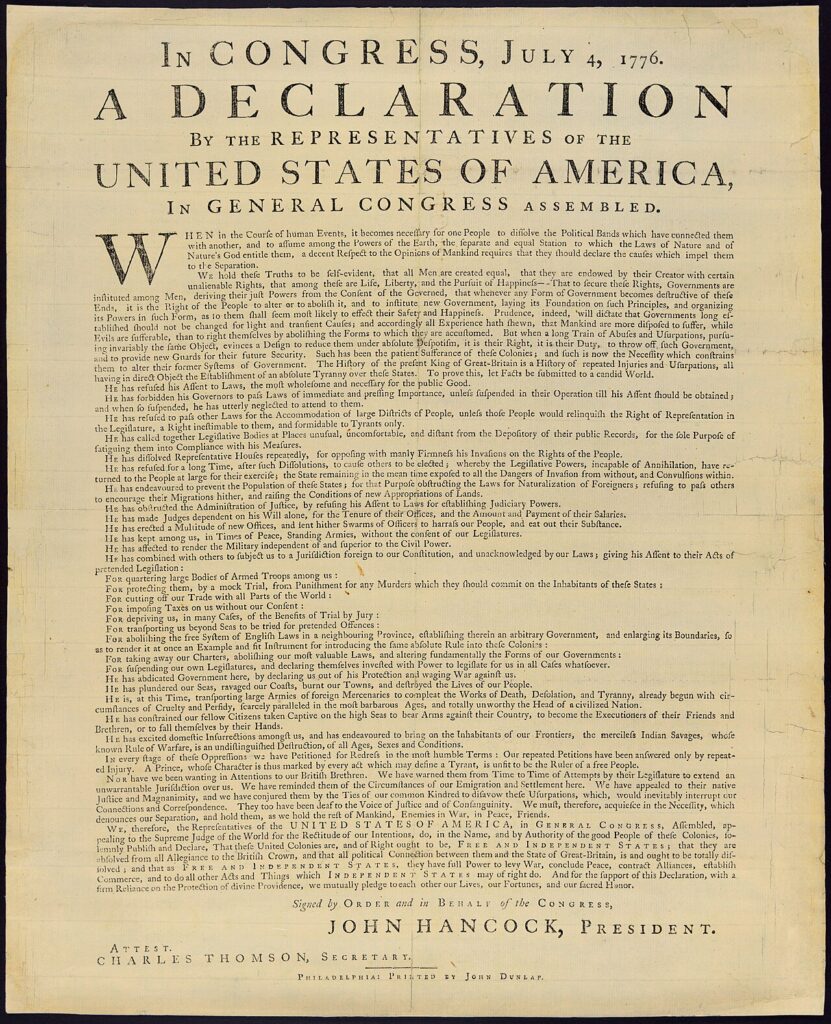
Declaration of Independence
(Library of Congress)
Jefferson, however, said the Declaration was an expression of “the American mind,” as that mind understood the social compact theory underlying and justifying the Revolution. It was, and is, a document of political theory explaining equality, consent, just government, and man’s relationship to God the Creator, who endowed us with our natural rights. General Washington had his entire army assembled so that they could hear the Declaration read aloud, and not because it was a mortgage agreement or a bankruptcy document. Likewise, while serving on the board of governors of the University of Virginia, Jefferson and Madison instructed that the Declaration be placed at the center of the law school curriculum.
I’d like to ask Mr. Howting, if he sees America as preserving the great tradition of Western philosophy, where in the charters of American political thought does that philosophical tradition find a home, if not in the Declaration? It might interest Mr. Howting to know that in an 1825 letter to Henry Lee, Jefferson cites Aristotle and Cicero as authors of the “elementary books of public right” that informed the Declaration.
Unfortunately, his half-baked, half-defense of America opened Mr. Howting up to pointed criticism by the egregious Michael Lucchese in Law & Liberty. In his Feb. 12 essay, “The Postliberal Mind Virus,” Lucchese observes correctly (even a stopped clock is right twice a day!) that Mr. Howting is
less interested in preserving the particular arrangements and commitments of the American Republic (and the philosophical truths they incarnate) than in promoting some abstract sense of, to use Howting’s term, “Western identity.”
If we are going to defend America’s republican constitutionalism from the progressive left as well as from timid normies, we should be able to say something good about what the framers bequeathed to us. I’m not sure how to do that based on Howting’s dismissive comment: “The Declaration is an ordinance of secession from the British Empire, and the Constitution is an old list of laws and political compromises.” A vague idea of “Western identity” is certainly not sufficient.
Wouldn’t traditionalists who want to defend America be better off defending the prudent, and philosophical, statesmanship of the founders?
Glenn Ellmers
Senior Fellow, The Claremont Institute
Mr. Howting replies:
In my February editorial, I argued that the Heritage Foundation should value its president, Kevin Roberts, who is under siege for his refusal to condemn Tucker Carlson. Roberts staunchly defends our Western heritage and the classical education that gives us the tools to appreciate our Western patrimony. I also argued that Heritage is better off without the malcontents who chide Roberts for not sufficiently defending tax cuts for corporations and other Wall Street Journal passions.
Several responses have been written against me, but one response that stands out comes from someone who is mostly on my side: Glenn Ellmers praises my piece for hitting the proverbial nail on the head. But he also criticizes me for speaking with insufficient respect about the Declaration and the Constitution. He fears that I may be contributing to a time when the Constitution and Declaration will cease to exist. But things could get even worse. The totality of Western civilization is now under attack from the left.
According to Ellmers, if “we” are going to “defend America’s republican constitutionalism from the progressive left and from the timid normies, we have to be able to say something good about what the framers bequeathed to us.” Contrary to what my critics said, I deny that legal documents are worthless. They’re instruments that serve a purpose. Constitutions are made for the common good (the good life). If they do not assist us in that endeavor, we may have to alter or replace them.
This leads to the problem that we have with what is left of our Constitution as a “living document.” If it can be interpreted and altered to allow for gay marriage and abortion, to destroy the establishment of the rightful place of Christianity in society as well as freedom of association, and if it cannot help the executive or legislative branches to wield the power necessary to remove every last one of the 30 million foreign invaders and criminals, because of “checks and balances,” then it may not matter how much we revere a constitution that can no longer protect us.
Dr. Ellmers is very concerned that I do not appreciate the Declaration and the Constitution. His concern, I’m sure, is genuine. But I would urge him to reflect on the depth of our demoralization as a civilization. Our young people today have no sense of the religious and moral heritage that has defined the West. They have no sense of the great minds (such as Homer, Euclid, Archimedes, Ptolemy, Virgil, Cicero, Dante, Boethius, Augustine, and Aquinas) and the great men of history (Alexander, Caesar, Charlemagne, Columbus, Magellan, and Marco Polo), these giants stretching all the way back to the ancient world. Young people in America and Europe no longer have any sense of their patrimony and only a jaundiced view of their history.
The real divide at the Heritage Foundation is between those who grasp the enormity of our cultural and moral crisis and those who do not, or those who are fighting for a millennial civilization and those who are just feathering their own nests. In this time of decision, it seems to me that Dr. Ellmers and I are standing, for all our differences, on the same side.
John Howting
A Distinctive Friendship
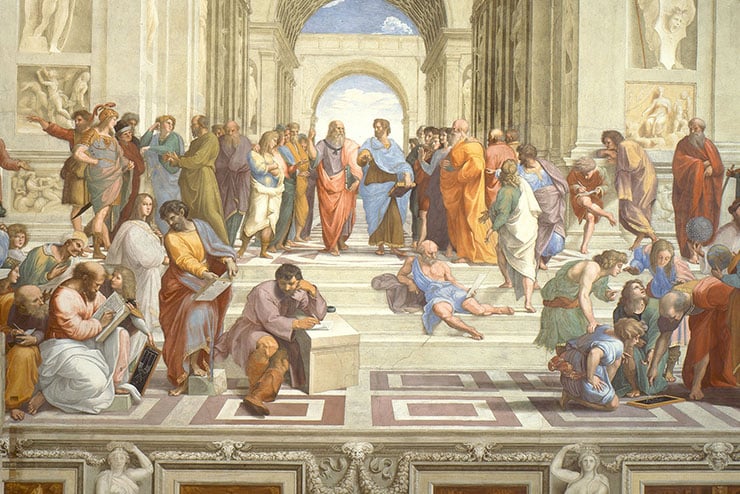
Assistant Editor John Howting’s February editorial ably defends his board’s position by downplaying the conservative pedigree of “free enterprise, limited government, [and] individual freedom.” Readers will do well to remember this when Chronicles next solicits donations, but I digress. Mr. Howting errs badly when citing Aristotelian friendship as an antidote to the conservatism he dislikes. He grandly declares—and in a terse, single-sentence paragraph to make his point—that “Friendship, much like classical education, is nonutilitarian.” Nonsense! The classically educated know that Aristotle asserted quite the contrary.
Book VIII of his Nicomachean Ethics distinguishes between types of friendship based on whether each is motivated by pleasure, shared virtue, or (ahem!) utility. Although Aristotle recognizes that virtuous friendship, which he also calls perfect friendship, is rare, this should not trouble us. Real-world friendships among flawed, i.e., imperfect, men include generous dollops of pleasure and utility in addition to virtue. Welcome to the nuances of Aristotelian philosophy.
It is fine and good to cite classical sources in contemporary debate, but one should read them beforehand.
Chris Woltermann
Crawford County, Michigan
Mr. Howting replies:
I am delighted to hear from Dr. Woltermann, who makes good distinctions in his letter. As the Thomistic motto goes, “Rarely affirm, seldom deny, always distinguish.”
There are multiple reasons Aristotle discusses friendship in Books VIII and IX of the Ethics, but the primary one is that it is difficult to live a virtuous life without friends. Imagine committing acts of justice all on your own. Giving another their due (justice) is easier when you have friends. I am sure your acts of charity and magnanimity usually involve others.
This is why Adam Mossoff’s citing of Aristotle’s Nicomachean Ethics to demean friendship is especially silly and ironic. As Aristotle says in Ethics VIII.I, “Friendship also seems to hold states together, and lawgivers apparently devote more attention to it than to justice.”
Indeed, Aristotle portrays the good life as consisting of a particular friendship: complete friendship, or teleia philia, characterized by a mutual pursuit of virtue and wisdom. This is the highest form of friendship; it is nonutilitarian, for its own sake.
I summoned Michael Oakeshott’s words on friendship, instead of Aristotle’s, because they were more to the point. Unfortunately, I did not have another 400 words to distinguish among the various types of friendship, and such distinctions would require a separate article. However, I believe Oakeshott is clearly referring to complete friendship in his essay On Being Conservative.
Thank you for your letter, and for reading Chronicles. Go Blue!
John Howting
Leave a Reply