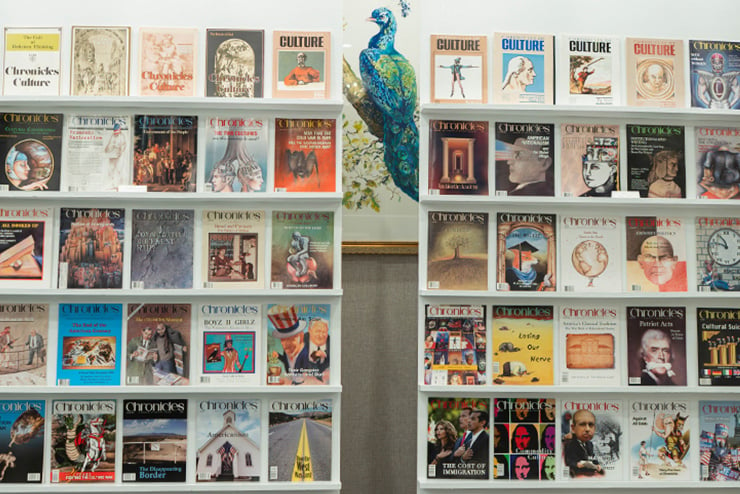
(This is an excerpted version of a speech written by Chronicles Editor Paul Gottfried and delivered at the gala celebration of the magazine’s 50th anniversary.)
Since I’ve titled my remarks “Chronicles, the Indispensable Magazine,” it behooves me to show our publication is exactly what we say it is. Chronicles has made itself indispensable not by wielding great power nor because those who read or contribute to our magazine thereby do well financially. Nor have we claimed that we can help our friends rise professionally in what has been, for us, a rocky political environment.
We used to joke that anyone who works for us may be signing his professional death warrant. This is not entirely a joking matter. Many on the left, and even in the center, regard us and our work with profound ideological distrust.
We take seriously that line from Mr. Smith Goes to Washington, when the newly appointed Senator Jefferson Smith reminisces that his father, a crusading newspaper editor, often told him that the “only causes worth fighting for are the lost ones.” At Chronicles, we have fought ferociously for lost causes, which T. S. Eliot famously described as the “abandoned ones.” We took those positions because we thought they were right. Characteristically, we stood with Main Street against Wall Street even when that was not a popular stance among free marketers; we opposed the neoconservative foreign policy when that was the dominant one for the conservative establishment; and the magazine’s editors were vilified in National Review, The Wall Street Journal, and other vehicles of respectable GOP opinion for prematurely criticizing the Bush fiasco in Iraq.
Domestically, we warned against the rise of the cultural and political left, as Americans surrendered their families and communities to a managerial state and anti-discrimination regime. We also questioned whether self-government or a serious constitutional regime is even possible given the instruments of persuasion available to a flagrantly biased, nearly monolithic media empire. We never believed it was our duty to make nice with what we regarded as destructive forces, but we were willing to build connections with what we considered the non-establishment, non-crazy left.
It was, however, harder to develop friendships with our conservative establishment at home because we deviated so often from party lines. One struggles to recall all those many heresies we committed in the eyes of the conservative nomenklatura by trampling on so many sacred cows.
On Middle Eastern politics, even more than on other subjects, an unmistakable party line prevailed. As fate would have it, I strayed from it grievously sometime in the mid-1980s. And while I didn’t grasp at that time the extent of my deviation, the movement struck back by declaring me an outcast.
This treatment was much the same as what befell other dissenters on the right. As Americans of an older generation, we just weren’t used to having our brains filled with authorized views. But we did feel a deep loyalty to what we understood as traditional conservatism. or to what Sam Francis summarily described as “the Right.” We also moved lurchingly toward our present populist orientation, but that was not necessarily our starting point 50 years ago.
Originally, the magazine was a potpourri of book reviews interspersed with anti-communist screeds, courtesy of our first editor, Leopold Tyrmand, an émigré from Communist Poland. In those early days, which I may be one of the few mortals still around to recall, Chronicles was vigorously interventionist in foreign policy and closely aligned with the Heritage Foundation on most social issues. Tyrmand viewed our magazine even in its incipient state as a quintessentially American publication because we were based in Rockford, Illinois, the Midwestern rust belt town where I taught at the local college. Our former college president, John Howard, founded and served as the head of the Rockford Institute, and through his fundraising and encouragement, Chronicles came into existence.
Both Tyrmand and Howard regarded the magazine as indispensable because we interpreted new books and American culture from a patriotic American standpoint. Equally significant from their perspective, we undertook our task in a recognizably Midwestern setting.
It was only in the mid- and late 1980s that Chronicles acquired its later brand as an independent-minded magazine of politics and culture. After Tyrmand’s death and during the early editorship of Tom Fleming and the presidency of Allan Carlson, the magazine began moving away from standard conservative positions and assumed its later populist character. It also made powerful enemies in high places, and by the mid-1990s, meetings of conservative dignitaries were called to find out what could be done to silence such unwanted dissent on the right.
This sinister undertaking succeeded only with the eclipse of the presidential hopes of Pat Buchanan, the populist hero whom the magazine supported politically. Once Pat’s presidential prospects went south, Chronicles fell on hard times. We became “naked to our enemies,” if I may quote Cardinal Woolsey. Our subscriptions gradually dwindled, and conservative establishmentarian types increasingly stayed away from those too closely identified with our cause.
At the beginning of the 1990s, Chronicles was still a key player in American conservatism, but even then, it took positions that gave neoconservatives gastric indigestion. Ten years later, the magazine had been politically marginalized, though not enough to prevent it from being periodically pilloried in National Review, typically for taking positions, as in the Iraq War, which turned out to be perfectly correct. As one might expect, even when our conservative gatekeepers backtracked, they never admitted that our side had been right. Nor to this very day will most members of that establishment ever mention our name, except to deplore our “extremism.”
For all that, we’re still in business and have lost none of the feistiness that has always marked our publication. Our now-stated dedication to American renewal is, in fact, a continuation of what we have always stressed. In alliance with the Center for Renewing America (CRA), we are now turning more than ever to policy issues, which is consonant with the direction the magazine has been moving in for several years.
But this doesn’t mean that we’ve abandoned the cultural front. Culture and politics are now more than ever inextricably linked in all Western societies. Unless we can prevail in stopping the left, which is working to subvert traditional morality and culture, we won’t be expounding great works to a rising generation because their minds and hearts will have been snatched by the dark side.
This brings me to what I think is a common feature of Chronicles and CRA as we approach today’s challenges. Chronicles always understood that the radicalization of American politics, education, and culture is not entirely attributable to an unfettered left. Also blameworthy, in varying degrees, has been a well-financed, influential conservative movement that has not opposed its adversaries as vigorously as it might have done. Because of this dereliction of duty on the right, the left was granted too many concessions. If the left wanted gay marriage,” or sex-change surgery for adults, our conservative establishment gave way often by degrees—or so it seemed to me, as I observed our would-be conservatives pursue their policy objectives and personal interests.
This is not to say that our side would have won all its battles if better resistance had been available. The thoroughness with which the cultural and social left has taken over the public space, particularly over the last 20 or more years, has been staggering. But we should recognize that connected to these unfortunate triumphs has been ineffective resistance. Those who could fight back continued to yield ground. Instead, they should have listened to us stalwarts further on the right and have been less concerned with running afoul of “respectable opinion.”
Let me point out that in sharp contrast to other self-described conservative enterprises, we at Chronicles happily publish authors who disagree with us. Our editorial board welcomes debate, even if this predilection rattles some readers and occasionally causes us to lose subscriptions. At Chronicles, we strive to be more tolerant of dissent than those who hypocritically reproach the left for being guilty of what they themselves do.
Our magazine, if I may continue to enumerate our accomplishments, has been among the few conservative publications that stress the incremental nature of America’s political and cultural revolution. That whirlwind we are reaping has been gathering for decades. It is therefore ridiculous to pretend that until recently we were on the right course, but then suddenly fell into outer darkness. Radicalization has been occurring in our country since at least the 1960s. And this is precisely why it’s now so hard to turn the culture around. Only those who grasp the challenge before us fully will be able to change the status quo. Before leading an effective resistance, it seems necessary to understand how long and how fully our adversaries have been entrenched.
For those who read Chronicles, it is hard not to notice our concern with international affairs. Although we favor protecting American interests and see ourselves as a magazine of the American populist right, we recognize that the Europeans and we represent the same civilization. We are, furthermore, undergoing the same crisis produced by an international left. Among Western populist movements, a shared battle is taking place against a left that controls the mass media, the managerial state, educational institutions, and the culture industry. That well-situated left has eaten into our social and cultural fabric, and although we are less affected than the British, Spaniards, or Germans because we have a stronger tradition of freedom, we too are fighting the same battles as our allies across the ocean.
Chronicles has been keenly aware of this common fate, which is why we have devoted so many pages in our magazine to commentaries on other Western countries. For better or worse, we belong to the same cultural and political orbit, and what goes on here influences the rest of the West for better or worse. The notion that we can cut ourselves off from others who share our civilization, going back to antiquity, is for me a nonstarter.
These remarks should indicate why I began this oration by stressing the indispensable nature of our magazine. Chronicles has unflinchingly confronted the problems and dangers of American politics and society, and we have shouldered that task for the last 50 years in the face of the scorn or inattention of all establishments, conservative or otherwise. We fought on nonetheless because we held doggedly to our beliefs and because we thought that our critics were wrong or, perhaps, just overly career-minded.
Despite past tribulations, Chronicles is once again gaining prominence as a magazine of American renewal. And we’re experiencing our second life as we shepherd a young populist right now taking shape, and as we extend our friendship to those in the conservative mainstream who are willing to accept it. Our future with CRA may be even more illustrious than our past high noon. That on our 50th birthday as a publication, we are rising once again as a looming cultural and political force, witnesses to the phoenix-like character of our magazine, one whose fateful founding and astonishing survival we have come together tonight to celebrate.
Leave a Reply