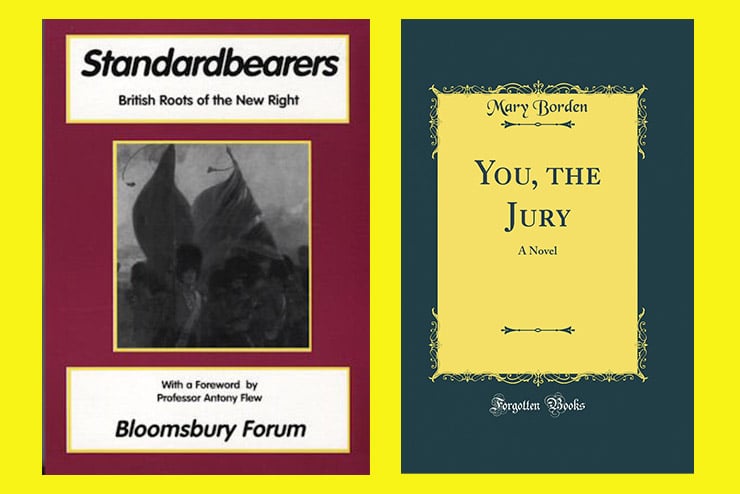

Published in 1999, Standardbearers: British Roots of the New Right is a collection of essays by authors including Jonathan Bowden and Chronicles’ very own Derek Turner, about Britons who should inspire the modern right. The list includes several prime ministers and other politicians, as well as writers, scientists, artists, musicians, and economists, all of whom provide alternatives to the modern status quo.
The first chapter discusses the writer George Alfred Henty, a now-forgotten figure but once the “foremost name in children’s fiction in Victorian Britain.” Henty had worked as a war correspondent throughout the 1860s and ’70s, covering the Franco-Prussian War, the Ashanti War in West Africa, and the Carlist War in Spain, among others. His books celebrated British military exploits and were wildly popular with young boys. It is not surprising, therefore, that Henty has now been thrown down the memory hole.
Those witnessing the recent working-class riots in the UK may be interested to read the chapters on Benjamin Disraeli and Joseph Chamberlain. Both politicians recognized the necessity of appealing to working-class patriotism. Disraeli supported the extension of the franchise to a million working-class voters while embracing a patriotism that appealed to all classes. Joseph Chamberlain supported protecting British jobs and industry and opposed global free trade and immigration.
Even more relevant to recent events in Britain is the chapter on Enoch Powell, whose prophetic 1968 “Rivers of Blood” speech on immigration foretold the current conflict. Powell also proved remarkably prescient on the nature of what was then the European Economic Community, now the European Union. While many regarded it as a purely economic arrangement, Powell correctly predicted that it would become a stifling political union.
Modern statesmen should take note of the chapter on Lord Palmerston, foreign secretary and prime minister, which begins with his wise words:
It is a narrow policy to suppose that this country or that is to be marked out as the eternal ally or the perpetual enemy… We have no eternal allies and no perpetual enemies—our interests are eternal and those interests it is our duty to follow.
Not all the characters featured in the book can be called conservatives. Robert Blatchford was an early socialist but a British patriot who inveighed against the “childish cosmopolitanism” of his fellow socialists, and whose speeches on immigration would probably get him prosecuted for hate crimes today.
—Piers Shepherd
Literature that does not adapt to changes in the cultural context becomes sclerotic. Effective renewal without destruction of its premises demands what may be called artistic tact. Or as Jean Cocteau observed, “knowing how far you can go too far.”
One art form that has persevered amid change is the British social novel. Solidly established in the 18th century and carried to brilliant heights in the 19th century, it remained vital despite immense historic upheavals in the 20th. A fine example is You, the Jury (1952), by Mary Borden.
Borden offers a slice of life in England from 1914 to circa 1950, characterized by the old class distinctions, ranging from a member of the House of Lords, through professionals and others in the middle classes, to servants and, below them, the dregs. It’s a world of great houses and villages, families, and the Church. Their local dramas seem petty, of course, except to those who endure them. The greater world exists only at a distance. Borden makes it all highly worthwhile in a skillful first-person narration, a point of view that, as Henry James and others illustrated, combines immediacy with perspective and reflective assessment.
Martin and Francis are boys in 1914 as the relatively stable post-Napoleonic period in Britain ends, and share a powerful bond of friendship. Martin is illumined, so to speak; renouncing the world, he believes he can heal it. He demands extreme sacrifice from himself and from Francis, his disciple. Pascal’s words are apt: “Whoever wants to act the angel, acts the beast.”
When World War II begins, Martin registers as a conscientious objector, but volunteers to serve as a noncombatant medical aide on the North African and Italian fronts. He is indefatigable. Witnesses report later, however, that he went beyond the Geneva Conventions to favor enemy wounded, helped prisoners escape, and invited British soldiers to mutiny. This leads to postwar charges of treason and an exceptional trial.
Countless novels today drop from our hands, boring or repelling us. We do not care about the characters. Borden’s story, however, draws us into a real world with people whose concerns and experiences appeal to us and enlarge our understanding of the good, and the dangerous, during a crucial time.
—Catharine Savage Brosman
Leave a Reply