The Naked Gun
Directed by Akiva Schaffer ◆ Produced by Seth MacFarlane ◆ Distributed by Paramount Pictures
“What were the funniest jokes?” a reporter from Germany’s NDR public radio network asked me in a live interview as my 10-year-old son and I exited the Cologne cinema, where Die Nackte Kanone, better known as The Naked Gun, had its first performance this summer. We watched the film in English, but my German was good enough to tell a foreign television audience that I could not focus on any particular element of writer-director Akiva Schaffer’s revival of the law-enforcement spoof, which unreeled gag after gag. The totality of the experience brought me back to my teenage years, when the first three Naked Gun films appeared.
Schaffer and the film’s co-producer, Seth MacFarlane, best known for Fox’s Family Guy, presumably spent much of their Gen X childhoods absorbing the comedy of the 1980s. In that universe, revolutionized by National Lampoon, Second City, Mel Brooks, Woody Allen, and the early seasons of Saturday Night Live, sarcasm was both the medium and the lingua franca. Tracing back to the Marx Brothers, whose films enjoyed a renaissance in the wake of the Vietnam conflict, it indulged heavily in social commentary and allowed more room for parody, farce, wordplay, sight gags, and non sequiturs than did the self-referential sitcoms that appealed to Baby Boomers or the pointless irony that amuses millennials.
The original Naked Gun films came from the Zucker, Abrahams, and Zucker (ZAZ) team, a collaboration of brothers David and Jerry Zucker and the late Jim Abrahams. After producing Kentucky Fried Nation (1977), a movie-length collection of comedic sketches spoofing various film genres, and Airplane! (1980), a spoof of an earlier and deadly serious disaster film, Airport, and its sequels, they moved onto Police Squad!, a TV series initially envisioned as a film that mocked the crime dramas that had sprouted across network television. ZAZ particularly targeted for parody the TV series M Squad, which starred an unsmiling Lee Marvin in its run from 1957 to 1960, and Felony Squad, a late 1960s series featuring crime investigations intersecting with life lessons.
ZAZ’s project had no film-length arc, so Paramount instead produced Police Squad! as a six-episode television series for ABC. Despite solid ratings, it did not last. According to its star Leslie Nielsen—an actor cast as the deadpan but oblivious Frank Drebin and who otherwise was known for decades of playing serious roles as cops, soldiers, and other authority figures—the show was cancelled for the curious reason that its humor required too much attention to understand. “The viewer,” Nielsen later summarized the network’s attitude, “had to watch it in order to appreciate it,” thus making it too demanding to continue.
TV Guide called this rationale “the most stupid reason a network ever gave for ending a series,” but ZAZ was undeterred. Nielsen reprised his role in the 1988 film The Naked Gun: From the Files of Police Squad!. In this and the franchise’s two subsequent films, he starred opposite the then-respected retired athlete O. J. Simpson, who played Drebin’s accident-prone partner, Nordberg, and George Kennedy, an equally serious actor in previous decades, whose credits included The Dirty Dozen and Cool Hand Luke (both 1967), as his superior, Ed Hocken. Elvis Presley’s ex-wife Priscilla played throughout the franchise as Drebin’s love interest and eventual wife, Jane Spencer. Ricardo Montalbán was the first film’s debonaire villain, succeeded by a ruthless Robert Goulet in 1991’s The Naked Gun 2/12: The Smell of Fear, and a rough Fred Ward in 1994’s The Naked Gun 33 1/3: The Final Insult.
Could the franchise be revived after 31 years? Doubts were already prevalent in the 1990s, when the ensemble’s antics began to fade with repetition and familiarity. A reliance on political satire, magnified by the second film’s plotting as a mockery of George H. W. Bush’s environmental policy, limited its longevity. After Simpson’s dramatic arrest and trial for the murder of his ex-wife and a Los Angeles waiter (within weeks of the critically panned third film’s commercial release), the franchise became part of current events in a way that was hardly helpful.
A new sequel featuring Nielsen was announced in 2009, but gained little traction before the star died a year later. A 2012 video game adaptation posited a son of Drebin’s, Frank Drebin Jr., as the new lead character. In 2013, there was talk of a reboot of the original series, but another eight years passed before MacFarlane stepped forward to produce the new film as a conventional sequel. In 2022, Liam Neeson was cast as Frank Drebin Jr., with Shaffer as director.
A former boxer who grew up Catholic in Northern Ireland, Neeson, 73, is one of the very few actors with the gravitas to pull off the next generation Drebin. Like Nielsen before him, his decades-long filmography mostly includes serious men of action and authority—assassins and cops alongside Oskar Schindler, Rob Roy, and a Jedi Knight. Age was no factor—like many Hollywood septuagenarians, Neeson looks much younger than he really is. Nielsen, in any case, played Drebin Sr. well into his 60s, at a time when that was considered old age.
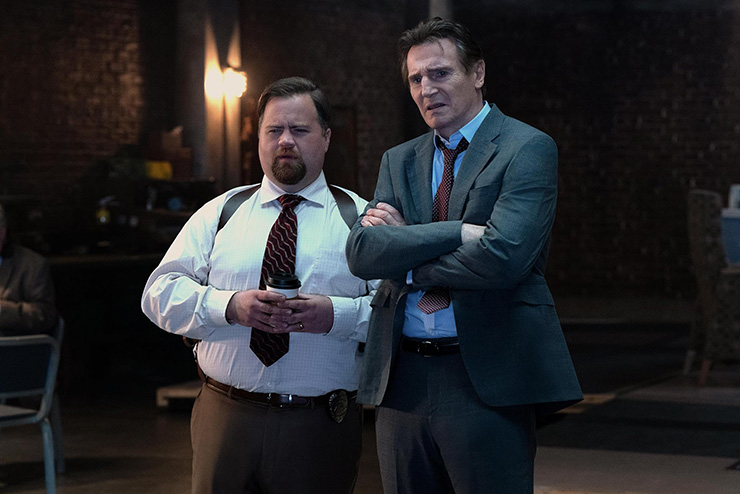
Neeson never quite escapes his native Irish brogue and radiates a quiet sensitivity that Nielsen’s Drebin famously lacked. The part calls for more than a mere imitation of Nielsen, however, if for no other reason than to keep the franchise fresh. “I want to be just like you, but at the same time be completely different and original,” Frank Jr. says, parodying the belated sequel’s core challenge, when quietly asking a memorial plaque to his father to help and guide him. To prevent the scene from becoming too serious, the camera pans first to Ed Hocken Jr., son of George Kennedy’s character in the original franchise and forgettably played here by Paul Walter Hauser, addressing a similar plaque to his father, and then to a row of other Police Squad officers doing the same until a close-up shows a black officer about to address O. J. Simpson’s Nordberg. In the film’s only reference to the disgraced co-star of yesteryear, the young officer breaks the fourth wall and shakes his head “no.”
The gag was a tactful way to explain the absence of Simpson, who died in 2024 after a troubled life following his controversial acquittal. Schaffer dispensed with a few other elements of the original series. The opening credit police car light, which weaves in and out of unexpected situations to a jazzy tune in a parody of the now-forgotten opening to M Squad, was left out in favor of a more serious introduction, which sets up a bank robbery that Drebin Jr. foils, improbably disguised as a little girl.
Other familiar elements were retained. Drebin Sr.’s tension with the mayor, played by Nancy Marchand of later fame in The Sopranos as Tony Soprano’s mother, is replicated in the bossy attitude of Police Squad’s image-conscious chief, performed by CCH Pounder. “Weird Al” Yankovic, who had cameos in all of the first three films and is one of the very few original cast members still alive, has one here, albeit at the end of the credits.
Frank Jr.’s blossoming romance with the female love interest, played by an older but still fit Pamela Anderson, is retold in a dialogue-free montage set to an upbeat song, just as Frank Sr.’s relationship with Jane blossoms in the first film. The original effect was an economical way to show the couple falling in love without taking too much time away from the main narrative. Here, however, Schaffer crafts the montage into an eyerollingly absurd love triangle involving an enchanted snowman who turns homicidal with jealousy. The scene recalls the director’s poorest writing for Saturday Night Live, by then long into middle-aged decrepitude, in tedious skits dwelling on sexual awkwardness.
The film wisely holds back from lampooning current officeholders, a move that could have instantly alienated half of filmgoers. The new villain, Richard Cane, is an Elon Musk-like electric car entrepreneur who has a secret plan to reduce humanity to its most destructive instincts so that a new race of supermen might emerge under his leadership. Played by John Huston’s son Danny, who has had a career playing smilingly evil corporate guys, his villainy builds slowly and ultimately falls into cliché, particularly after decades of similar male antiheroes suffusing popular culture.
Cops and police culture get the brunt of the satire, some of which inevitably references Law & Order and its spinoffs, now with us for 35 years, in which older trench-coated cops in the Jerry Orbach vein seem to drink endless takeaway coffee. That is a recurrent and amusing trope here, but the satire goes deeper when Neeson incredulously asks the chief, “You mean cops are expected to obey the law?” In another scene, when Drebin Jr. pumps a bartender for information, the dialogue creatively reveals that of the thousands of criminal suspects he has shot, only one was white.
Despite these caveats, the film was funny, well-paced, and enjoyable. It is easy to imagine younger audiences embracing it in a rejection of twee millennial/Gen Z humor. My Alpha Generation son gave it high marks and quickly devoured the prequels via streaming. After a second viewing of the new film in Munich a couple of weeks later, we arrived in France, where he demanded to see it again under its exaggerated French title Y-a-t’il un flic pour sauver le monde? (Is there a cop who can save the world?). Who knows? There might be hope for comedy.
Leave a Reply