“Woke right” began as a justified criticism of a deranged fringe obsessed with Jewish influence. When disaffected classical liberals like James Lindsay tried to apply it to everyone to their right, it collapsed under its own contradictions.
Few political terms inspire as much revulsion in me as “woke right.” (“Conservatarian” comes close.) A gaggle of anti-woke influencers has spent the last few years trying to popularize the idea that there is a right-wing equivalent of the woke left. They argue that this woke right, which most certainly includes paleoconservatism, must be stopped; otherwise, it will doom the anti-woke cause and allow wokeness, commonly believed to be in retreat, to come roaring back.
Yet despite this crowd’s best efforts, its crusade ultimately failed. The obnoxious term might be here to stay, but the ascendant MAGA right—the only right that matters—has rejected the attempt to characterize ideas deemed too right-wing as “woke.”
Although the origins of the term “woke” aren’t entirely clear, its emergence on the left is widely accepted. One of the earliest documented examples can be found in a statement issued by the Negro United Mine Workers in 1940 that reads, “We were asleep. But we will stay woke from now on.” The term’s political meaning—awakening to the reality of systemic oppression—would later prove useful to leftists in the 2010s. Black Lives Matter activist DeRay Mckesson famously did publicity stunts wearing a shirt that read “#StayWoke” and featured the Twitter logo—fitting, given that the shirts were distributed at Twitter headquarters. But it didn’t fully catch on until it became a catchall term conservatives would apply with varying degrees of accuracy to left-wing identity politics.
Tracing the precise origins of the term “woke right” is similarly difficult. While centrists have long indulged in horseshoe theory, arguing that the far-right and the far-left are two sides of the same coin, specifically invoking wokeness in this context is a fairly recent development. The academic James Lindsay, unofficial leader of this curious crusade, posted the term for the first time on April 17, 2021. “This thread will piss the Woke right off,” wrote Lindsay on Twitter. “Watch the comments and quote tweets.” In the thread in question, Lindsay claimed that communism was not an economic theory, but a “Hermetic religion with a historicist teleology.” Only a card-carrying member of the woke right could object to this definition of communism, clearly.
Lindsay, once a leftist academic, came to prominence in 2017 when he and two other academics devised a scheme to get satirical papers published in poststructuralist gender-theory journals, to reveal the nonsensical nature of the ideas published by such left-wing publications. He has since made anti-wokeness his calling card, seeing it everywhere, especially in anyone who holds political positions to the right of his center-left classical liberalism.

It wasn’t until 2024 that the anti-woke right train gained momentum. Lindsay’s use of the term skyrocketed in that year, and others using the term began to increase as well.
To understand why the term took off in 2024, we must rewind the tape a bit. On Oct. 7, 2023, Hamas launched its infamous attack on the Nova music festival in Israel, murdering over 1,200 people and taking 250 hostage. Israel declared war on Hamas shortly thereafter—a war that continues to this day. Yet that war hasn’t been exclusively fought far off in the Middle East. It quickly became a global information war, with people around the world taking sides and enlisting to fight online in digital trenches.
Twitter, long the most politically significant social media platform, was particularly ripe for such an info war. The year prior, Elon Musk purchased the site and dispensed with the censorious policies previously responsible for silencing controversial voices on the right. As such, following Oct. 7, Zionists weren’t merely forced to contend with the anti-Israel left—that, they expected—but also a raucous and quite often deranged anti-Israel right.
It’s true that paleoconservatives here at Chronicles and elsewhere have caught quite a bit of flak over the years for their criticism of U.S.-Israel policy and of the neoconservatives—who, while certainly not representative of Jews per se, were and are a disproportionately Jewish bunch. But there has always been a clear line between the paleoconservative position on Israel’s influence over U.S. politics and what Chronicles Editor-in-Chief Paul Gottfried refers to in his book The Conservative Movement as the “Lunatic Right.” A better word for this group might be the “JQ Right,” given its singular focus on the so-called “Jewish Question.” Unlike the anti-Israel left, the JQ Right is not merely content to critique the Netanyahu administration or AIPAC—they see Jews as the primary source of all the world’s evils. Some influencers including Andrew Tate, Jake Shields, and Candace Owens, have cultivated audiences that include members of the JQ Right. Perusing the mostly pseudonymous profiles of this audience reveals screeds about Jewish global conspiracies, unabashed support for Adolf Hitler, and advocacy for cartoonishly evil solutions to the Jewish Question.
Twitter was particularly ripe for such an info war. The year prior, Elon Musk purchased the site and dispensed with the censorious policies previously responsible for silencing controversial voices on the right. As such, following Oct. 7, Zionists weren’t merely forced to contend with the anti-Israel left—that, they expected—but also a raucous and quite often deranged anti-Israel right.
This development presented Lindsay and others in his orbit with a golden opportunity. The JQ Right, they were quick to point out, was exactly what they had been warning about. These anti-woke influencers argued that there was a “woke right” that viewed Jews the same way the woke left viewed whites—as an all-powerful, oppressive force that must be defeated before any real change can occur.
Most who have paid close attention to this JQ Right—even Israel-critical paleoconservatives such as myself—will begrudgingly admit that there is something to this comparison. Replace the woke left’s denunciation of white supremacy with the JQ Right’s howls about Jewish supremacy, and you do notice some similarities. To both the black racial activist and the Jew-obsessed white nationalist, there is a single group of people responsible for the evils of the world. Both are hostile to any attempts to inject a bit of nuance into their respective worldviews, which suggests that these worldviews were formed through less than rational activity.
This is the same with the so-called woke right. Despite being critical of left-wing Jewish organizations and U.S.-Israel policy, since Oct. 7 I have been accused of either being a secret Zionist agent (more specifically, a “Jew shill”) or an actual Jewish person myself. These accusations are often hurled at me online in broken English, which makes sense considering how popular this stuff is in the Global South.
I am usually content to ignore or ridicule the stupidity of such online interlocutors. After being accused of taking “Jewish money” on one occasion, however, I asked my accuser which Jewish person was paying me. His answer: Paul Gottfried. Another guy in this crowd, a Catholic YouTuber with a sizable following, condemned Gottfried for denouncing “the Nazis and fascism.” Just wait until he learns the Church’s position on those movements.
Professor Gottfried, of course, has long been a critic of left-wing Jewish organizations, neoconservatives, and U.S.-Israel policy. Holding the line on these issues for decades, as we all know, was no easy feat, and he took those positions at great personal and professional expense. The fact that the JQ Right views him as an arch-Zionist intent on subverting American politics for the benefit of the Jewish people should, I hope, sufficiently illustrate the vulgar stupidity that defines this crowd.
Had Lindsay limited his “woke right” crusade to opposing this gutter anti-Semitism, I wouldn’t find it so objectionable, even if I’m skeptical of those who make policing the right their primary mission. I publicly push back against this garbage from time to time myself—not merely because it’s idiotic, but because those who drink the Jewish Question Kool-Aid wind up turning against President Trump, whom I view as the only serious vehicle for right-wing change in America at the present time. Some in the JQ Right were delusional enough to believe that Kanye West, the famously unstable rapper who recently released a song about molesting his male cousin, would win the 2024 presidential election as an outsider candidate. (Kanye’s “campaign” lasted a few weeks, and he would later apologize for anti-Semitism.) But to James Lindsay, to be woke right entails much more than a disordered fixation on the Jews.
Lindsay made this clear late last year when he went after the Christian nationalists. In a December article in the online magazine New Discourses, Lindsay details how he pranked the Protestant conservatives at American Reformer by submitting under a pseudonym an essay critical of liberalism. The prank entailed more than tricking the magazine into publishing one of their critics. In the essay, Lindsay included excerpts from Karl Marx’s The Communist Manifesto, edited to render them critical of liberalism rather than capitalism.
Lindsay wrote an article shortly afterward in which he explained why he submitted the essay. He concedes that the American Reformer isn’t anti-Semitic, unlike the JQ Right. “American Reformer represents not the cringe-inducing (antisemitic) fringe of the Woke Right,” Lindsay wrote, “but its more respectable, mainstream wing.” American Reformer, Lindsay argued, has earned its membership in the woke right by daring to critique liberalism:
The Woke Right is Woke enough to argue against liberalism in exactly the same pompous and conspiratorial way (literally) Karl Marx argued against his own class enemy. So, if by “Woke” we mean running the Woke operating system and sociopolitical architecture, the Woke Right is clearly Woke.
In Lindsay’s view, right-wing critiques of liberalism qualify as “Grievance or Woke architecture” because they propose an oppressor/oppressed hierarchy—a characteristic most would agree defines the woke left. This reveals Lindsay, like many in the anti-woke crowd, to be a disaffected liberal, one eager to ensure that the right-wing reaction to wokeness doesn’t stray too far from whatever he considers “classical liberalism.” Anyone who takes a contrary position here is thus considered “woke right.”
Of course, this broad definition of right-wing wokeness applies to many more people than just the few loons on the internet who are intent on resurrecting the Third Reich in 21st-century America. Lindsay applies it to many types of conservatives, including Christian nationalists and Orthodox Jews.
While Lindsay has styled himself as a staunch defender of the Jewish people, he has some curious criticisms of Israeli-American political philosopher Yoram Hazony, who wrote a glowing review of Stephen Wolfe’s book, Christian Nationalism. Lindsay had the following to say of Hazony, an Orthodox Jew, on Twitter:
Seems weird that Hazony, an observant Israeli Jew, gave Wolfe’s Christian Nationalism book such a glowing endorsement outside of some cynical political play, given that it would shut down Jewish beliefs in America if taken seriously. Maybe Hazony’s interests aren’t American, tho.
Lindsay has at least remained consistent in his attacks against liberalism’s right-wing critics. But for a self-proclaimed opponent of anti-Semitism, it is more than a little odd for him to accuse a prominent Jewish conservative of subverting American politics for Israel’s benefit. Methinks those on the pro-Israel right who have fallen under Lindsay’s spell are in for a rude awakening.
While some anti-woke pundits have, for various reasons, joined Lindsay’s anti-woke crusade, overall, it has proven a failure. Not only has the concept of the “woke right”—and Lindsay himself—become a running joke online, but the Trump administration is decidedly uninterested in what Lindsay has to say.
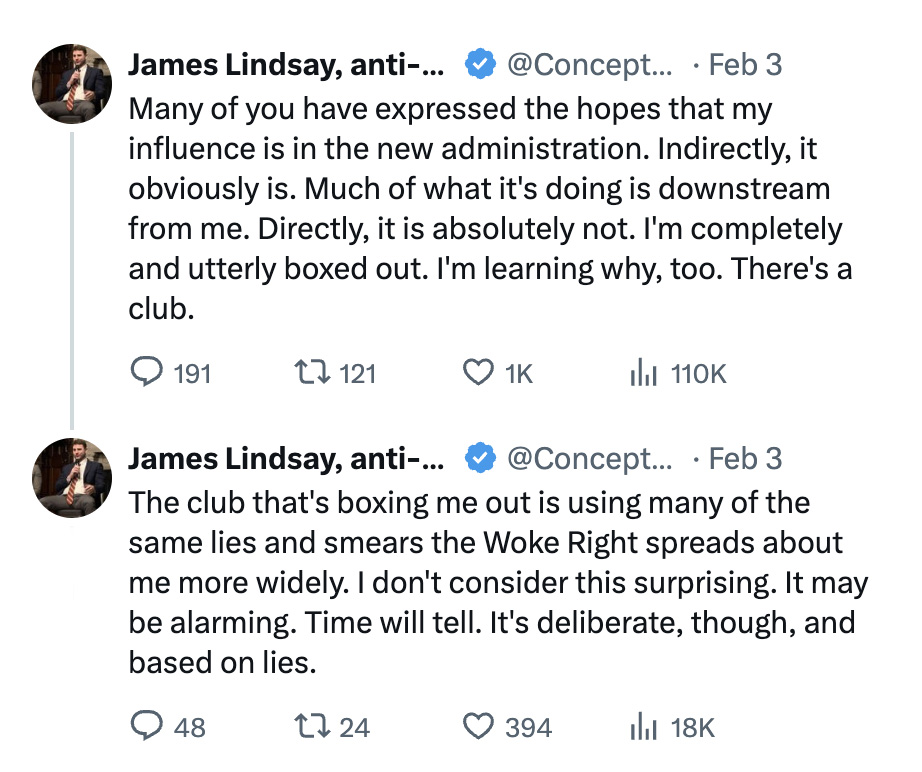
Lindsay was initially excited for Trump 47, writing on Twitter on Jan. 31 that the woke right was “completely out of step with the Trump administration.” That elation didn’t last, as he would lament a few days later that he was “completely and utterly boxed out” of the second Trump administration. Lindsay, ever the conspiracist, blamed his lack of access to Trump 47 on the existence of a secret club “using many of the same lies and smears the Woke Right spreads about me.” It seems Lindsay’s bid for court whisperer was denied. What a shame.
We cannot know for sure why the Trump administration blackballed Lindsay, but we can be grateful it did so. That he has no influence over this administration is a very good thing. As someone who lives in Washington and regularly interacts with people working in Trump 47, I can tell you that they incline toward paleoconservatism, or what Lindsay slanders as “woke right.” Lindsay’s quest to safeguard 20th-century American classical liberalism is of no interest to them. But they are also not fans of the gutter anti-Semitism promulgated by the JQ Right—which is another thing for which we can be thankful.
In his crusade to root out right-wing wrongthink, Lindsay is woefully out of touch with the current political moment. His attacks on those on the right who don’t agree with his own classical liberal brand is just more of what the left has been doing for decades. One might have hoped that we had abandoned this fastidious gatekeeping. Unfortunately, Lindsay proves that’s not the case.
After President Trump pulled off the greatest political comeback in history, the right is in a somewhat better position than it was before, and more able to combat the left’s cancel culture. In his crusade to root out right-wing wrongthink, Lindsay is woefully out of touch with the current political moment. His attacks on those on the right who don’t agree with his own classical liberal brand is just more of what the left has been doing for decades. One might have hoped that we had abandoned this fastidious gatekeeping. Unfortunately, Lindsay proves that’s not the case.
Bad ideas, to be clear, are worth pushing back against. I do so when I deem necessary. Nevertheless, the anti-woke right crowd devotes far more time to attacking those considered too right-wing than those deemed insufficiently right-wing. That gives their game away. It shouldn’t come as a shock that Trump 47 wants nothing to do with them.
Still, as the right continues to win, there will be those who worry that the right is moving too far to the right. For that reason, I don’t expect the term “woke right” to disappear. It will continue to be part of the vocabulary of those who like nothing better than to police the right. But given that MAGA, overall, has rejected it, it is evident that the woke right crusade has petered out, to the dismay of those, like Lindsay, who viewed it as their ticket to political influence.
Leave a Reply