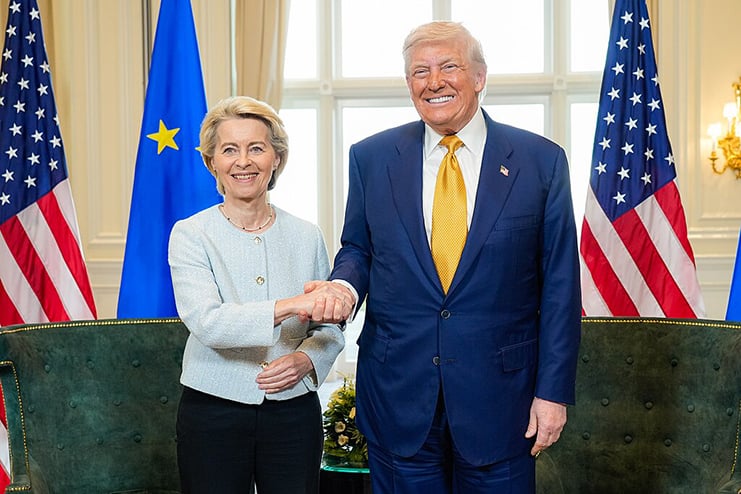
For the last day of 2025, I had planned “A Year in Review” similar to the one I prepared a year ago, but it was not to be. It did not work. There is too much imbalance between the most important foreign policy development of 2025—Trump’s decoupling of America from Europe’s effete ruling class—and just about everything else that has been going on in the world.
Compared to this process of historic import, the war in Ukraine (soon to be in its fifth year), the never-ending misery of Gaza, the tension over Venezuela, the standoff in the South China Sea, and everything else look distinctly second-rate. The trans-Atlantic rift of 2025 has the character of a turning point, comparable in form, and perhaps even in substance, to the Diplomatic Revolution of 1756, when Austria’s Habsburgs abandoned their long-standing partnership with Great Britain and allied with their old enemy, France.
An early whiff of the winds of change came less than a week after President Donald Trump’s second inauguration, when Elon Musk made a virtual appearance at a campaign event for Germany’s right-wing populist party, Alternative for Germany (AfD). Enthusiastically greeted by almost 5,000 attendees in Halle, Germany, the newly appointed head of the Department of Government Efficiency declared that the AfD was “the best hope for Germany.” “It’s good to be proud of German culture and German values, and not to lose that in some sort of multiculturalism that dilutes everything,” Musk went on. “Children should not be guilty of the sins of their parents, let alone their great-grandparents.”
The “firewall” around the AfD, painstakingly built and cultivated by the German political establishment for years, was thus decisively demolished. AfD’s events and statements could be ignored with impunity for as long as they remained confined to the German milieu, but this was world news. The media machine, uniformly leftist, went berserk, accusing Musk of “undermining our democracy” and interfering in the German election, which had been scheduled for Feb. 25. It was a sight to behold.
February 2025 was the watershed month, with no fewer than four significant events that clearly indicated that a major U.S. policy shift was not merely imminent but underway.
On Feb. 12, attending his first NATO meeting in Brussels, Secretary of Defense Pete Hegseth told his fellow defense ministers that Europe needed to “take ownership of conventional security on the continent.” He also told his European colleagues that the Trump administration expected them to shoulder the burden of providing the “overwhelming share” of future military aid to Ukraine.
On the same day, President Trump declared that he and Vladimir Putin would negotiate to end the war in Ukraine. He announced a “lengthy and highly productive phone call” with the Russian president. Trump clearly stated that he would negotiate bilaterally with his counterpart in the Kremlin. This was a cold reality check for the Europeans, not to mention the hapless Ukrainian president.
Just two days later, on Feb. 14, came Vice President JD Vance’s memorable speech at the Munich Security Conference. He condemned the European liberal elite for stifling free speech, allowing rampant immigration, and undermining democracy. He noted Europe’s retreat from its “fundamental values” and warned against censoring a substantial part of its own population under the guise of “misinformation” or “disinformation” policing.
Vance stunned the audience by saying he feared the threat to Europe from within more than that from Russia or China. This was an oration of historic significance. For the European establishment, it was a cold shower. A fundamental shift in the relations with Washington could no longer be denied.
On the last day of February came the stunning, unprecedented Oval Office confrontation between Volodymyr Zelensky on one side and the tandem Trump-Vance on the other. It was hard to escape the impression that the Ukrainian president was merely an unwitting punching bag, symbolizing—in the eyes of his hosts—the European political class, which pretended he was a latter-day Churchill while expecting America to continue footing the bill.
From that point on, it was clear that radically new forms of trans-Atlantic alignment, antithetical to the post-Cold-War Western consensus, were not only thinkable but imminent. Fast forward to the final weeks of the year. “The decades of Pax Americana are largely over for us in Europe, and for us in Germany as well,” Chancellor Friedrich Merz said two weeks ago, and for once he was right. With his National Security Strategy announced a week earlier, Trump has finally codified a radically new approach to America’s relations with Europe.
The document accepts that Russia does not pose an existential threat to Europe, which has a clear advantage over Russia by almost every measure except for nuclear weapons. Indeed, according to the Stockholm International Peace Research Institute (SIPRI), Russia spent the equivalent of $149 billion on its military in 2024, Germany $88.5 billion, and the European NATO members a total of $454 billion. The ratio is three to one. It is patently absurd to suggest that a Russian army, which is hard-pressed to advance a few miles in the Donbas, is poised to take on “Europe” once it is done with Ukraine.
More importantly, the NSS recognizes that the European Union is no one’s fatherland. The EU is not considered a role model for anyone in the world; it is merely a magnet for millions of mostly unemployable “refugees” and the promised land for climate fanatics and censorship aficionados. Trump’s travel ban levied against five particularly obnoxious Euro-censors was a relatively minor but eminently heartwarming piece of news to receive just two days before Christmas.
The three actual world powers—the United States, China, and Russia—mercifully do not share the EU’s dystopian universalism. Historically rooted senses of identity will prevail over globalism, and balancing real interests in the real world will trump ideologically driven hysteria.
Nigel Farage of Reform UK, Marine Le Pen of the National Rally, and Alice Weidel of the AfD should be standing ready to take over from Prime Minister Keir Starmer, President Emmanuel Macron, and Chancellor Friedrich Merz, to lead Western Europe from self-annihilation to recovery before the end of this decade. America should help them do so, overtly and covertly, for Europe’s sake, and in its own interest.
Leave a Reply