History is better understood as courtship than as chronology. A good historian doesn’t trudge through names, dates, and events, but flirts with them, marvels at them, and occasionally quarrels with them. He studies the past as he would a character—be it tragic, comic, or often contradictory. Walter McDougall is one such historian.
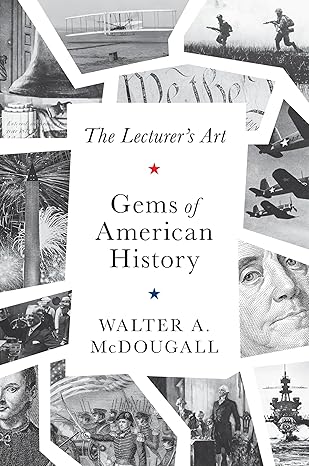
After more than 13 years teaching European diplomatic history at UC Berkeley, McDougall arrived at the University of Pennsylvania and was soon asked to expand his repertoire to include American history. The role required building an entirely new lecture series from scratch—a challenge he embraced with characteristic relish.
What followed is a work that is neither strictly chronological nor conventionally thematic. In Gems of American History, the Pulitzer Prize-winning historian guides us not through yet another dry, dusty recounting of events, but through a romance. Or perhaps to put it more aptly, a colonial sash full of medal-ribbons: each “gem” is a story that helps define our nation’s rich history. Running through them all, however, is a single thread: the effort to understand American identity not as an abstraction, but as a living tradition. As Lincoln once intoned, we are bound by “the mystic chords of memory.” McDougall does not pluck them lightly.
Though it arrives in the form of a book, in spirit Gems of American History is a series of university lectures polished by performance and sharpened by decades of teaching. Each chapter is comprised of a beginning, middle, and an (often dramatic) end. This is the result of McDougall still bearing the pedagogical scars of sitting in lecture halls himself, only to hear a professor glance at the clock and sigh, “We’ll pick up here next time.” He vowed never to do the same.

One of McDougall’s most incisive interpretive moves is his rejection of anachronistic framings. He refuses to cast the founders as metaphysicians or systematic philosophers in the mold of Plato, Aquinas, Kant, or Rousseau. Neither does he suggest they were somehow guided by the later interpretive frameworks of Leo Strauss’s political theory. They were, above all, Anglo-Americans—heirs of the Common Law, steeled by Protestant casuistry, and forged in the crucible of British constitutionalism and its Scottish Enlightenment critique. They viewed politics as a matter of prudence and legal precedent. They did not seek to inaugurate an age of reason but to conserve and recalibrate the historic rights of Englishmen under conditions that had rendered those rights insecure—above all, the over-centralization and extractive pressures of the late British Empire suffering from internal rot and feckless leadership.
Another interpretive case McDougall lays out in his lectures concerns the intellectual character of the founders—a subject often buried beneath hagiography. While they have long been canonized as saints of civic virtue, the founders bear less resemblance to Plato’s philosopher-king than Machiavelli’s ideal statesman: shrewd, learned, pragmatic, and deeply attuned to the contingencies of power. This comparison is even more striking given that the latter was largely exiled from the English-speaking canon.
Machiavelli—known in England by the diabolical sobriquet “Old Nick”—was the philosopher whose ethereal form nevertheless haunted Continental political theory even as Discourses on Livy had by then crept back into circulation from the catacombs of Florentine infamy into the private libraries of gentlemen reformers. It is one of McDougall’s more ironic observations that the American revolutionaries were, at bottom, intellectual conservatives more devoted to Livy, Cicero, and Harrington than Rousseau, Condorcet, or the salons of Paris.
Indeed, John Adams quoted Discourses on Livy liberally in his Defense of the Constitutions (1788). He, like his colleagues, understood that political longevity demands not sentimental appeals to virtue but intricate institutional checks—mechanisms sturdy enough to restrain ambition yet supple enough to endure crisis. What undergirded the founders’ project was the understanding that liberty is not the absence of hierarchy, but the binding of power within a deliberate structure. Appeals to Christian virtue—or to any moral disposition—were, as both Franklin and Hume suspected, too fragile a foundation on which to build a durable republic.
According to McDougall, no figure personifies this synthesis more fully than Franklin himself. Before he was America’s sage, he was Britain’s most ardent conciliator—spending more than a decade in London attempting to preserve the Anglo-American bond on American terms. While Congress drafted airy “Model Treaties,” he courted Versailles with a subtlety worthy of the Medici court—engaging in double-dealing, indirection, and long silence until Saratoga afforded him sufficient leverage. His diplomacy was a study in Machiavellian patience. The American Founding, McDougall implies, cannot be disentangled from the traditions that preceded it: a classical republicanism tempered by a distinctively Hebraic notion of covenant; a Protestant eschatology that suffused civil order with millenarian urgency; and above all, a legal consciousness rooted in Blackstone, Coke, and the procedural pragmatism of English courts.
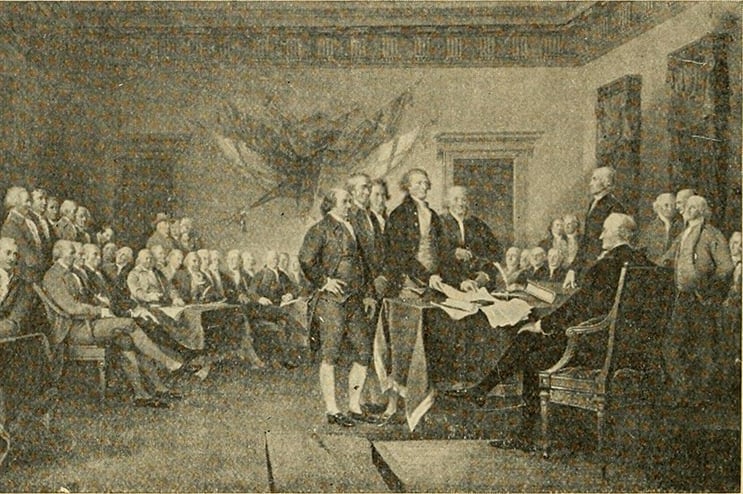
These efforts culminated in the Revolution’s most decisive diplomatic victory: Franklin’s reception at Versailles in 1778 and the subsequent Franco-American alliance. McDougall reminds us that the Declaration of Independence may have contained lofty ideals, but its deeper function, as originally conceived, was far more practical: It was a war measure, crafted as much to court foreign powers as to inspire domestic resolve. The tension between principle and pragmatism mounting throughout McDougall’s Gems culminates in a subtle but striking reading of the founders’ postwar anxieties.
By 1793, the French Revolution had descended into bloodletting, French agents stirred sedition in American cities, and democratic clubs sprang up in imitation of the Jacobins. Here McDougall turns his eye to President Washington’s final and most prescient public act: his 1796 Farewell Address. It is a text less often read than quoted, but one that remains a tour de force of republican statecraft. It was, in effect, the capstone of the American Machiavellian moment. Washington did not call for isolationism, as later caricatures suggest, but for independence—and independence not just from monarchs and ministers abroad, but from the passions, factions, and foreign lures that might render the young republic vulnerable to corruption from within. “The insidious wiles of foreign influence,” he warned, are “one of the most baneful foes of republican government.” Founding a republic, explains McDougall, is a task for men willing to contend with the world as it is—not as they would have it be.
McDougall devotes as much attention to American genius in high politics as he does to its incarnations in private enterprise, the pioneering spirit, and madcap ambition. Two iconic figures, a century apart, represent the essential but often overlooked pillars of the American tradition: fiscal independence anchored in civic responsibility and technological innovation unburdened by institutional oversight. Stephen Girard and the Wright brothers—one a merchant-banker of revolutionary vintage, the other two tinkerers of the machine age—reflect a distinctively American civic ethos that is rarely orchestrated from the top down.
Born in Bordeaux in 1750, Girard was half-blind and all-nerve. He sailed into Philadelphia as a ship captain and remained to become one of the most influential Americans of the early republic. By 1810, he was corresponding with Thomas Jefferson and managing a fortune worth over $2 million. Girard’s bequest to found a school for orphan boys was, at the time, the largest private charitable donation in U.S. history. Girard College—meticulously detailed in his will down to the dimensions of its perimeter wall—still operates today in North Philadelphia. Girard emerges as the archetype of what might be called republican capitalism—a man who fused Old World fiscal discipline with the exigencies of a fledgling republic, personally bankrolling the War of 1812 when the federal credit system faltered.
If Girard proved indispensable to the early republic’s fiscal architecture, then the Wright brothers represent the triumph of what McDougall calls Yankee know-how. In one of the book’s most charming lectures, McDougall devotes sustained attention to the brothers not merely as inventors, but as archetypes of the American craftsman. The brothers, he notes wryly, “grew up behaving in ways the next century’s psychologists would term obsessive-compulsive.” They stuck close to home, were painfully shy—“especially around females”—and devoted themselves to solitary, technical pursuits. By 1899, their attention turned skyward.
By the time they lugged their “Whopper Flying Machine” to the windswept dunes of Kill Devil Hills, they did more than slip the surly bonds of earth. Their revolution in flight vindicated a deeper national faith: a distinctively American knack for innovation—one that is equal parts science and daredevilry. Through examples like the Wright brothers, McDougall reminds us that American greatness—built in workshops and backrooms and enforced by discipline, frugality, and the stubborn, eccentric pursuit of the possible—could accomplish what state-sponsored laboratories and imperial ministries could not dare dream.
Importantly, McDougall’s treatment of the Revolution resists the temptations of piety and pageant. He reminds us that independence was not inevitable—and perhaps not even necessary. Had Westminster governed with more prudence, the colonial rupture might never have occurred. Britain’s incoherent colonial policies—the Sugar Interest battling the Tea Interest, Parliament in the hands of the Squirearchy—had degenerated into a bureaucratic farce. The national debt had nearly doubled by 1763, and interest payments alone devoured over half the annual budget. Beneath the veneer of imperial confidence lay a morass of factionalism and fiscal decay—an empire, McDougall explains, that was no longer capable of governing itself, much less governing others.
That conclusion was nonetheless intolerable to the new republic’s emerging civil religion, which required the founding to be providential rather than accidental. Hence, America was never a nakedly secular project. From the start, it clothed its ambitions in the language of Providence. Paine, who detested organized religion, nonetheless framed Common Sense around prophecies from the Hebrew Bible—appropriated from Milton—and attributed to monarchy the stain of original sin. Deists found in his pamphlet the God of Nature; Christians found the God of Sinai.
McDougall writes: “Thus did Paine, like Paul the Apostle, become ‘all things to all men,’ and craft a template for all American political rhetoric to come.” The Israelites of Deuteronomy, warned by Moses that “neither armies nor allies can save them” if they fall away from God, became—almost by typological instinct—the model for “We the People.”
McDougall brings a necessary sobriety to what he calls the “American Civil Religion” of the founding, and nowhere is this more evident than in his treatment of the Declaration of Independence. Often imagined as a bolt from heaven, Jefferson’s draft “did not begin in apotheosis,” as McDougall dryly notes. Jefferson himself confessed his intent was simply “to state the common sense of the subject.”
And what was that sense, precisely? A litany of lifted phrases: from Thomas Paine, from colonial pamphlets, and most extensively from the soaring lines found in George Mason’s Virginia Declaration of Rights, which had articulated the claims to life, liberty, property, and the pursuit of happiness weeks earlier. It was Mason—not Jefferson—who first gave form to the American grammar of rights: the abolition of privilege, a free press, toleration of religion, and the structural armature of constitutionalism. Jefferson’s contribution, McDougall suggests, lay in editorial finesse, not prophetic genius. Even the immortal invocation of “inalienable rights” was softened and recast by Congress to better strike the proper liturgical chord.
As McDougall observes, the Declaration itself “was squirreled away and largely ignored.” It took a second national rupture—the Civil War—for Americans to rediscover their sacred text and elevate it to the level of Scripture. Only after World War II did the Declaration and Constitution enter their final resting place: “a chemically, climatically controlled tabernacle… ringed by a chancel rail over which endless queues of tourists (perhaps pilgrims) squint in reverence.”
McDougall’s treatment of the American Civil Religion—part covenant, part creed, part cultivated myth—is among the most provocative contributions of his lecture series. He contends that this symbolic architecture once furnished a moral canopy over our political order, inviting citizens to see themselves not merely as interchangeable rights-bearing units in a regulatory regime but as stewards of a providential mission. That canopy, he suggests, has all but collapsed. The shared cosmology that once united Deists and Theists, Enlightenment radicals and Puritan moralists, has receded into what McDougall might diagnose as civilizational amnesia. We rehearse the public rites and revere the founding scripture yet lack the unwritten constitution—the shared ethical and cosmological assumptions—that once lent those artifacts coherence and force.
Yet McDougall does not simply lapse into despair. By tracing the contours of America’s early self-understanding, he reminds us that no regime endures for long without a story to tell about its origins, its duties, and its destiny. Whether the right can recover the old creed or craft a new one from its ashes emerges as the book’s most haunting and unresolved question.
In one of McDougall’s sharpest lectures, he cautions that the very conceit of “American exceptionalism”—a term he reminds us was first popularized not by the founders but by Pope Leo XIII and Communist Jay Lovestone, and was then later sanctified by Cold War sermons from Presidents Kennedy and Reagan—may itself be the pride that goeth before the imperial fall. Drawing on Toynbee’s axiom that empires die not by murder but by suicide, McDougall asks what happens to a republic that comes to believe it’s exempt from the Second Law of Thermodynamics, let alone history itself. “If it means that Americans are exempted from the laws of entropy,” he writes, “then such exceptionalism can only be proven sub specie aeternitatis.” The delusion that one’s nation is under divine dispensation is, according to McDougall, not just naïve but potentially fatal.
With characteristic precision, McDougall shows that such presumptions were not present at the founding. The Puritans “were not impelled by an exceptional American impulse.” Likewise, the founders built a republic predicated on restraint and a humble posture among nations. The cautious statecraft of Washington’s Farewell and the Monroe Doctrine held firm for nearly a century; even President Cleveland, in his 1885 inaugural, paid them deference. But within a generation, that consensus was swept away.
As McDougall tells it, the closing of the frontier, the forging of a steel Navy, and the siren call of missionary capitalism brought about a cultural pivot. The Republic that once sought to avoid foreign strife came to imagine it could redeem the world’s sins. Progressives concluded that the principles of Washington and Jefferson—neutrality, commerce with all, entangling alliances with none—were no longer adequate. “The world was shrinking,” McDougall wryly notes, “and Americans noticed.”
In its early modern usage, empire implied something precise—untrammeled sovereignty, not the globe-straddling leviathan of alliances, bases, and interventions America would maintain from 1941 onward. And yet, the United States would construct precisely such a system entirely alien to its republican origins.
The shock of Pearl Harbor did not trigger a five-year war so much as a 50-year global emergency: a totalitarian rivalry fought under the banner of saving the world’s soul. From that prolonged twilight struggle emerged the “imperial presidency.” An office once designed to ensure civilian control of the military became the operational cockpit of a global empire. Congress ceased declaring wars and instead approved budgets for endless “conflicts,” “interventions,” and “police actions.” By the end of the century, as Truman quipped, the office held powers that would make Genghis Khan green with envy. For McDougall, this was the fulfillment—and the betrayal—of a century-long metamorphosis: where once America was a Promised Land, it became a Crusader State.
McDougall traces the gradual erosion of the founders’ restrained conception of national interest through the rise of four sequential foreign policy traditions, each reacting to the occasion of war or revolution. First came Progressive Imperialism, the debut of America’s role as Cuba’s paternalistic liberator. The second tradition, Wilsonianism, emerged from the wreckage of the Great War—a war that not only shattered the myth of progress and buried the old balance of power, but elevated American ideals into universal mandates. President Wilson, less a statesman than a prophet of the Progressive Social Gospel, believed America could reorder the world through law, institutions, and collective security. That peculiar heresy proclaimed that the very “idea of America is to serve humanity.” Wilson envisioned Christ as a reformer, the State His instrument, and its credentialed experts a priesthood tasked with the redemption of mankind—at home, then abroad. American elites have assumed that their own institutions are not merely American blessings but universal rights. Worse, they have assumed that other cultures, whether they know it or not, yearn to become versions of America. If a people declined that invitation, it was not a signal to retreat, but to intervene harder. Wilson’s vision, McDougall observes, endures less in formal policy than in the institutions of the American mind: the university, the press, the permanent foreign policy class.
In the vacuum of collapsed empires, a new world order emerged—bipolar, armed with rival universalisms, each claiming the right to redeem mankind. Soviet communism and American liberal democracy became dueling gospels, each backed by nuclear fire. From this emerged the third tradition: Containment.
This was not merely a strategy to hold Soviet aggression at bay, but one that justified global deployments, propped up dictators, and confused the defense of freedom at home with its frenzied export. Vietnam, Korea, Iran, Chile—all became altar stones in a temple built to a foreign policy apparatus..
The final and most ambitious tradition McDougall identifies is Global Meliorism. This was not war in the conventional sense, but peace through perpetual involvement. Foreign policy is no longer about defending American interests but about managing the internal affairs of other states. Its premise is that tyranny, terrorism, and poverty can be cured by humanitarian aid, economic development, social engineering, and the imposition of liberal institutions. It presumes, with breathtaking hubris, that every tribe and tongue yearns to be governed like a D.C. think tank—but with cruise missiles and NGOs deployed in tandem.
Together, these four traditions form a kind of post-constitutional catechism of global uplift. Under these rubrics, the foreign policy establishment developed its own priesthood: careerists, scholars, and bureaucrats who saw themselves not as stewards of the national interest, but as apostles of the Crusader State. Its high priests reside not in Congress, but in Foggy Bottom, Langley, and the think tanks of Massachusetts Avenue.
Yet long before these creeds, America’s earliest posture had been that of instinctive restraint. Jefferson’s neutrality, Monroe’s Doctrine, Jackson’s Manifest Destiny—all emerged without a centralized grand strategy, and still they worked. Tocqueville marveled at this restraint. McDougall compares it to card sense: a natural flair for statecraft without the trappings of theory.
McDougall implies that, perhaps, American foreign policy has reached its final stage: when a Republic no longer defends its borders but glorifies its abstractions. When it ceases to ask, Should we? and only calculates, Can we? McDougall is skeptical that Trump and his America First strategy can “break the spell” cast by Wilsonianism. Perhaps the most honest model of statecraft, as McDougall channels from Samuel Huntington, is not to command history but to weather it: to see the ship of state not as an ark of destiny but as a vessel tossed on eternal seas, guided by the old charts—prudence, restraint, and a stubborn reverence for one’s limits.
To read McDougall’s Gems is to be swept up into an older tradition. He invites one to accept a slower, more cultivated rhythm of thought. In between my own busy schedule as a student—final exams, racing deadlines, and many social obligations—reading these lectures felt oddly indulgent, akin to prix fixe dining or slowly sipping a fine wine. McDougall invites his reader to taste the subtle notes of irony and pathos before moving to the next course. His approach stands in defiant contrast to the metrics-obsessed pace of modern academia. He does not write as a footnote-choked pedant but narrates with the unhurried poise of a Homeric bard. He is a raconteur, summoning battles, treaties, migrations, machines, and myths with the cadence of someone who has not only read the past but plausibly could have lived it..
With the sensitivity of Virgil and the control of a veteran rhetorician, he revives the forgotten art of narration. His account of the Battle of New Orleans, for instance, is not a postscript to the War of 1812, but its operatic climax: Lord Bathurst drafts orders with sly detachment; General Jackson charges at breakneck speed through mud and musket smoke; Lafitte’s pirates slink in like revenants on the bayou—and then, at the very moment when the war had technically ended, the bloodiest battle takes place. Events do not merely unfurl; they tighten like a noose. We hear the panic of Governor Claiborne pleading for militia reinforcement and detect the scent of a city on the brink. The terrain is detailed and the climactic slaughter—British soldiers falling “like blades of grass beneath the scythe of the mower”—bears the weight of tragic inevitability.
Nor does McDougall shy from his own memory’s archive. He recalls the jungle silence of Vietnam and the cognitive dissonance of seeing the Stars and Stripes flutter over alien Asian soil. His account of the jungle—“utter blackness and utter silence,” the surreal pathos of “I’m Leavin’ on a Jet Plane” played over intercom Muzak—resists both nostalgia and polemic. War, he tells us, is “95% boredom punctuated by 5% terror.” His lecture on Vietnam is told not through the usual geopolitical abstractions or generational angst, but through memory of someone who experience it. Even his reflections on flight rise above the usual centennial pieties. From Daedalus to Lindbergh, from Icarus’ fall to Magee’s ascent, he weaves flight into the great human romance with the sky. “To fly!” he writes, “It must be… like sex with gods.”
McDougall is that rare figure in modern academia. He does not hide behind jargon or cloak uncertainty in postmodern cynicism. He believes in the past as a real place, filled with real actors, making choices under pressure and in the dark. And he tells their stories with the conviction that those choices matter. History is not a puzzle to be solved or a grievance to be aired, but a trial to be endured. For all its folly and blood, we are not alone in its trials. Others came before us — equally bewildered, equally brave. And in the telling—lucid, spare, and unflinching—there is consolation. If anyone is fit to tell it straight, it’s a man who survived both Vietnam and the Ivy League—and who lived to lecture about it.
Leave a Reply