During the recent media blitzkrieg promoting Jake Tapper’s and Alex Thompson’s book Original Sin, RealClear Politics founder Tom Bevan tweeted: “[A] nauseating fact about the Tapper/Thompson book: they’ve gotten more media in 2 days than most authors get in a lifetime, all of it from liberal media – except @megynkelly. NONE of these outlets would have given a minute to conservatives if they’d written the same book.”
Bevan is right that liberals gave Tapper an obscene amount of coverage, but Megyn Kelly wasn’t the only conservative who filled Tapper’s sails with promotional wind. Conservatives on various websites and social media spent a solid week dissecting, investigating, and insulting Tapper, who had the gall to announce that Biden was known to be cognitively impaired after Tapper himself hid that fact from the public for over four years.
This conservative obsession with Tapper, however, points to a larger problem in conservative media: It still parasitically lives on its larger, liberal host. Megyn Kelly, the Daily Wire, National Review and the various websites all exist to engage with the latest leftist trigger: waiting, as it were, to scream about the latest woke outrage.
Of course, there is value in this, to be fair. The left does need to be contradicted, ridiculed, and refuted. Yet with all the technology we have at our fingertips and the staggering success of conservative media—Ben Shapiro once boasted that he “sleeps on a bed made out of money”—we still have not managed to cultivate many reporters who can go out there and, well, actually report from the field.
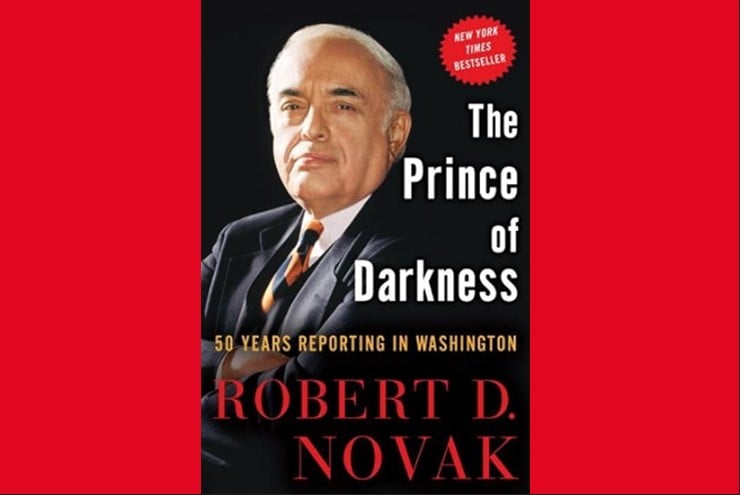
I’m going to be leaving journalism this year, so in reflecting on this decision and the state of our media, particularly conservative media, I found myself recalling the work of Robert Novak. While conservative media has exploded since Novak’s death in 2009, his tenacious style of reporting has not expanded along with it. As revealed in his 2008 autobiography The Prince of Darkness, Novak was conservative, but one who insisted on digging for new stories and not just spouting off in response to stories reported by the liberal media. He was a journalist with a genuinely free-thinking mind. “Mr. Novak had nothing in common with the partisan water-carriers who pass themselves off as conservative ‘journalists,’” The Economist once observed. In an obituary that ran in the left-wing magazine The Nation, John Nichols argued that
the important thing to recall about Novak is that, at his best, he was an ideological rather than a partisan journalist … Novak would eventually declare himself to be a ‘right-wing ideologue.’ But his columns and comments were often as rough on the Republican establishment as they were on the Democrats.
Novak famously argued against both the Persian Gulf War and the 2003 invasion of Iraq.
According to Novak, it was his practice, as well as that of his collaborator, Rowland Evans, to try to include a piece of breaking news in every single column they wrote. As Novak told Washingtonian magazine in 2003,
We followed that rule for 30 years. I still follow it. Sometimes it is some little triviality, the kind of story that creates a sensation in Washington for 24 hours and then you wipe the garbage up with it. But I just loved those kind of stories when I was a young reporter, and I love them now.
In 1972, after South Dakota’s Senator George McGovern won the Democratic primary in Massachusetts, journalist Robert Novak (1931-2009) called Democratic politicians all over America to get their opinions. Novak reported to his readers that an anonymous Democratic senator had spilled some dirt about McGovern. “The people don’t know McGovern is for amnesty, abortion, and legalization of pot,” the senator told Novak. “Once middle America—Catholic middle America, in particular—finds this out, he’s dead.”
McGovern did indeed become known as the candidate of “amnesty, abortion, and acid,” leading to his being routed in a 49-state landslide loss.
Journalists in 2025, even conservative ones, seem to lack Novak’s work ethic or curiosity. Instead, like liberals, they often fall in love with one voice or one opinion and, as a result, miss or misinterpret stories. Too many are so locked in to the routine of responding to the liberal media, which is still the alpha dog in journalism even if it doesn’t have to be, that they fail to platform the most interesting and important stories.
Nic Rowan is the recipient of a 2025-26 Robert Novak Fellowship. The Novak Fellowship provides $35,000 in grant money and expense assistance for young writers to dive into longer or more costly reporting projects. For his project, “The New American Way of Death,” Nic will research the spread of assisted suicide and recent shifts in how death is viewed in the United States. “When you’re a professional writer, you feel a lot of pressure all the time to be constantly churning,” Nic said. “There are some ideas that deserve more in depth looks at a longer length of time and from a balanced viewpoint.”
Yet Rowan managed to badly botch a story that deserved just such consideration—my story.
In March of 2023 Rowan reviewed my book The Devil’s Triangle: Mark Judge vs the New American Stasi for The American Conservative. As Chronicles readers know, The Devil’s Triangle is about the way I was dragged into the liberal media’s 2018 hit on Supreme Court nominee Brett Kavanaugh. The book reveals the plot, and how I eluded criminals, opposition researchers, the media, and Kamala Harris—who were all set on a path to try and destroy me and Kavanaugh. You would think it would have gotten huge play in conservative media, but it did not.
Actually, there was (eventually) a bit of coverage. I was interviewed by Martha MacCallum on Fox. Yet here is the interesting thing: Fox only contacted me after word got out about Christine Blasey Ford’s book. Ford, readers will remember, was the woman who accused Kavanaugh of sexually assaulting her and charged me with watching this outrage occur while at a high school party in 1982. MacCallum’s people were good to me, and asked good questions. Yet it’s revealing and in keeping with my criticisms of conservative media, the interview only came about in reaction to Ford’s book. My own book had appeared more than a year before Ford’s and Fox showed no independent interest
Yet Rowan’s review reduced the entire drama down to a tired story of people on both sides attempting to rise in the Washington, D.C. pecking order. I’m serious. Rowan writes:
After all, Washingtonians, who often think of themselves as more grand than people in other American cities, are a gossipy lot, forever attempting to find import in their neighbors’ most mundane habits. Kavanaugh is a special case even among these. He was born in the city and, as his status in it rose, plenty of Washingtonians from his childhood in Bethesda to his time at Yale Law School watched with interest. When Christine Blasey Ford accused him of a drunken sexual advance attempted in high school—speaking up nearly twenty-five years later—many others who knew him from his school days also took the opportunity to speak. His old enemies demonized him and his old friends defended him, but it all amounted to about the same thing. Kavanaugh was becoming Somebody, and anyone who could plausibly connect himself to Kavanaugh might become Somebody too.
This is the kind of thing that Robert Novak would never have written.
As a friend of mine I’ve known for 50 years put, “He got you and the people we grew up with exactly wrong. It’s not just a little off—it’s the opposite of the truth.” The close Catholic community we grew up in didn’t really care about what passes in Washington for social status. Much more important in our group were our manners, our regular mass attendance, the books and movies and sports we liked, and the people we eventually would marry. Back then and even to this day I hear from many people who want nothing to do with political power or the Washington that perpetuates that kind of phoniness; it’s not that they dislike Brett—although some do—it’s that that kind of life never appealed to them, or to me. We have no desire to Be Somebody.
Rowan notes that Brett and I “played football together, vacationed together, and threw wild parties together,” then adds this:
But it seems like there isn’t much more to it than that. Even in Judge’s account, it becomes clear that, by the end of high school, Kavanaugh was entering the ranks of professional Washingtonians while many of his friends were simply becoming townies. This separation of wheat from chaff occurs commonly at elite high schools near the city, but those who experience it usually only recognize it—often painfully—in retrospect. Judge first realized that he and Kavanaugh were friends in a static sense (frozen in time somewhere around 1983), when they, along with other high school friends, met at a bar during the Ken Starr investigation. Kavanaugh, who was working on Starr’s team, refused to engage with Judge on the subject—and Judge realized then that it was “because he has moved up in political circles.”
Before writing something so mean and ill-informed, Robert Novak would have done some basic research. He would have called me on the phone or talked to the friends I grew up with. The reason why Brett “refused to engage” with me about Ken Starr was not just because Brett had become politically powerful, but because I had become a successful journalist. I had published three books and won a Dateline Award for a piece that would eventually become the book Damn Senators (a book about my grandfather who was a professional baseball player for the Washington Senators).
Instead of noting any of this, Rowan writes that in 1998 I “was stuck in much the same place as in high school. His grandfather, Joe Judge, was one of the great heroes of the Washington Senators, who led the team to win the 1924 World Series. His father, Joseph Judge, was an editor at National Geographic, who likely discovered the true point of Christopher Columbus’ landfall in the New World. But Mark Judge himself, like so many sons and grandsons of great men, was, at that time, at least, a ne’er-do-well, a writer for alternative newspapers and a philosophical dilettante.”
That “dilettante” was actually an award-wing journalist and book author who would teach journalism at Georgetown University for three summers. Kavanaugh himself often complimented my work—as did Ken Starr, who I met at a party in Georgetown when Brett got married. Robert Novak would have known those things.
According to Rowan, I was so distraught by my station in life, and by the fact that I would only be known for “keggers” that happened when I was in high school, that I had nowhere else to turn but Pat Buchanan:
He consoled himself by looking to the example of Pat Buchanan, one of the few professional Washingtonians who has also always remained a townie. Judge latched onto Buchanan not so much for his politics but for his romanticized depiction of his childhood in the city. “I never left the District,” Buchanan claims of his upbringing. “I did not leave the city until I was twenty-one years old.” Buchanan, Judge writes, will always be a figure of fascination for locals because he is “not only a national political figure but also a panjandrum of the D.C. Catholic Ghetto.” And Judge, who was involved in many of the same Jesuit institutions as Buchanan, sees himself in a similar role, a man with friends in two cities: the one on Capitol Hill and the real one, which for him is Georgetown, the dives on U Street, and the crumbling row houses near Howard University. By comprehending both equally, he can safely claim that he fully belongs to neither—and put a comfortable distance between himself and the reality of his situation.
This is just bizarre. While I have always admired Pat Buchanan and indeed contributed an article to the first issue of The American Conservative, which Buchanan co-founded, the idea that I was trying to accept my dreadful situation in life by looking to PJB as a fellow “townie” is laughable.
As I have said, friends and I often poke fun at the “Catholic ghetto” Buchanan (and we) represent. It’s not malicious, it’s done with love, but my closest friends and I have always kept a foot outside of that world. My father was a world-traveling National Geographic editor. My worldview has never been provincial.
In his review, Nic Rowan also brings up Mike Sacks. Sacks, who I discuss in The Devil’s Triangle, was profiled in the Washington Post in 2018 during the Kavanaugh nightmare. Sacks was on the record saying all kinds of garbage about me and Brett, despite never having laid eyes on either one of us. It’s ironic that in 2025, after so much effort having been expended to get conservative media in a position to be taken seriously, that Sack’s BS is now indistinguishable from Rowan’s. Conservatives are very busy reacting to the latest woke outrage, they’ve fallen deeply in love with their own voices, and they can meme like you wouldn’t believe, but I would trade it all in for the integrity and accuracy of one Robert Novak.
As I recently noted in Chronicles, a reporter for a glossy liberal magazine is doing a profile of me this summer. This writer is liberal, but not crazy left. She has already staring asking some serious questions about the people who set me and Brett up, The New York Times reporter who apologized to me (a story that was picked up by Fox News and that I got by picking up the phone), and the fact that I single-handedly spiked a Hollywood movie that was going to be released to slander me and Kavanaugh. In short, a liberal is going to land the story that conservatives are ignoring. Not to worry, though—Megyn Kelly, Nic Rowan, and plenty of others will offer their hot takes when the story breaks.
Leave a Reply