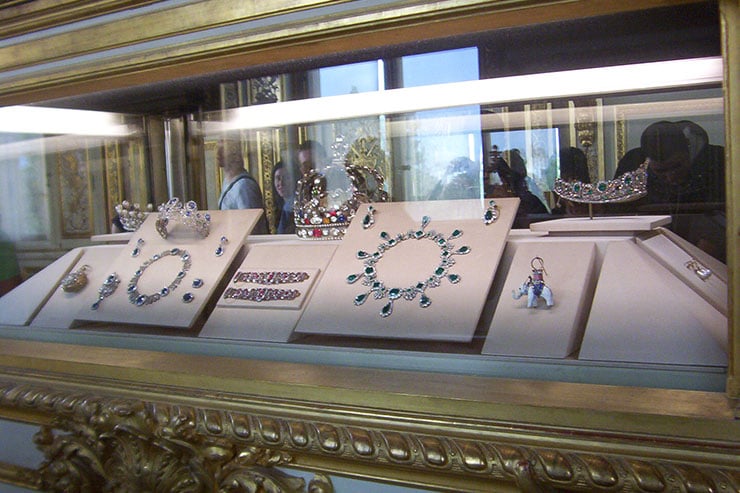
Early Sunday morning, a group of professional thieves, disguised as construction workers, entered The Louvre Museum in Paris and pulled off an extraordinary seven-minute smash-and-grab straight out of Ocean’s Eleven. In broad daylight, the criminals stole priceless crown jewels, including some that once belonged to Napoleon Bonaparte and his Austrian noble wife.
I couldn’t help but think of how this brazen robbery of French treasure is symbolic of the much greater theft of national wealth under the government of French President Emmanuel Macron.
Macron’s administration is on the verge of collapsing, as the French have grown increasingly impatient with his autocratic rule and France’s moribund economy. The nation’s gross domestic product is stagnant, and France is suffocating under a pile of debt larger (in relative terms) than that experienced during Napoleon’s wars of expansion, which ultimately bankrupted the country.. Napoleon and Macron both embodied King Louis XIV’s famous dictum, “L’État, c’est moi,” i.e., “I am the State,” signaling their belief in monocratic control over parliament and the nation, and a disdain for the will of the people. But it appears Macron’s time is up.
The parliament is deeply divided and increasingly entrenched against President Macron’s government. Since the start of 2024, Macron has appointed five different Prime Ministers, each of whom have either resigned or been forced out. As the second appointee, Michel Barnier’s ouster was triggered by a no-confidence parliamentary vote, the first one to succeed since 1962. The latest appointee, Sébastien Lecornu, lasted less than a month before he resigned. (He was re-appointed by Macron days later). So far, Macron has resisted demands to resign or to call an early election before his term is up in 2027. But the pressure is mounting, and it would not be surprising to see the French government collapse by the end of the year.
Since coming into power, Macron has worked to centralize the government further and strengthen the state. Some 57 percent of France’s GDP is derived from government expenditure, a proportion higher than that of the former Soviet Union of the 1980s (50 to 55 percent) or that of the communist government of Vietnam. Even under the Chinese Communist Party’s control, China’s government expenditure represents only 34 percent of GDP. The French economy, once an industrial powerhouse of post-war Western Europe, is therefore now more centralized and profligate than most of the communist world.
As a result of government spending, France now has $3.7 trillion of national debt, representing over 114 percent of GDP. This is the highest debt in relation to GDP in the European Union and one of the highest in the world. The debt ceiling originally agreed to by members of the EU was to be capped at 60 percent of GDP, but now the EU’s debt-to-GDP has risen to 88 percent for the region as a whole, largely because of fiscal incontinence in France, Italy (138 percent), Greece (153 percent) and Spain (104 percent).
Since 2022 France has been spending as if it were at war, funding the Ukrainian side of the conflict with Russia without popular support and against its own long-term strategic interests.
At 57.5 percent, France already has the highest average tax rate in the EU, compared to the 50 percent rate in overtaxed Germany and Italy. In the United Kingdom the average tax rate has fallen to 35.3 percent, one of several positive results of Brexit for the English middle class. In inflation-adjusted terms, the French pay €117 in taxes and social security for every €100 in purchasing power.
Macron’s power has been extended by an uneasy alliance with the far left. The rightist parties are similarly working to unite, and hammering home the issues closest to many French, including mass illegal immigration and the increased public violence, and a stagnant economy that has broken the social compact that held France together since World War II.
Some of Macron’s socialist comrades are proposing a new wealth tax as a way out of the fiscal hole. They want to levy a two percent tax on all real estate and other assets held by anyone in France with more than €100 million in assets. This would be a disaster for innovation and entrepreneurial risk-taking. A similar experiment was already tried—and failed disastrously—in Norway. There, a wealth tax that was expected to bring in €125 million of additional revenue ended up costing the nation €381 million because of the departure expatriation of wealthy citizens and their businesses from the country. As in Norway, such a program in France is likely to chase out whatever entrepreneurs remain. Norway’s experience is a lesson that should be learned not just by the French but by voters in New York City, who are about to elect a socialist mayor.
Macron isn’t the first French president in recent years to deplete France’s coffers. Between 2004 and 2009 France’s central bank under President Nicolas Sarkozy sold on the cheap 589 tons of gold for a mere €9.3 billion in proceeds. That gold would have been worth nearly 10 times more (€81 billion) by now today and provide some comfort to France’s increasingly nervous creditors.
Governments that run unsustainable deficits, grossly enlarge debt, and thereby encourage persistent inflation, deplete their nations’ wealth. Inflation and indebtedness are two hidden forms of taxation and wealth confiscation that are little different in effect from the theft of crown jewels at the Louvre.
Leave a Reply