When the original 1995 Pixar film, Toy Story, stole the hearts of a generation, the franchise’s true antagonist wasn’t a villainous toy or sadistic tween—it was the inevitable, and sometimes cruel, passage of time. The lasting resonance of those early films came from their honest portrayal of the way children, no matter how deeply they cherish the things that mark their childhoods, eventually grow up and move on.
Now, with Toy Story 5 hitting theatres, Woody and the gang face their greatest enemy yet: the smart tablet.
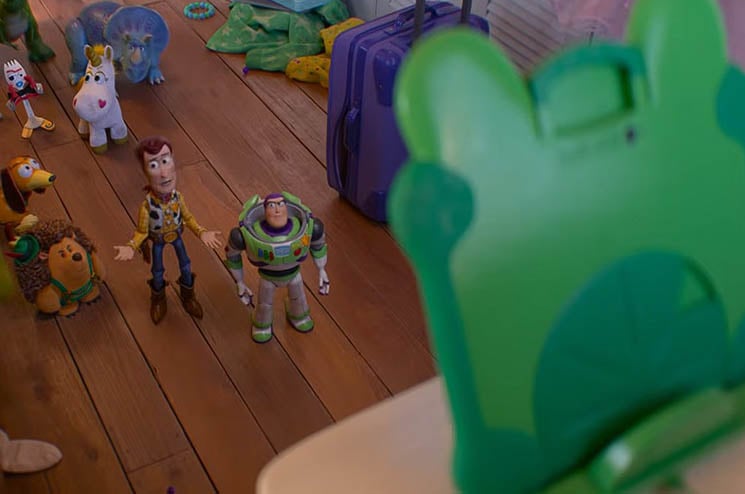
The story centers on eight-year-old Bonnie, whose parents gift her a Lilypad—a frog-themed smart tablet designed to help her socialize online. Almost instantly, this algorithmic leviathan consumes Bonnie’s time and attention, turning her into a screen-addled zombie: her imagination fades, her toys are left neglected on the bedroom floor, and she’s robbed of the precious childhood years she should be spending playing outside and having fun. It’s a powerful—if somewhat dated—message: after all, Hollywood tends to move at a glacial pace when it comes to capturing the zeitgeist.
While the film ostensibly takes aim at Big Tech, a deeper look reveals a massive contradiction at the heart of Disney and, indeed, the entertainment industry as a whole. The very corporation asking audiences to lament screen addiction is also using the Toy Story brand to fuel an aggressive attention-harvesting machine—complete with companion mobile apps and digital spin-offs designed specifically to keep those same children surgically attached to their devices.
This hypocrisy is better known as recuperation—the process by which a corporation swallows up a critical or rebellious idea, sanitizes it, and sells it back to the public as a safe commodity. The system essentially defuses the bomb by selling it back to you as a souvenir. Instead of allowing a critique of screen addiction to threaten its bottom line, Disney releases a 100-minute warning about tech precisely to neutralize the message. The system doesn’t mind if a movie tells children to go outside and play, so long as the parent pays Disney for the ticket to hear that message.
To do this, Disney leans on its market dominance, using its monopoly over the 31-year-old franchise to full effect. Through vertical integration, the studio controls the entire pipeline from creation to delivery: producing content via Pixar, streaming beloved classics directly into homes via Disney+, and building interactive Toy Story worlds within its own theme parks. Each of these experiences is carefully crafted to keep consumers connected to its proprietary ecosystem. At the same time, Disney employs extensive horizontal integration, spreading the intellectual property across countless formats to capture every second of a child’s attention—and a parent’s wallet.
Movies expand into video games, mobile apps, television spin-offs, and merchandise. At a cursory glance, I can count at least 40 existing or forthcoming video games, mobile apps, smartphone games, and hardware-based educational games featuring characters from Toy Story.
In a clear-cut display of corporate irony, Disney-aligned retail stores even sell physical iPad cases designed to look exactly like the Lilypad—the movie’s tech-tablet nemesis. And this is not a new strategy, but rather a long-standing blueprint.
As far back as 2011, to coincide with Cars 2, Disney produced “Appmates”—plastic toy cars designed to work with an iPad racing game. Features like the streaming platform’s autoplay function are intentionally engineered to cynically exploit a child’s high time preference, ensuring that the moment one binge loop ends, the next screen-binding cycle begins and the attachment to the glass endures.
Toy Story’s symbiotic relationship with Big Tech is no glitch in the matrix; it’s baked into its history. The franchise has long been used to entice new generations and Disney’s aggressive capture of the mobile market is nothing new. Via an early digital land grab on the exact day the original iPad launched in 2010, the House of Mouse was ready with a free, interactive Toy Story digital book app to colonize Apple’s very first tablet screens. Nearly a decade later, ahead of the launch of its Disney+ streaming service and theatrical release of Toy Story 4 in 2019, they launched Toy Story Drop! to capture the mobile market and amass millions of downloads before the film was even released.
Big Tech does not fear our anxiety about screen time—it welcomes it with alacrity. It packages our collective guilt about digital overconsumption, wraps it in nostalgia, and sells it back to us, ensuring the critique of the machine remains just another driver of profit über alles.
This method perfectly exemplifies the warning of Situationist philosopher Raoul Vaneigem, who famously wrote that those who talk about radical ideas without anchoring them in the real realities of everyday life “have corpses in their mouths.” By transforming a child’s natural impulse for active, radical play into passive, algorithmic consumption—packaged first as a theater ticket, and later as a Chinese-imported plastic iPad case—Disney achieves what Vaneigem called cybernetic control. The free market’s remarkable ability to adapt to market forces means we are no longer fighting a single leviathan, but a multi-headed hydra: strike down one aspect of digital addiction and the system will grow a new business plan from its bloodied stump. The machine hasn’t been challenged. It has successfully proven that within the spectacle, even our desire to unplug is just another product waiting to be bought.
Leave a Reply