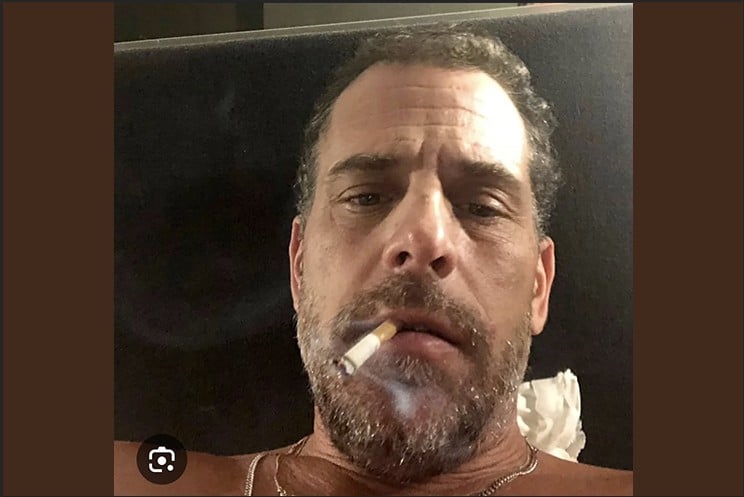
Hunter Biden is back. As Jay Stahl of Yahoo News explains:
Hunter Biden was once considered the free-wheeling “Black sheep” of his famous first family: the lost laptop-owning, crack cocaine-using, womanizing recipient of a preemptive presidential pardon.
And Biden seemingly considered all of that when publishing a series of X-rated social media posts on X (formerly Twitter) that poke fun at his past scandals. In doing so, the Beautiful Things memoirist is now a public-facing advocate for the arts and sobriety after battling drug and alcohol addiction.
Unfortunately, there’s more to Hunter’s comeback than the fawning press would have you believe, and Hunter’s tweets don’t only “poke fun at his past sandals.” Instead, they are a farrago of Oprah therapyspeak, Twelve Steps bromides, DNC talking points, deflection, and pseudo-medical nonsense. And their goal is apparent: to launder deeply shameful behavior with the cleansing waters of narcissistic recovery platitudes.
This Hunter, the man who bedded his dead brother’s wife, offers the following:
Addiction is never an excuse, but it can be an explanation. Seeking genuine forgiveness from those we have harmed is one of the hardest things to do in recovery. It’s one of the hardest things for any of us to do in life. I’ve found that, before you begin that journey, you have to first forgive yourself. I would love to hear about your experience, strength and hope today.
If you spend any amount time among Twelve Steppers, you will hear this kind of talk a lot—the notion that you need to “forgive yourself” before you can ask others to forgive you. There’s a kind of seamless logic to it that flows well and seems to make sense. The trouble with it is that it is self-serving nonsense. Hunter also adds this:
Shame is not guilt. Guilt says I did something bad. Shame says I am something bad. Guilt is appropriate. Shame is a cell with no windows. Most people use the words interchangeably. That mistake is lethal.
Bull. A sense of shame is powerful and, more than that, it is honest and necessary. Shame is the emotion that recognizes the evil acts one has committed and can lead to genuine contrition, especially among addicts who tend to compound their evil and stupid acts as a way of covering their shame. I gave up drinking in 1990, and the main thing that led me to apologize to those I had harmed or embarrassed wasn’t therapy or the Twelve Steps so much as it was my good, old-fashioned, and healthy Catholic sense of shame and embarrassment. It was recognizing and owning the harm I had done to others. Unfortunately, I also took it upon myself to write a book about my experience, as Hunter Biden did. Unlike Hunter, however, I now realize that this exercise was, itself, a dumb and selfish act—and it proved to be one that would come back to haunt me.
Assuming the annoying posture of some combination preacher-psychotherapist, a common behavior among the newly sober, Hunter confidently offers us his bullet points on recovery. Among them are:
You cannot shame someone who has already named the thing you are holding over them. Say it first. Say it in plain light. The weapon drops.
Guilt can coexist with self-respect. Shame cannot. You can hold the damage and the dignity at the same time. I know because I live there.
Nobody gets clean on a winning streak.
You have to be almost self-delusional in your forgiveness of yourself.
Again, it is important to recall as we read this that we are talking about a man who slept with his dead brother’s wife. Addiction may be a disease—although I prefer the word disorder—but it is also what too few still call it. Evil. And Hunter does not confront this evil.
This question of evil as it relates to addiction is the thrust of the new book The War Of The Gods In Addiction: C. G. Jung, Alcoholics Anonymous, and Archetypal Evil by David Schoen. Schoen challenges the overuse of therapeutic and medical language that guides any modern discussion of addiction. The book focuses on the work of psychiatrist Carl Jung, who played a pivotal role in the formation of Alcoholics Anonymous. When he wrote about addiction, Jung, whose theories launched a lot of New Age ideas about things like the meaning of dreams, comes across like an Old Testament prophet in comparison to his intellectual descendants. Importantly, Jung believed that addiction was very much a struggle between God and the Devil.
In The War of the Gods, Schoen takes that a step further, dismissing even St. Augustine as being insufficiently realistic about the objective reality and true danger of evil. Schoen, a long-time addiction counselor, argues that while genetics and biochemistry certainly play a role in addiction, there is another more powerful element present: archetypical evil. Addiction is not just a malady or habit or disease, like diabetes; it is a life destroyer, a devouring, malicious force that explodes homes, friendships, and even love itself.
Schoen writes: “Ultimately addiction swallows up and destroys creativity … the addiction ultimately wants everything burned and sacrificed on its altar alone.”
He adds,
In addiction, there is a permanent hijacking of the entire psychic system; the normal ego complex and all of its functions are as if put under a powerful diabolical spell that suspends and paralyzes them—the whole kingdom and everything in it … I cannot state strongly enough that to describe this core of addiction as a killer is not a dramatic overstatement to get your attention or an alarmist exaggeration; it is the stone-cold truth and reality of addiction.
For his part, Carl Jung grew interested in alcoholism sometime in the 1920s. One of his patients, an investment banker named Rowland Hazard, came to Jung for help to stop drinking but could not find a way to stay sober. Jung told Hazard that his case was more or less hopeless—only one shot was available to him: a religious conversion. Jung added that conversion experiences were rare but, according to Alcoholics Anonymous (AA) founder Bill Wilson’s memoir, Jung recommended that Roland “place himself in a religious atmosphere and hope for the best.”
Hazard began to recover when he discovered a Christian organization called the Oxford Group. He got sober and then recruited a fellow drunk named Ebby T., helping him to get sober by the same process. Ebby then encountered his old friend, the alcoholic stock speculator Bill Wilson. After a powerful religious experience where he was blinded with a white light and claimed he stood in the presence of God, Wilson founded AA. The group and its culture have permeated modern life, from Oprah Winfrey to the political class, but it has devolved a great deal from Wilson’s own encounter with God. Twelve Steppers today recognize a “higher power” that helps them stay sober and get through daily life, but this power can be understood as anything—the Christian God, Buddha, a loved one, or even a dog.
This softer approach to God is intended to help get resentful and disbelieving drunks under the tent, and perhaps it does that much. But what has been forgotten once they get there is that Bill Wilson and Carl Jung were prescribing much stronger stuff. The great white light Wilson claimed to have seen and felt and, indeed, religious belief and spiritual warfare with Satan, are essential parts of any successful “program” of sobriety. Wilson wrote to Jung in 1961 to express his “great appreciation” for his efforts:
[Y]ou frankly told [Rowland] of his hopelessness, so far as any further medical or psychiatric treatment might be concerned. This candid and humble statement of yours was beyond doubt the first foundation stone upon which our Society has since been built.
Jung replied to Wilson a week later:
[Rowland’s] craving for alcohol was the equivalent, on a low level, of the spiritual thirst of our being for wholeness, expressed in medieval language: the union with God.
It is true that I consumed a lot of beer and did some dumb things in my heyday in the 1980s, but the fact that I got nowhere near Hunter’s snorting, gun-toting, hooker-hiring, influence-peddling, sister-in-law-nailing, debauched state had everything to do with a sense of shame. If Hunter Biden had any decency he, too, would be ashamed instead of searching for a way to unload that emotion.
Jung wrote:
I am strongly convinced that the evil principle prevailing in this world leads the unrecognized spiritual need into perdition if it is not counteracted either by real religious insight or by the protective wall of human community … An ordinary man, not protected by an action from above and isolated in society, cannot resist the power of evil, which is called very aptly the Devil. But the use of such words arouses so many mistakes that one can only keep aloof from them as much as possible.
Jung observed further that
[the word] “alcohol” in Latin is spiritus, and you use the same word for the highest religious experience as well as for the most depraving poison. The helpful formula therefore is: spiritus contra spiritum.
Scientists have long-since dismissed concerns about the Devil and inserted instead inquiries into things like genetic risk to explain the malady of addiction. The language and philosophy of modern Twelve Step culture is filled with medical terms and nonjudgmental self-help clichés about being true to oneself, taking things one day at a time, and how deep down we’re all good people. This argot is a faint echo of St. Augustine, who considered evil privatio boni, or the absence of the good.
In War of the Gods, Schoen isn’t having it:
St. Augustine’s theory ignores aspects of scripture—the Devil, Lucifer, the fallen angels, and hell—that argue for a different, less humanely subjective conclusion … [he] reduces evil to the purely subjective human realm, which has influenced and encouraged many believers and nonbelievers to dismiss the existence of Satan and the Devil ever since, or at least to minimize and deny the reality of the phenomenon that these mythic images represent.
“Radical honesty does not give you back who you were,” Hunter Biden preaches. “It hands you the clean slate of who you always wanted to be. The mask comes off. The cartoon other people drew of you stays on the page.”
Yet radical honesty, in fact, can give you back who you were. Before I started drinking, up until the dark final years of my addiction, I was mostly a conscientious and kind, if flawed, person. That person returned when I put the bottle down. Of course, even at my worst I was no match for the coke-snorting, gun-toting, sister-in-law-nailing, and influence-peddling Robert Hunter Biden. By dismissing evil, not to mention his propensity to sell policies and beliefs that promote evil, Hunter Biden dismisses the possibility of real recovery. If he weren’t a Biden, he would be ashamed.
Leave a Reply