There are countless eras in music history that might deserve to be called revolutionary: Mahler’s Symphony No.5, the hypnotic explorations of La Monte Young, the punishing sonic intensity of the first Swans record, Nas’s “Illmatic” at the height of hip-hop’s golden age, and the emergence of Slayer and, with it, the birth of thrash metal. As a lifelong music nerd, I’ve spent years chasing those moments when music changes everything. For me, one such moment came unexpectedly when I first heard the Carter Family on an old radio aboard a fishing boat in the Atlantic, a few miles off the coast of Nova Scotia. Years later, sifting through dusty records in my cramped apartment, I realized that revolution had taken place in 1927.
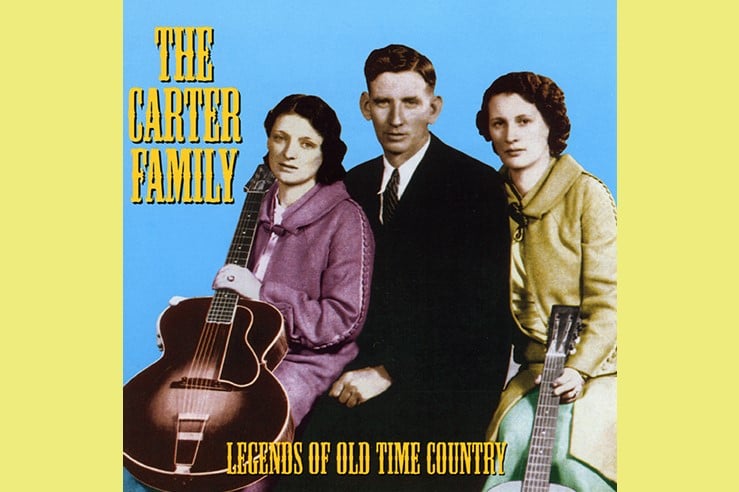
In a makeshift recording studio in Bristol, Tennessee, a quiet trio from Maces Spring, Virginia, stood before a microphone and, without realizing it, laid the foundation for what would become country music. The Carter Family—A.P, his wife, and his sister-in-law, Maybelle—didn’t just play songs; they defined an entire genre. More importantly, they captured a sense of lonely, earthy beauty that still pulls at my heart every time I hear those old recordings.
In July 1927, Ralph Peer, a talent scout for the Victor Talking Machine Company, placed an ad in local newspapers seeking musicians from the mountains. A.P. Carter persuaded a pregnant Sara and a teenage Maybelle to accompany him on the arduous journey across the mountains to Bristol.
During the Bristol sessions, the trio recorded songs such as “Bury Me Under the Weeping Willow Tree.” While other groups, such as The Skillet Lickers, played up hillbilly stereotypes, the Carters brought something different: a haunting sincerity. Sometimes, when I listen to Sara’s deep, resonant voice, I close my eyes and imagine my own grandparents sitting around the radio, transported by these same sounds. Her voice feels like a message from a vanished world, but also like a thread tying me to my own.
If A.P. was the architect and Sara was the soul, then Maybelle was the engine. Before the Carter Family emerged, the guitar was generally regarded as a background rhythm instrument. Maybelle changed everything with her now-universal technique called the Carter Scratch.
By picking out the melody on the bass strings with her thumb while strumming rhythm on the treble strings with her index finger, Maybelle made the guitar a lead instrument. This innovation turned the guitar into a solo powerhouse. There is a spellbinding moment in the intro to Wildwood Flower—in Maybelle’s playing, I hear the DNA of almost every flat-picking style since, from Woody Guthrie to Johnny Cash’s “boom-chicka-boom.”
The Carter Family’s legacy is not only about their playing style, but also about the songs they chose to share. A.P. Carter was among the first American “song catchers” traveling Appalachian backroads to gather fragments of old hymns and British ballads. However, it was his collaboration with Lesley “Esley” Riddle, a black guitarist, that revealed the true depth of their sound. Riddle had an incredible memory, nicknamed the human tape recorder, learning the melodies of spirituals and work songs from black churches and labor fields. These were songs that A.P. would later adapt for the radio.
This blending of traditions is echoed in the Library of Congress field recordings captured by John and Alan Lomax. When I listen to those archival recordings of slavery-era field hollers, I hear the same haunting, bare-bones sound that is present in Carter’s early music. There is a raw, transcendent beauty in songs like “Long John,” recorded in 1934 at the Darrington State Prison Farm in Texas. Sung by a convict known as “Lightning” and his fellow black inmates, the song is driven by the sharp rhythmic crack of axes. These work songs depended on their steady, repetitive rhythms to keep pace with the hard labor of breaking rocks or felling trees.
To me, there is a direct line from the rhythmic thump of Maybelle’s thumb-picking to the heavy, synchronized strikes of Lightning’s axe. Both were recorded with portable single-microphone setups, set amid the vast open Appalachian wilderness, giving them an unfiltered atmosphere that prioritizes soul over polish. They sound like two sides of the same acoustic coin—echoes of isolation, grit, and resilience from the rural South; just as powerful and timeless now as when recorded. What amazes me most is how this music, created in faraway fields and back porches nearly a century ago, finds a home in my heart thousands of miles from where it was recorded.
In the late 1930s, the family moved to Texas to perform on XER, a “border blaster” radio station with a powerful radio transmitter just across the Mexican border. The station broadcast at enormous wattages, far beyond what was allowed in the United States, and the Carter Family’s music reached listeners throughout North America, from California to New York. This exposure helped turn their mountain music into a national soundtrack.
Nearly a century later, I return to the Carter Family’s music to escape the pressures of modern life. In a world awash in generic pop, auto-tuned slop, and AI-generated country, playing one of their crackly old records feels like rebellion. The Carters remain my gold standard for authenticity—in sharp contrast to an age defined by instant gratification and atomized individualism.
As we approach the centennial of the Bristol Sessions, the Carter Family stands as proof that the most lasting music isn’t always the most complex. Their songs were built on simple three-part harmonies, a Gibson L5 guitar, and the honest stories from the working class. They transformed the private music of Appalachian cabins and coal camps into something the whole world could hear—without losing its sense of intimacy. With my feet up and two fingers of Jack Daniel’s in hand, I let these melancholic songs of love, loss, anguish, and heartbreak drift through the room. The spirit of the Carter Family lingers—keeping me on the sunny side, their music always reminding me of home.
Carter Family Values
Leave a Reply