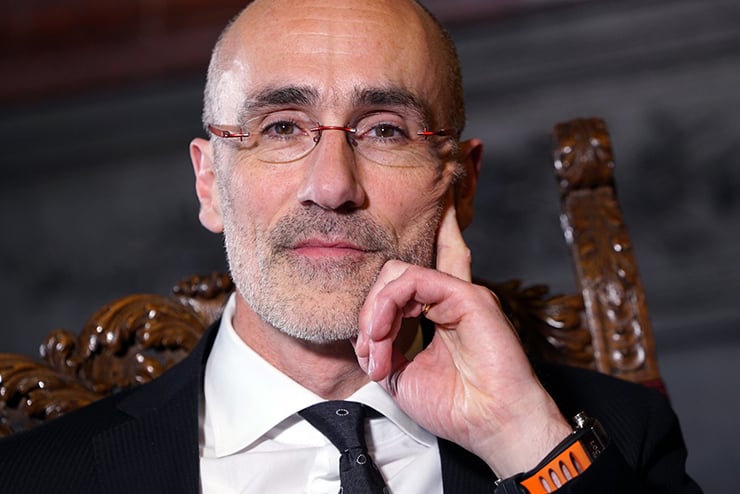
Arthur C. Brooks, one-time president of the American Enterprise Institute (AEI), has a new book out. The Meaning of Your Life: Finding Purpose in an Age of Emptiness is the latest in his series of self-help volumes that purport to use social science alongside the usual motivational talk and New Age Oprah clichés to enable “human flourishing.”
Brooks was once considered a conservative, writing books such as The Conservative Heart and serving as AEI’s president from 2009 to 2019. Now he is pals with Oprah Winfrey and has even coauthored a book with her: Build the Life You Want: The Art and Science of Getting Happier. He has certainly built the life he wants by pounding the theme of “happiness” and other pop psychology notions into a glittering empire. Brooks has gone from policy wonk to positivity guru, charging $100,000 a pop for speaking engagements and teaching highly popular classes at Harvard on how to attain happiness.
If I may offer a bit of self-help advice to readers: Stay away from Arthur C. Brooks.
Brooks has made a lot of money offering soporific platitudes, but his latest works are remarkable for studiously avoiding core truths about the nature of evil.
A convert to Catholicism at age 15, Brooks quickly retreated from conservatism when Donald Trump arrived on the scene and put forward serious plans to address the problems Brooks was being paid merely to examine at AEI.
Rather than dedicate himself to writing serious books on theology, however, Brooks appears to have been caught up in California spiritual vapor.
Take one example from his new book, The Meaning of Life:
Today in our ultra-engineered, technologized world, [finding love, purpose, and meaning] is no longer ordinary. We must seek these parts of life on purpose, and there are no shortcuts. You don’t get them by buying a device, taking a supplement, or listening to beta-wave noises while you fall asleep. That won’t work. What will work is making a concerted choice to avoid devices; to see and pursue your relationships and experiences in an old-fashioned way; to force yourself to grapple with the transcendental, philosophical, spiritual parts of life where happiness truly lies.
In other words, put down your phone and go outside. To drive home this supposed deep insight, Brooks recalls an encounter he had with “a young striver” named Marc:
Marc, age 32, is exactly what you would conjure up in your mind if I asked you to imagine a textbook striver: He’s college-educated, hardworking, and healthy. His parents broke up when he was young, and they never had much money, but Marc avoided trouble, went to a small state college, and landed an excellent job as a data analyst. He eats right, and exercises a lot.
Brooks went on to say about his encounter with Marc that “something sounded off. As he described his carefully managed accomplishments, his voice was hollow, as though he were describing a scenario he didn’t really believe. Pressed to go deeper, he said: My life feels empty.’”
To describe what was missing, Marc told a story. A year earlier, he had gone on a first date with a woman he had met online. On the date, she mentioned that her garbage disposal was clogged. Marc “fixed it for her that very evening.” This gave him “a deep sense of satisfaction.” However, later, at his own apartment, Marc “remembered that his own garbage disposal was clogged as well. The fix was easy, but he had just never gotten around to doing anything about it. A year later, he still hasn’t.”
Leaving aside for a minute that I don’t believe this story or that Marc even exists, it’s incredible how this anecdote, and the Brooks prescription for solving it, is something even a 10-year-old could figure out. Don’t be lazy. Chase the girl. Fix your sink when it breaks. Don’t live through screens.
Really? Is this advice worth 100 grand a speech?
One of the hard questions Brooks largely ignores is the nature of evil—something that must be confronted if a human being is to attain serenity. Its absence is notable given the religious experience Brooks had in 1979, and noted in an article in America magazine:
At age 15, I visited the shrine of Our Lady of Guadalupe as part of a school band trip to Mexico. I had no connections to the Catholic Church at the time; I am not sure I knew any Catholics at all. But from within a crowd of teenagers on a forced march through a boring old church, I looked up at the image of the Blessed Virgin on the famous tilma, which still hangs in the shrine. I did not fall into a rapturous trance. I was not overcome by sweeping emotion. But a simple observation captured my imagination and lodged in my memory: Mary was appearing to me.
“People often mistake their imagination for their heart,” wrote Blaise Pascal, “and so often are convinced they are converted as soon as they start thinking of becoming converted.” It is true that Mary did not convert me in that singular moment. But the image stuck in my mind. A few months later, I started the conversion process at my local parish in Seattle. My Protestant parents were mildly chagrined but quickly recognized that if this was my teenage rebellion, Catholicism was probably better than drugs. I entered the church at 16 and began the great spiritual adventure of my life.
You’d think that the appearance of the Blessed Mother would trigger a lifetime of devotion, contemplation, and writing on the teachings of the Catholic Church. But Brooks took a different path.
In his 20s Brooks had trouble in school, so he went to Spain to be a musician. He returned, attended Thomas Edison State College (a distance-learning college), and then went on to the RAND Graduate School in California. After that, he taught at Georgia State University and Syracuse, then at AEI and Harvard. It’s either impressive or sketchy as hell that Brooks went from almost dropping out of school to becoming the president of a leading conservative think tank.
However, with the arrival of Trump, Brooks was faced with an existential problem. The passive, position-paper ethos of the AEI conservatives—exemplified by people like Mitt Romney, Matthew Continetti, Jonah Goldberg, and David Frum—was suddenly under attack by a populist right that had grown weary of talk that did not translate into action. They wanted to deport illegals, root out fraud, sandblast wokeness, and look at the world as it really is. They wanted to solve problems, not host friendly debates with people they believed were destroying their country.
In 2017, Brooks gave a speech at the annual prayer breakfast in Washington, D.C. Trump was in the audience. Brooks ladled out his message of human flourishing and “loving your enemies.” He exhorted Trump to follow the words of Jesus. After Brooks took his seat on the dais, Trump stepped up to the mic. “Arthur, I don’t know if I agree with you—and I don’t know if Arthur is going to like what I’m going to say,” Trump said, before ripping into the “very dishonest and corrupt people” who had “done everything possible to destroy us, and by so doing, very badly hurt our nation.” “They know what they are doing is wrong,” Trump went on, “but they put themselves far ahead of our great country.”
Politico described the fallout this way: “In the media firestorm that ensued, observers quickly pointed out that Trump had not just repudiated Brooks’ advice; he had questioned the teachings of Jesus Christ himself.”
To the contrary, President Trump was reminding the audience of the reality and nature of evil. Unlike Arthur Brooks, Trump rejects the lazy theology that pretends evil must be tolerated. Yes, Jesus taught us to love our enemies. He also cast out demons.
In 1978, when Arthur Brooks was still a teenager living in Seattle, M. Scott Peck published The Road Less Traveled, a book that would become a best-selling phenomenon. Although considered a classic self-help manual, which it is, The Road Less Traveled has a depth that is missing from Brooks’ The Meaning of Your Life. Here is Peck on evil:
First, I have come to conclude that evil is real. It is not the figment of the imagination of a primitive religious mind feebly attempting to explain the unknown. There really are people, and institutions made up of people, who respond with hatred in the presence of goodness and would destroy the good insofar as it is in their power to do so. They do this not with conscious malice but blindly, lacking awareness of their own evil—indeed, seeking to avoid any such awareness. As has been described of the devil in religious literature, they hate the light and instinctively will do anything to avoid it, including attempting to extinguish it. They will destroy the light in their own children and in all other beings subject to their power. Evil people hate the light because it reveals themselves to themselves.
Peck goes on to argue that “evil is laziness carried to its ultimate, extraordinary extreme.” He calls love “the antithesis of laziness.” While “ordinary laziness” is not necessarily evil, those caught up in it will:
actively rather than passively avoid extending themselves. They will take any action in their power to protect their own laziness, to preserve the integrity of their sick self. Rather than nurturing others, they will actually destroy others in this cause. If necessary, they will even kill to escape the pain of their own spiritual growth. As the integrity of their sick self is threatened by the spiritual health of those around them, they will seek by all manner of means to crush and demolish the spiritual health that may exist near them.
Is there a better description of the modern American left anywhere?
Arthur Brooks’ error cannot be described as demonic evil, but there is something about the way he dismisses the left’s evil that is so slothful that it approaches this other kind of evil. Brooks does not act in a way that actively attacks America’s spiritual health, but he preaches acceptance to the point that it smothers truth with incense and mantras, leaving us unable to confront the things that ail us. Here are some deep thoughts from Brooks:
There is evidence that as we become less exposed to opposing viewpoints, we become less logically competent as people.
The more control you have over your life, the more responsible you feel for your own success—or failure.
Satisfaction comes not from chasing bigger and bigger things, but paying attention to smaller and smaller things.
The first two are obvious, and the last one isn’t even true—doesn’t Brooks advise young people like Marc to go for big things—the right girl, a good job, a passion project? Taking those steps would require aspiration, guts, and a desire for something bigger, not smaller. It’s all just so much contradictory New Age pap—go outside and live in the real world, attain happiness, and live your best life, but don’t chase bigger things, don’t worry about success, and be happy with where you are while passively pursuing your dreams. It makes Joel Osteen look like Dietrich von Hildebrand.
Brooks was once asked by Politico if, “knowing what he knows now—about the limits of public policy, the trajectory of the conservative movement, the pessimistic mood of the country—does he look back differently on his work at AEI?” Brooks, America’s newest Dale Carnegie, waffled:
“I was honored to do that stuff for AEI. I think that we helped the country and help the world and set things forward and did good things.” He paused as a smile spread across his face. “But now I’m in the zone, man. I’m in the zone.”
He’s in the money, too.
Leave a Reply