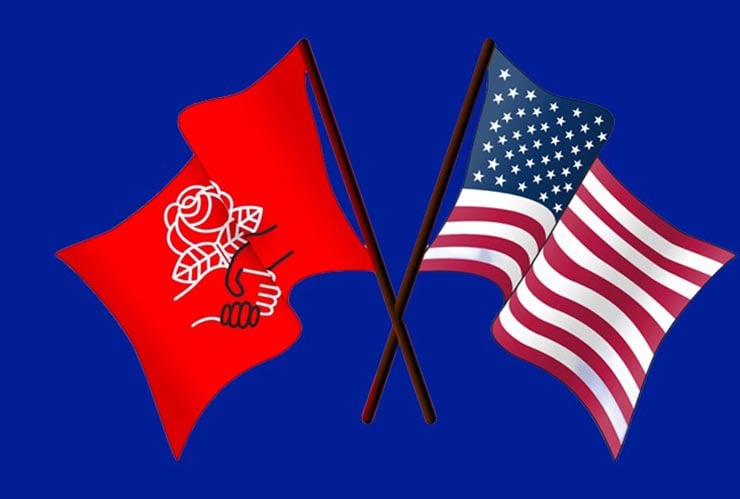
Since it is the party out of power, the Democrats and the American left would seem to hold all the cards in the coming elections. It can blame the right for higher costs, world instability, and other problems. The corporate leftist media are on the offensive, highlighting every problem relentlessly.
Yet, weirdly, the momentum does not appear to be on either side. In fact, the Democratic Party is polling lower than the Republican Party among swing voters who will ultimately decide the coming elections, now and in 2028.
Some party insiders have characterized the fight inside the Democratic Party as a civil war erupting at exactly the wrong time for the establishment. As the Democratic Socialists of America (DSA) come to prominence, its candidates are running as Democrats and winning primary elections in safe districts against establishment candidates. Once in office, the new socialist candidates mean to change the dynamics of our politics.
Pro-Democrat strategists see the dangers of a reaction to radical candidates that could endanger the party. The “socialist” label is still anathema to countless (especially older) Americans who rightly see that harmful ideology as the path to ruin. However, the socialists are not intimidated by old-timers, insisting that their skewed “woke” vision of society is America’s only hope.
Most leftists of this variety hold firm to woke positions on procured abortion, mass illegal immigration, unprosecuted crime, transgender “rights,” apocalyptic ecology, and other very left-wing issues. They hold these positions as non-negotiables because they are integral to their ideology.
The Democratic Party establishment, on the other hand, is a bit more moderate—or, at least open to negotiations that deny them immediate total victory. While sympathizing with leftist goals, they may be more willing to question the timing, degree, and speed of the proposed changes. So while they don’t really differ in kind from their more radical brethren, they are more inclined to say “not now” and “not so much” if they sense it is required to maintain their hold on power.
As a means to victory, these more moderate members are asking the radicals to tone down their message and adopt ambiguous language with wider appeal. They ask of their DSA counterparts a certain measure of dishonesty by demanding they assent to opinions that are contrary to their true beliefs. Many radicals feel they are being thrown under the bus.
Thus, for example, Thomas Edsall of The New York Times pleads with the Democratic faithful to stand behind “reasonable” planks to the party’s platform on such key issues as immigration, crime, and transgenderism. He calls upon the party to “perform a kind of brutal surgery on itself,” make “a public renunciation” of its liabilities, and carry out an “ideological exorcism” of its leftist program.
His message seems to be that Democrats, if they really want to win, need to stop being Democrats—at least for a while. They must hide or postpone their revolution.
Some of the Edsall proposals are frankly shocking, since they are so contrary to what has long been the left’s program. This is bound to only cause understandable dismay among younger, radical (which is to say, more honest) Democrats who feel betrayed.
For example, the Edsall proposals call for renouncing open borders and working together with Republicans on firmly enforced laws regarding illegal immigration and deportation of those “unauthorized” immigrants who commit crimes.
They call for aggressively prosecuting those accused of violent crime, restoring some bail requirements, and imposing more life sentences. They even favor jury-decided death penalties in states where the death penalty is supported—a position that would put these Democrats well to the right of America’s Catholic bishops.
Regarding the transgender issue, Edsall asks Democrats to admit that there are two sexes: male and female. People can claim an identity as another sex; however, such claims should not be allowed to alter reality or the scientific categorization of their biological sex. When unfair, sports teams should be allowed to exclude those who identify with the sex contrary to the one they were born with. Gender-affirming treatments should be banned for all under 18, Edsall proposes, since convincing studies reveal great harm deriving from them.
Other recommendations call for support of the free market and a repudiation of socialism.
Such proposals reflect some notions of common sense on the part of those in the party who have awakened to the fact that “woke” does not work. Moderate, third-way Democrats are advocating these kinds of changes since they wish to shed the Democrats’ “kind of crazy” image. The unreasonable desire to maintain a rigid ideological orthodoxy on pronouns, for example, often makes the they/them Democrats “sound weird, not empathetic.” The ghosts of “defund-the-police” activists calling for even more chaos during the 2020 BLM riots still linger.
Many other Democratic strategists echo the proposals of Thomas Edsall. People like James Carville have long been saying that the woke agenda is a creation of an academic elite disconnected from the working class. His message: The pace of things is too fast. Slow it down.
The National Catholic Reporter’s Jacobin writer, Michael Sean Winters, likewise urges restraint on the long march to power. His columns are full of advice to the pro-abortion Democratic Party, which he sees as an extension of the Church’s social justice movement.
He believes that the Democrats need to bring common sense to the culture wars if they are to advance. “Even if the Democrats hit a home run on economics, they also need to step back from the cultural extremism they have embraced in recent years,” he wrote in a June column.
The virtue signaling “crazy” positions energize the radical left but have proven disastrous at the polls. As The New York Times’ Ezra Klein noted in a recent essay:
Democrats became more uncompromising on immigration and lost support among Hispanic voters. They moved left on guns and student loans and climate, and lost ground with young voters. They moved left on race and lost ground with Black voters. They moved left on education and lost ground with Asian American voters. They moved left on economics and lost ground with working-class voters.
In truth, the Democrats’ problem is not how they present their liberal ideas. It is the ideas themselves that are turning off voters, especially as the party’s radical elements spell out in more honest detail a frightening agenda voters are not yet ready to embrace.
Their liberal philosophy calls for an evolving process of ever-more unrestraint. Over the years, this leftward march has gradually overturned the healthy restraints of morals, family bonds, community norms, and religious obligations.
The leftist drive to satisfy unbridled passion constantly demands concessions to the point that not even the restraint of sexual identity can be tolerated. So, yes, the left is moving too fast and too soon. Worse yet, the left cannot retreat.
Thus, the left finds itself in a dilemma. Neither radicals nor moderates dispute the core principles of radical equality that motivate them. They disagree on methods and speed. Moreover, they need the dynamism of this destructive process of unrestraint to energize their activists and many sympathizers. At the same time, the Democratic establishment needs “reasonable” moderation to appeal to the center that is rightly frightened by the rabid Jacobins.
To win, the Democrats need both energy and moderation. But these things work against one another in the case of the left. Each faction tends to suppress the other. Both cannot be satisfied at the same time and yet neither one is large enough to prevail. The vain attempt to carry out an ideological exorcism on the party—should it be even temporarily successful—will prove to be an existential event, forcing the left to abandon its radical identity.
The right suffers from a similar dilemma. The only way out for America is a return to Christian principles, morals, and order.
Leave a Reply