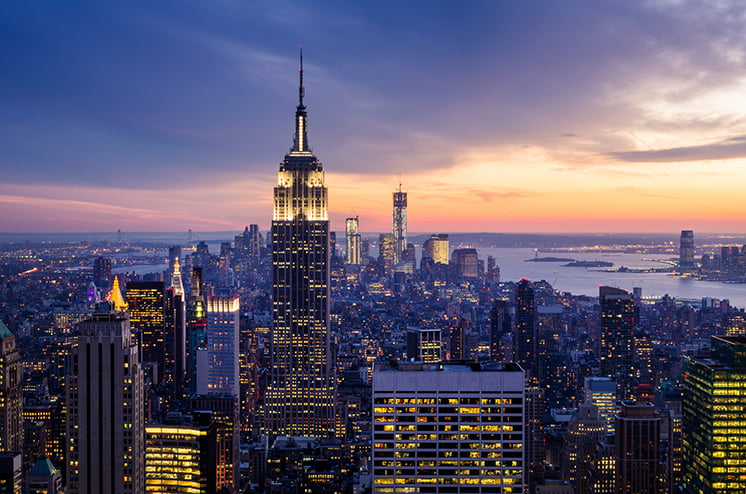
Earlier this month, I stood beneath the towering frame of the Empire State Building in Midtown Manhattan and something my friend Mark, a New Yorker, once told me immediately came to mind: People still travel from across the world to see the ruins of Rome, not because of anything Rome is doing today, but because its past, its achievements, its ascendancy in order and architecture, remain worthy of awe.
Of course, the Empire State Building is not a ruin. It still stands, unbroken and defiant, but increasingly it feels a monument—an artifact of a civilization at its height, now surrounded by signs of cultural and civilizational decline.
Ninety-five years ago, at its dedication, President Herbert Hoover pressed a button in Washington, D.C., which lit up and marked the official opening of the Empire State Building—then the tallest building in the world and a triumph of American engineering and ambition. Constructed in just 13 months during the depths of the Great Depression and following the hard, clean lines of Art Deco confidence, the skyscraper rose 1,250 feet (now reaching 1,454 to the tip of its antenna spire), boasting 102 stories and holding the title of the tallest structure on earth for a longer period than any modern building since. Designed in part to serve as a dirigible mooring mast, the skyscraper symbolized a nation unafraid to dream at scale. With its record-breaking height, rapid construction, and enduring architectural elegance, the Empire State Building quickly became not only an icon of New York City but also a lasting testament to the world of what American ingenuity and confidence could achieve—even in times of profound hardship.
To stand there now is to feel both wonder and grief. Wonder, because the building is still magnificent. Grief, because so much of the city around it seems to have forgotten the moral and cultural order that made such magnificence possible. The Empire State Building is not a ruin. It is not decaying. It is not embarrassed by its own greatness. It still rises. It still gleams. It still tells the passerby that civilization is supposed to ascend. But it now stands in a city too often marked by disorder, decadence, civic cowardice, ideological exhaustion, and leadership that treats inheritance as a burden rather than a blessing.
New York was once the focal point of Western civilization in the New World. It was the city of finance, publishing, architecture, fashion, industry, orderly and legal immigration, aspiration, and ruthless creative energy. Though it was not always gentle, and it was never innocent, still it had vitality. Builders built. Merchants traded. Editors argued. Immigrants assimilated. Artists sharpened their crafts. Men and women came there to make something of themselves, including my grandmother, who arrived in the city from rural North Carolina in the 1950s as an airline stewardess for Pan Am. The city expected greatness because the civilization behind it still believed greatness was real.
That world produced men like Donald Trump. Whatever one thinks of him, Trump never lost the New Yorker in his soul. In addition to being the nation’s chief executive, the president recently proudly described himself as a builder. He said, “I have a construction job, which is really like relaxation for me because I have been doing it all my life.” He came out of the city of cranes, lobbies, deals, marble, brass, tabloids, concrete, and skyline. He understands buildings are statements.
A building says something about the people who built it. A capital city says something about the nation that it represents. That is why Trump’s strong instinct to beautify Washington, D.C. matters. The proposed ballroom, the talk of arches, the restoration of parks and Lafayette Square, the insistence on order in the streets, and the willingness to use the National Guard to restore safety all come from the same basic conviction: a great country should look, feel, and govern itself like a great country.
The contrast between this attitude and that of the new left, with its growing affinity for Marxists and Islamists (the so-called Red-Green alliance), could not be clearer. The Mamdanis of the world do not dream in stone, steel, cornices, arches, monuments, and boulevards. They dream in control. They want a city of managed scarcity, rent freezes, public dependency, politicized services, ideological patronage, anti-police sentiment, anti-car schemes, government grocery stores, subsidized resentment, and permanent grievance. They do not seek to build a civilization worthy of free men and women. They seek to administer decline in the name of some deranged understanding of justice.
The question is not whether a public official is Christian, Jewish, Muslim, Hindu, or nothing at all. The question is whether he loves the civilization he has been entrusted to govern. A city can survive many things. It can survive corruption, recession, bad mayors, crime waves, and even ideological fashions. What it cannot endure forever is leadership that despises the cultural inheritance it occupies. New York cannot remain New York if its ruling class sees Western civilization as a crime scene, commerce as exploitation, history as victimhood, policing as oppression, beauty as elitism, and ordinary public safety as unnecessary.
This shift is not confined to policy but is inherently an existential and civilizational question. It is visible even in the buildings themselves. Since the brutalist turn of the 20th century, much of modern architecture has abandoned the upward-looking spirit that was once the calling card of the West. Where earlier generations built to elevate toward beauty, proportion, permanence, and transcendence to the divine, the contemporary liberal world builds to contain, to manage, and to level. Glass boxes and concrete slabs replace ornament and aspiration, stripping away meaning. The result is not advancement or renewal but regression: an architecture that no longer seeks to lift the soul but to flatten it, no longer ascending but descending, no longer transcending but merely existing.
The Empire State Building was not built by men who hated their country. It was not built by men who believed America needed to apologize for its existence. It was not built by men who thought ambition was a social disease or that excellence had to be dismantled in the name of equity. It was built by a civilization still confident enough to reach ever upward. Even in the midst of the Great Depression, America had not yet accepted the idea that decline was wisdom.
That is what struck me most as I stood there on the anniversary of its opening. The building is not just tall. It belongs to a world in which form followed purpose, labor had dignity, craftsmanship mattered, and the future was something to be conquered rather than feared. The men who raised it were not waiting for permission from a diversity consultant, a climate committee, a grievance caucus, or a municipal task force on inclusive urban feeling. They had a plan, a deadline, a hierarchy, a purpose, and a skyline to change.
New York’s tragedy is not that it lacks money. It has money in abundance. It is not that it lacks talent. Talent still floods in from every corner of the earth. Its tragedy is that too many of its leaders no longer know what money and talent are for. They know how to redistribute, regulate, denounce, apologize, subsidize, and rename. They do not know how to build. They do not know how to inspire. They do not know how to summon individuals to greatness. They do not even seem comfortable with the word.
And yet the Empire State Building still stands.
That is the mercy of monuments. They outlast bad ideas. They preserve truths that living elites forget. They remind us that our ancestors were not always fools, that beauty is not oppression, that order is not cruelty, that ambition is not greed, and that civilization must be maintained by people who believe in it. The Empire State Building is a rebuke to every woke and weaponized ideologue from the school of managed decline. It says, without speaking, that America was made for more than supervised decay.
At least the pizza is still good in New York. Though with inflation, disorder, and the steady war against the businessmen in the city, one wonders how long even that will last. A city that cannot protect its streets, honor its builders, respect the business owners who create its jobs, or admire its own monuments will eventually find a way to ruin even the simplest pleasures.
Still, I left the Empire State Building strangely encouraged. Not because New York is healthy. It is not. Not because the men now governing it are worthy of its inheritance. Many are not. I was encouraged because the building remains. It has seen depression, war, blackout, terror, corruption, bankruptcy, crime, decadence, and cultural madness. It has endured them all. It still points ever upward.
That is what America must do again. Build upward. Govern upward. Pray upward. Beautify upward. Remember upward. The Empire State Building was born in a moment of national pain, but it did not imitate the pain. It defied it. That is the lesson. A civilization is not restored by accepting ugliness, disorder, and decline as inevitable. It is restored when men recover the confidence to build things that deserve to outlast them.
Leave a Reply