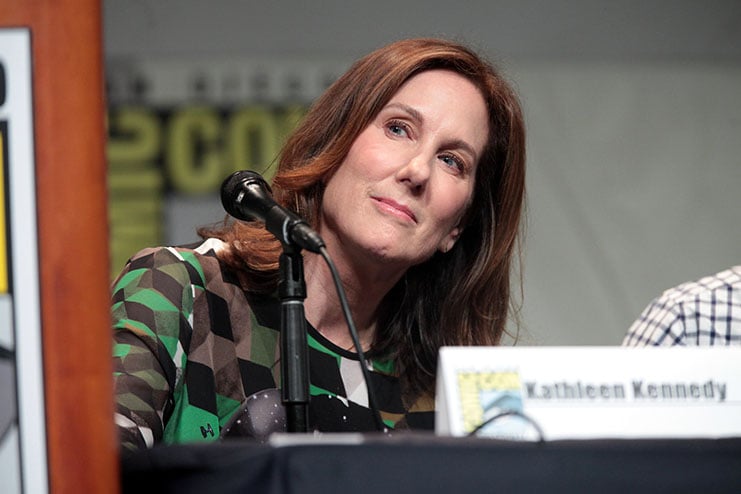
Kathleen Kennedy announced her exit from Lucasfilm last week after 14 years serving as president of the studio. Given that she is the woman who destroyed the beloved legacy of the Star Wars franchise, all I can say is: Good riddance! Unfortunately, however, her departure does not mean the studio has given up on pushing cultural leftism.
Kennedy became president of Lucasfilm in 2012 after Disney acquired the company from Star Wars creator George Lucas. She was a natural choice, having produced many blockbusters that left a lasting impact on American culture: E.T., Jurassic Park, and The Sixth Sense, to name just a few. But as the political winds shifted in the early 2010s, Kennedy became one of the most prominent figures in Hollywood’s culture war against conservative America.
As head of Lucasfilm, Kennedy produced five feature films meant to continue the Star Wars saga alongside several made-for-streaming television shows. She played a key role in revitalizing the franchise for what was euphemistically called the “modern audience.” In fact, this rhetoric was just the studio’s cover for embracing the most toxic left-wing fads of the day. The conventional wisdom was that unless filmmakers catered to diversity, equity, and inclusion, films would flop. Kennedy’s run at Lucasfilm was a long and painful exercise in proving the opposite.
Kennedy’s Star Wars overdid diversity casting, clumsily shoehorning nonwhite actors into roles that fans observed didn’t make sense. The films—hugely popular with young male audiences—moved away from strong male leads, highlighting female “girl boss” feminist protagonists instead. Fans criticized the “Mary Sue” trope, in which female characters are portrayed as so powerful and perfect they become uninteresting. Solo (2018) introduced the concept of droid-rights activism, while The Acolyte (2024) centered on a coven of lesbian witches.
Overall, the response to these films was mixed. According the review aggregator Rotten Tomatoes, professional critics mostly gushed over the early Kennedy-era projects. But after a while, even political loyalties failed to be enough to inspire stellar reviews for The Rise of Skywalker in 2019. Fan-written reviews at Letterboxd were consistently negative. And while The Force Awakens (2015) remains the highest grossing film in the domestic box office, subsequent films have had diminishing returns. Rather than take this criticism in stride, however, Kennedy took to blaming the supposed misogynistic “male-dominated” fan base for their lack of enthusiasm while consistently refusing to pivot.
None of this was immediately clear in what she told Deadline about her exit. She came off as the type of filmmaker we idealize, a storyteller who delights in the magic of movies. “My love is making movies,” she said. “I just love making things. I love the community. I love the shared experience. I love the collaboration. It’s just incredibly rewarding.” She told Deadline she was excited to move from the executive side back to a creative role outside of Lucasfilm. She even tempered her criticism of the fan base, downplaying it as just a “small percentage” that insists on being disappointed. Still, she said she “wouldn’t change anything that we’ve done over the years.”
Her words sounded like the practiced communications strategy of a savvy executive rather than someone doing some soul searching after being reviled by Star Wars fans. Rumors of her imminent departure from Lucasfilm have long swirled as the franchise descended from the box office to the streaming world, where it’s largely ignored by fans and critics alike. The interview was her attempt to reset the narrative, even as the studio remains on the same unhealthy track.
Her comments about the toxic fans of the Star Wars franchise managed to be even more offensive than her original insults. Calling her critics only a “small percentage” of the fan base is an attempt to marginalize the widespread and valid criticism she received, while pretending that the true fans actually love her work. As she put it last year, “I want to be clear. Anyone who engages in bigotry, racism, or hate speech … I don’t consider a fan.”
Star Wars has been one of the most beloved stories—and some of the most valuable intellectual property—in American popular culture for half a century. Kennedy has almost singlehandedly succeeded in making it not only culturally irrelevant but a financial disaster.
Even so, the Star Wars legacy is obviously not unsalvageable. A creative team of dedicated fans could easily set it right with a return to the spirit of the original storyline. But Kennedy’s two handpicked successors are unlikely to do that as they take control of Lucasfilm. She’s passing the torch to what Deadline referred to as her two “longtime lieutenants,” Chief Creative Officer David Filoni and fellow girl boss executive Lynwen Brennan. Unfortunately, under their tenure, Star Wars is likely to shift further left.
Leave a Reply