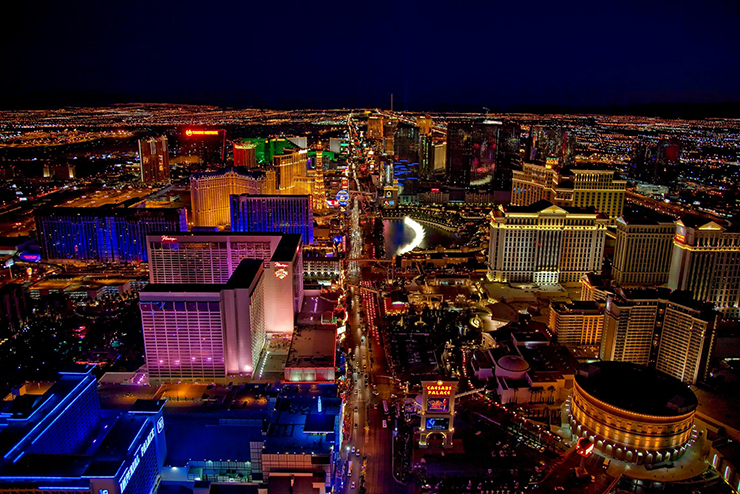
The city of Las Vegas has long promoted lifestyles that would make Caligula blush. That most controversial and American of cities, Vegas has had several iterations. Built first on gold-fever, it then added the mafia, prostitution, junk bonds, porn and video-game conventions, and then finally, and perhaps most cynically, the short-lived attempt to reform itself into a giant “family-friendly” amusement park. One might say Sin City embodies much of neoliberalism and most of what is worst about our country.
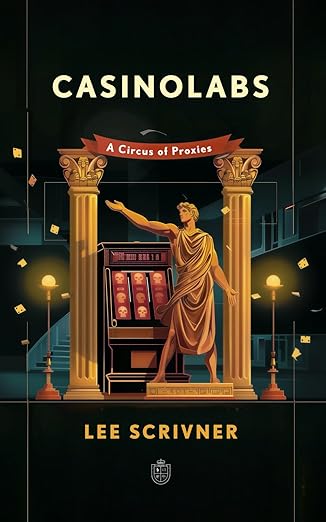
This makes it a natural setting, then, for American satire. A new novel, Casinolabs by U.S. academic Lee Scrivner, does just that, beginning with the city’s reform phase in the mid-1990s, when events like nuclear testing, another charming feature of the region and an important part of the book’s backdrop, were less of a distant memory.
The novel’s protagonist is one Morton Waterhouse, a man whose very existence seems a cosmic joke. By day, he is a lowly greeter at a Roman-themed mega-casino, wearing an ill-fitting toga and welcoming drunk, sunburnt tourists with “Hail Caesars!” By night, he retreats into the Stoic meditations of Marcus Aurelius to numb himself to the indignities of his station and the raging grudge he holds against his father, Bill,a degenerate gambler.
The book’s title comes from the name of its fictional architectural firm, Casinolabs, which promotes an all-encompassing vision of a liberal utopia. Such “thematic consultants” are imagined to be the culprits behind Vegas’s mid-’90s marketing rebrand as a place appropriate for families, which, with dark-comic hilarity, is shown in contrast with Morton’s own family’s dysfunction and the simultaneous skyrocketing of national divorce rates.
But the main mission of Casinolabs’ architects and designers is to import into the Vegas Valley all of the glorious civilizations of the past—Egypt, Renaissance Italy, Medieval Britain—and reimagine them as themed casinos: The Luxor! The Venetian! The Excalibur! In these architectural themes, history also getsrepurposed for mass consumption, devolved into a cartoon for marketing purposes, and scrubbed of all perilous, “problematic” depth by the mid-’90s equivalent of woke DEI consultants.
In this gaudy pantomime of “progress,” Scrivner finds some of his richest satire: Casinolabs’ architects, having declared war on the past, now reconstruct it as a safe space, where the marble statues of the gods and heroes of antiquity come with trigger warnings—though the real danger comes in the form of a strange new gambling device devised by Casinolabs called “Octopoker.”
Morton instinctively pushes back on these developments. When Casinolabs proposes enticing new generations of tourists with slogans like “Kids are Caesars too,” Morton scoffs at this liberal ethos of universal validation where everyone gets a trophy. Besides, why should Morton want casinos to be “safe spaces?” Wouldn’t that only make Bill, his degenerate, Boomer dad, even more comfortable and clueless as he gambles away Morton’s inheritance?
Everything changes when Morton finds himself being recruited by Casinolabs and he seizes his chance to set things right. Under Morton’s bold new vision, casinos would no longer be mere temples to brain-dead vice, instead, they would offer courses in “philosophy, ethics, aesthetics … and sandal repair.”
Of course, Morton’s Casinolabs colleagues who, unlike him, must live in the real world, find no value in his marketing pitch. But the real world of Scrivner’s novel continues to be undermined from all sides, until nothing is as it seems.
Bill, for example, has spent his life complaining of a traumatic brain injury he sustained decades ago while in the military—not fighting in Vietnam, but from a nuclear blast at the Nevada Test Site (nearly a thousand such test detonations took place around the state until they were banned in 1992). But Morton, and Bill’s psychologist, Dr. Nichols, are skeptical. Are Bill’s complaints real, or are they as fake as the Vegas casino façades? Is it a greedy ploy for military compensation, similar to Vegas’s deception-based gambling industry? Is Dr. Nichols really on the path to curing his poor client, or do his many psychological diagnoses—Munchausen syndrome, Diogenes syndrome, etc.—serve only to ensnare Bill in a web of ever more impressive-sounding psychobabble, further pathologizing his would-be normally functioning, albeit narcissistic, brain?
Like Jonathan Franzen’s novel, The Corrections, Casinolabs tries to dig down to first things—ties of kinship and duty to historical continuity amid a postmodernity of cancel culture, the amnesia of overstimulation, and perpetual novelty. Thus, not unlike Tom Wolfe’s novels, the book reminds us of what is foundational, and lays bare the contradictions inherent in liberal utopianism. Like Wolfe, Scrivner understands that the true comedy of modern life lies not in the failure of ideals, but in their success.
The progressive pieties of the ’90s—diversity as marketing strategy, history as theme park, morality expressed as a progressive slogan—are allowed to run their course until they collapse under the weight of their own absurdities. One is reminded of the novels of Douglas Coupland or Michel Houellebecq. The novel’s strength lies in its ability to expose the emptiness of sensitivity-training buzzwords like “multiculturalism” simply by showing them in action—distorted into grotesque casino-scapes, as profit-driven parodies of themselves. The result is a story that is as entertaining as it is intellectually satisfying, a rare feat in today’s cultural landscape.
Leave a Reply