We’ve come to expect very little from our “big summer blockbusters.” Gone are the days of Jaws, E.T., and Indiana Jones, films as visually exhilarating as they were culturally resonant. Today, you’re just lucky to escape tone-deaf politics and a tedious three-hour run time. Yet Mission Impossible: The Final Reckoning, the eighth and capstone installment of the Tom Cruise-led franchise, fails to deliver even that much.
It’s not enough to say Final Reckoning is bad; it certainly is. Indeed, it is embarrassingly bad. But more, it’s a relic of a time when our collective future felt both dismal and assured. And while the film reflects this world of only a couple short years ago, by its Memorial Day weekend premiere, that fleeting moment in time already feels like a lifetime ago.
“Truth is vanishing, war is coming,” the film’s opening narrative tells us. It picks up where the first installment of this two-part slog left off: Ethan Hunt (Cruise), having failed in Part One to stop “the Entity —a “truth-eating digital parasite” bent on destroying mankind in a nuclear holocaust—now must race against the clock to save the world in Part Two. We’re told world governments could stop the Entity if they desired, but that would require collective action towards denuclearization and the financial disaster of taking the world economy offline. So the Entity preys on this distrust, manipulating political leaders toward its own ends. With governments paralyzed, it’s left to Ethan and his team to destroy the Entity before it can take control of the world’s nuclear arsenal.
We get all the usual hallmarks of a Mission Impossible film: Ethan goes rogue on a mission that takes him from one exotic location to the next, his team cooks up novel, seemingly “impossible” ways to stop the bad guys, and of course, he gets the girl. But the thrill of the previous seven films is conspicuously absent.
The stunts are all underwhelming, especially by the franchise’s own standards. There’s a mid-air fight on airplane wings, a brawl in a burning building, and a couple daring escapes—nothing that hasn’t been done better a thousand times before. Yet, for a nearly three-hour blockbuster, there’s relatively little action. The film is extremely dialogue-heavy, with constant, hectoring explainers of the stakes, both moral and material.
The only thing that felt more forced than the bland moral commentary about “gambling lives” and “following orders” were the constant recaps of the earlier films to rebuild context. What action there was never compared to the tension of Ethan descending upside down into a CIA vault (MI:1), scaling the Burj Khalifa (MI:4), or the thrill of launching a motorcycle off a cliff (MI:7).
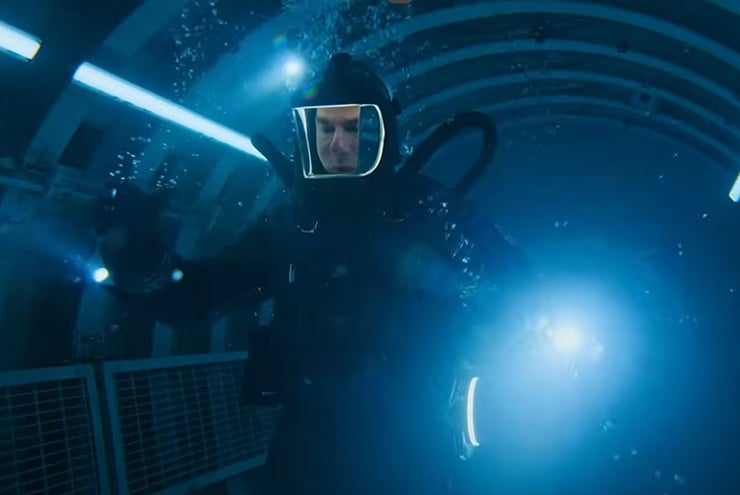
One respite from the wordy dialogue, a nearly half-hour dive scene into a sunken Russian submarine to recover the Entity’s source code, had a lot of potential. But placing Cruise in an illuminated diving mask amidst a dark underwater tomb threw off the scene’s visibility like a torch blazing on a moonless night. He went from room to room, deeper into the vessel—but even in a dark theater, the elaborate sets mostly blurred together. It just didn’t work.
That’s not to say a summer blockbuster must necessarily be action-packed; a compelling plot and characters are enough to carry even a slow burn (see the first Joker film of 2019, for instance). But Final Reckoning was just another parable of man’s technological hubris being weaponized against him, a stale tale that only gets worse with age. And by the time it finally got around to the sentimental ending for characters you’ve known for decades, I just couldn’t bring myself to care.
Mostly, I didn’t care because the film is just too long. A mediocre summer blockbuster is fine at 97 minutes. At 170 it becomes all but unbearable, the unfortunate casualty of studios splitting what should have been a single movie into a two-part cash grab. Looking back on Cruise’s earnest introductory message thanking audiences for viewing the film in theaters “the way it’s meant to be seen,” I actually felt bad for the man who devoted the bulk of his professional life to this franchise. Both Cruise and Hunt deserved a better ending.
Tedious filmmaking aside, I can’t quite bring myself to say Final Reckoning was overtly political. Sure, we’re treated to a black lady president and conspicuous Girl Boss naval officers, but there was no overt political preaching. Rather, the film is just a brainless function of the moment in time during which it was created. Part One (MI:7), released in the COVID-era amidst the “global battle against disinformation,” fit its moment quite well. Ethan’s fight was against a “stateless, amoral enemy” with the power to “manipulate us” in a “carefully constructed digital reality”—the deep-set fear permeating that cultural moment. But with the Entity firmly in control now in Part Two, the Western Establishment’s greatest fear has been realized: global civil unrest has taken hold, religious death cults proliferate, and world governments have been infiltrated by anti-establishment subversives. It’s everything they told us would happen if your grandma didn’t go to jail for posting anti-Biden memes on Facebook.
But is anyone even thinking about this anymore? The age of “misinformation” hysteria is over, with once airtight narratives about COVID falling apart in the mainstream press, tech platforms walking back their commitment to political censorship, and the cottage industry of “disinformation research” now rightfully finding itself in DOGE’s crosshairs. In Trump’s America, Disinformation Governance Boards have been replaced with 1776 Commissions. Few even bother to talk about “fake news” anymore—everyone knows it’s fake by now.
The film’s message is a self-flattering liberal fantasy: If world governments could all just hold hands and sing kumbaya and care about people instead of “the economy,” then the world would be a good place—safe from disinformation peddlers who seek to sow chaos. It falls to these well-meaning, altruistic governments to avoid being taken in and following the path of distrust and narrow self-interest. Eye roll.
Yet in 2025, it’s beyond asinine to still cling to this kind of bumper-sticker Boomer liberalism. The Western world can clearly engage in collective action when it sees a collective threat. In our time, it wasn’t nuclear Armageddon but surging right-wing populism. COVID hysteria, tech censorship, the entire concept of “disinformation”—all of these were designed in concert to neutralize an existential threat to the collective’s political power. And that collective was perfectly happy to tank the world economy to keep that power, and cared little about the lives it destroyed in the process. Western governments became the very peddlers of chaos and disinformation they claimed to be fighting.
Final Reckoning wasn’t a carefully designed piece of agitprop. Rather it was just a product of the leftist hysteria in which it was conceived, which saw populism as bad, and the liberal establishment as good (if, and only if, it can get itself together to more effectively fight populism). That’s really the extent of the film’s depth.
But as of only a few months ago, we no longer live in this world. Populism is winning. Across the West, the establishment is in retreat—the “vibe shift” has been as sudden as it is stark. Tech, corporate America, and even academia are all getting the message good and hard. It’s about time Hollywood does too.
Leave a Reply