It’s a feeling moviegoers don’t experience much anymore: that rush upon walking out of a theater and feeling somehow different. In the two hours you’ve spent in the dark, you’ve come to know characters you now care about. You’ve learned spiritual and philosophical lessons. You’ve laughed with them and even, perhaps, fallen in love.
Such was the case last December when I left the AFI Theater and Culture Center in Maryland after seeing Köln 75. It’s a movie that reminded me why I love movies. It also reminded me why so many modern movies, particularly American ones, are just so bad these days. With awards season underway and the Oscars approaching, I picked up the recently released Blu-Ray edition of Köln 75. After a second viewing I can confidentially say that this little, small-budget, independent German film by the Brooklyn writer and director, Ido Fluk, is better than any of the Best Picture contenders.
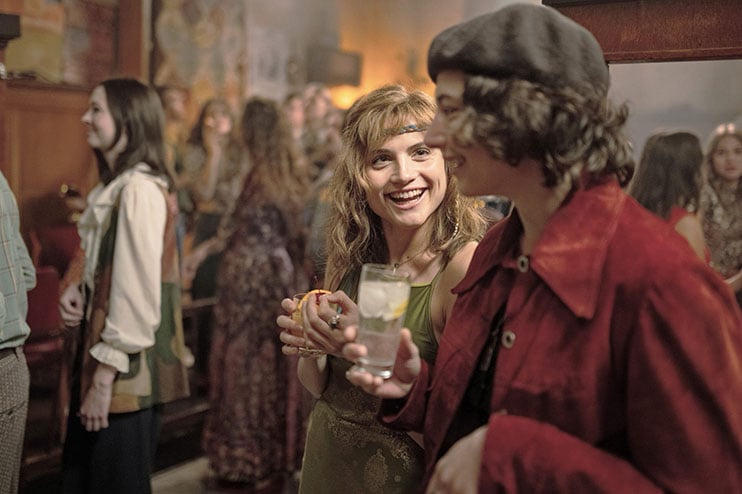
Köln 75 tells the story of Vera Brandes (Mala Emde). In 1975 Brandes was an effervescent teenager living in Germany. The hot music in that country at the time was not rock-n-roll but jazz, and at 16 years-old, Brandes is asked by saxophonist Ronnie Scott to book his next concert (she had lied to him about her age). Brandes is a natural, changing her voice to sound British, or older and more confident, and easily winning people over with her exuberance and good looks. She is surrounded by Bohemian friends and a boyfriend, and some of the characters occasionally break the fourth wall to directly address the audience. Soon Brandes is getting attention in the newspaper in sexy punk rock poses, the media’s newly minted “jazz bunny.” Her parents are not amused.
One night, Brandes sees the great jazz pianist Keith Jarrett in concert. The effect is transformative. Brades is determined to bring Jarrett (a great John Magaro) to Köln, Germany, a feat which she accomplished on Jan. 24, 1975. Entirely improvised, the show, The Köln Concert, later ends up becoming the best-selling jazz solo and piano solo album of all time.
Brandes faces every obstacle in trying to get Jarrett onto the stage, from her disapproving parents to money issues, to a piano that is so run down and decrepit that Jarrett refuses to play it. The race-against-the clock pace is electrifying, but the parts where Köln 75 slows down are just as important. Indeed, it is in these scenes tha we learn why Fluk is a superior filmmaker to most of those found at the Academy Awards.
The plot of Köln 75 is similar in many ways to the plot of the Os car favorite, Marty Supreme. In that film we have another young person obsessed with a goal and willing to ignore any obstacle to achieve it. Yet where Timothy Chalamet’s Marty is an unlikable and self-centered jerk, Mala Emde’s Vera Brandes conveys a winning and positive energy. She’s no a saint, of course, but a teenage girl who is precocious in her capacity to make a success of herself, earn money, and assert her self-confidence in the world in a way that is, almost, dangerous—but all of this is in the service of a goal that is about something bigger than herself. She aims not to serve just her own ambitions but to bring a great artist to the people because she believes in the good of the thing itself.
There is also a spiritual undercurrent to Köln 75 that most American films today are lacking—probably because their creators don’t have the theological literacy to pull it off. The film features several fantastic clips of jazz greats like Miles Davis, Count Basie, and Duke Ellington. In one clip Duke Ellington says that he doesn’t “play the piano.” Rather he spends all day “dreaming.” That is to say, his musical and creative energy is less an effort of his own will than a kind of holy dream state. This theme is touched upon in Köln 75. When Vera first sees Jarrett play, her face in the concert hall is shrouded in near total darkness, as though she is in a nocturnal dream state.
Journalist Michael Watts, played beautifully by Michael Cernus, hitches a long ride through Germany with Jarrett, telling the pianist that he loves the dream state his incredible music provides. They pull off to the side of the road and stand before a lovely field one morning and Jarrett says that he prefers to think of the music as “becoming awake”—in other words, awake in a spiritual sense. It’s dialogue that’s difficult to imagine hearing in a contemporary American film.
Also refreshing is the way Brandes and her “radical” 1975 friends are depicted. Brandes and her best friend Wanda (Shirin Lilly Eissa) are caught up in the thick of ’70s feminism, yet they are never shrill, hectoring, or dogmatic. When asked what they want by an interested male neighbor, Wanda replies that she seeks to “overthrow oppressive political systems.” She then claims that they “don’t believe in boyfriends.” Seconds later Brandes is seen embracing her boyfriend. Unlike the pedantic lecturing that just happened at the Grammys and is sure to happen at the Oscars, the makers of Köln 75 know that “revolutionary” slogans coming out of the mouths of teenagers sound more absurd than serious— Moreover, the characters themselves appear to know that, too.
Finally, of course, there is the scene where Brandes convinces Jarrett to play. John Magaro is brilliant as Jarrett, a jazz genius who is tired, dealing with an injury, and has to sell his airplane tickets for money. Jarrett refuses to play the second-rate piano he is given in Köln, but Vera eventually wears him down. Coming close to calling him a coward, she argues that he has a true opportunity to do something unpredictable and daring. The scenes are not played with the broad melodrama of today’s American films, but as honest and realistic communication between human beings.
Several years ago, a pseudonymous critic “Nerdwriter” posted an essay arguing that a fundamental problem in modern filmmaking is the insertion of “moments at the expense of scenes.” Moments are awesome, that point in the movie when things move in slow motion, or characters finally kiss, or the hero dispatches the villain. Yet truly great films also require scenes, time when the characters stop to talk, or there’s a digression that doesn’t have any action but reveals something important about a character, the feeling, as Nerdwriter says, where “anything can happen and the characters can go anywhere.” Köln 75 is thrilling because it is filled with such scenes. It is the kind of film American filmmakers once knew how to write and direct.
Leave a Reply