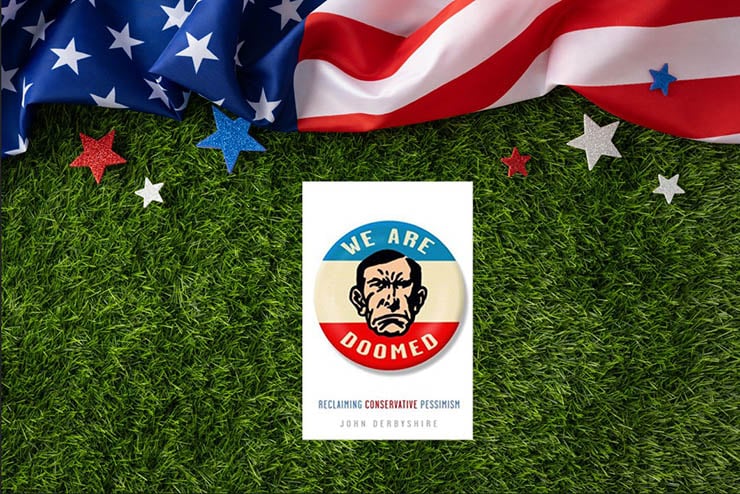
More than 15 years since its publication and as America approaches its 250th anniversary celebration, it is worth revisiting John Derbyshire’s splendid book, We Are Doomed. Derbyshire convincingly argues that conservatism has an innately pessimistic outlook. His case is quite solid, though, as he admits, it is a bit hard to stomach emotionally.
“To my kids I should like to say: I am sorry to have brought you into this mess,” he writes at the book’s conclusion. He clearly feels, as I do, that his is … well, a rather unsatisfying message to give to one’s offspring.
A decent number of Americans agree with Derbyshire. Pew Research survey results show that three of every five Americans believe that the country’s best days are behind it. That is an impressive, if depressing figure. Pew’s data gatherers nevertheless attempt a positive spin. We are “in a sour mood,” they write, but “there are … signs of optimism about the future.” I can’t find evidence in their report to support such a positive gloss on the data; to me, it looks like they are just whistling past the graveyard.
In truth, these 2026 survey results are not exactly news. If you are middle-aged or younger, Americans have been generally unenthusiastic about the state of the country for pretty much the entirety of your adult life. There was a brief period in the late 1990s and early 2000s when the percentage of those satisfied with the direction of the country slightly topped the number of those dissatisfied, but more than 60 percent of us have expressed general dissatisfaction consistently for the past 20 years. At times, the numbers of those dissatisfied get way up into the upper 70s and low 80s.
What should we think of this at the threshold of the country’s 250th birthday? Is this a semiquincentennial celebration that rightly and joyfully points us toward a bright future? Or is it more of a melancholic, nostalgic occasion permeated by the sense that the good times are gone forever?
Derbyshire’s book may help us come to grips with these questions. He neatly positions himself in opposition to the “politics of hope” as the “Hopey Changey” types define it. Such an attitude is rightly out of the question for right-wingers, who understand that America’s deepest problems—material and spiritual deprivation and suffering, as well as conflicts that threaten at every moment to spill over into overt violence—will not be solved. They are the eternal, unsolvable human problems.
Progressive efforts to solve insoluble problems only create new problems, often at least as dreadful as the original ones. Whether we can continue to mitigate the eternal problems in a way that preserves the unity of the United States is the real question, especially as so many of our fellow citizens are attached to an ideology that throws all our hard-earned prosperity into the bottomless pit of utopianism.
Perhaps we are in the last days of the grand American experiment. Hope of a political variety may well be, as Derbyshire indicates, a fool’s game.
Yet as well-constructed as the argument in We Are Doomed is, I continue to struggle against its conclusions—both in political terms and especially in the spiritual realm. The reasonable way to frame hope, I would suggest, is to look toward the divine spark in human nature, and what that promises in terms of our resilience. Most importantly, we can look to what it tells us about our trajectory not only in this fallen world but beyond it.
Derbyshire admits to having come to an unapologetic, rationalist materialism after his departure from the Anglican congregation. He goes so far along this trajectory in We Are Doomed as to argue, with plenty of detectable ambivalence, that “the winds are blowing … away from free will” and toward determinism. I do not share this part of his worldview.
I have learned more about principled conservatism from John Derbyshire than from almost any living writer, so this is not meant as a rebuke of him or his book. In political terms, I find We Are Doomed quite convincing, even as I resist its conclusion because I have young children and worry about their future in this country. Derbyshire himself expresses a similar concern for his own children. Yet, the reasonable part of me is largely persuaded that America’s best days are behind it—perhaps in the mid-20th century, as Derbyshire suggests—and that decline and eventual dissolution may lie ahead. Yet my investment in my children’s lives, in the lives of my students over the years, and in the young generally compels me to resist that conclusion. My continued participation in the political and cultural fight, and my desire to win it, arises from that tension.
The question of spiritual hope, however, is what is ultimately decisive for me. Even if the U.S. as a political experiment is doomed—and it may well be—humankind is not, at least not for the faithful.
Derbyshire ends We Are Doomed by invoking Samuel Beckett’s Happy Days, whose protagonist, Winnie, is buried up to her neck in muck yet still chirps about how happy the day is. Derbyshire presents Winnie as a “model” for us: “With low to zero expectations, we [should] soldier on.” But is it right to say that Winnie has low expectations? The Winnies I have known—especially my paternal grandmother—were devoutly Christian and therefore possessed the highest of expectations. Beckett himself was an atheist, and a bleak enough one that he reportedly could not bear to look at children because he saw only ruin and death in their futures. Yet in his play, Winnie invokes God. Without that invocation, I would suggest, it is hard to draw much sustaining energy from Winnie’s declarations that the day is happy.
Though there is not much rational reason for hope, perhaps hope was never meant to be rational. Rediscovering the proper spiritual roots of hope may soothe our anxiety over America’s political future.
Leave a Reply