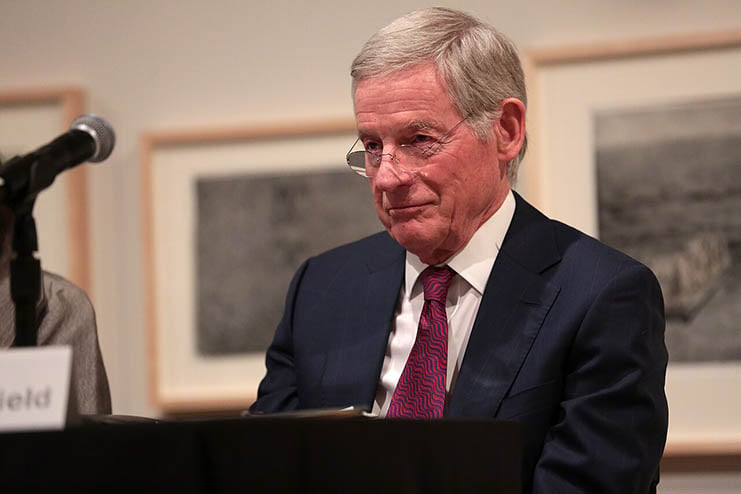
“I love Harvard wisely and not too well: just a little more than it deserves,” wrote legendary Harvard University political philosopher Harvey C. Mansfield in a 1990 review for the Public Interest, a neoconservative publication that appositely became defunct more than two decades ago. Mansfield’s review is one of 17 opinion essays included in his new book, Where Harvard Went Wrong: Fifty Years of Commentary That Fell on Deaf Ears. The review featuring his confession of undue generosity is a critique of his former dean Henry Rosovsky’s The University: An Owner’s Manual, a long since superannuated retort to the modern conservative movement’s first criticisms of academia, as found in the works of Allan Bloom, William Bennett, E. D. Hirsch Jr., and Lynne Cheney, among others.
Rosovsky counseled his fellow administrators to stand firm in defending the practical value of what American universities supposedly do and avoid politicized statements vulnerable to allegations of partisanship. That argument has echoed in recent battles between universities and the Trump administration. But as Mansfield pointed out 36 years ago and reconfirmed as recently as last year in a Harvard Crimson article included in this collection, it is the universities that have politicized themselves, while campus conservatives either remained silent or kept their objections cloying and coy.
The bold politicization, Mansfield reckons, was the product of a much bolder left. The process alienated a sizeable majority of Americans from higher education and invited significant financial and reputational consequences. The dwindling number of campus conservatives neither stood athwart history nor yelled “Stop!” while the larger movement evolved without them, asking the difficult question of what, if anything, the conservative intellectual leadership had “conserved.” Mansfield believes that Harvard “provoked—or even invited” its clash with President Trump but softens that judgment in the book’s preface to argue that the Trump administration is “hardly faultless.”
Mansfield entered Harvard as a freshman in 1949, decades before his university even thought about abandoning that gender-specific term in favor of the dehumanizing but “more inclusive” designation “first-year.” With only one brief absence, he remained at Harvard until he retired from his position as the William R. Kenan Jr. Professor of Government in 2023. Now 94 years old—with more than 70 of his years logged on Harvard’s campus—he has stored up a lifetime of bemused disappointment, captured in writing that he candidly admits has had no effect on his institution or on academia generally. Instead, he recalls that he and his ideas were treated with “polite, even genial, disdain,” usually by people who boasted that they were “inclusive.”
There are certainly worse fates for faculty members who transgress progressive orthodoxies, violate or merely find themselves accused of breaking woke speech and behavioral norms, or simply hold a different political opinion from those of their colleagues. That may be the book’s most important lesson. Mansfield was long protected by tenure, eminence, and a culture that was until relatively recently still deferential to older faculty members, even when they were white and male. But that system only worked if the few tolerated conservative faculty members conceded almost every argument, accepted virtually every change, offered no sustained resistance, and moderated any view necessary to remain welcome in the faculty lounge. More than 30 years have passed since Samuel Francis decried accommodationist conservatives with those proclivities as “beautiful losers,” but from the title of Mansfield’s book alone it is hard to conclude he was ever tempted to transcend the label.
At earlier stages of Mansfield’s career, he could advocate positions that would today almost certainly doom even the most senior professor teaching anywhere, with the possible exception of state universities in Florida or Texas. In 1986, Mansfield categorically rejected women’s studies as a Harvard field of concentration, arguing that such programs were uniformly feminist in ideology and leftist in politics and therefore the opposite of “inclusive.” But he seems to have spent much of his career avoiding confrontation in favor of what sound like Sisyphean attempts at respectful dialogue. His enthusiasm originated in his youthful observation of an exquisitely civil campus debate between a young William F. Buckley, Jr. and Harvard’s famed liberal economist John Kenneth Galbraith.
Over the course of his career, however, Mansfield learned the hard way that polite attempts to advance conservative arguments could be safely ignored. As long after the inspirational Buckley-Galbraith debate as the year 2017, he recounted in a Washington Examiner op-ed that one of his longstanding complaints was greeted with “embarrassed silence” at a Harvard faculty meeting, which the faculty then predictably “decided to do nothing” about.
Mansfield claims that he opposed only two major bugbears over his long career: affirmative action and grade inflation, both of which he eventually wrote off as “lost causes” after decades of unproductive rhetorical opposition. He expresses pleasure in the Supreme Court’s outlawing of race-based affirmative action in college admissions, which happened just after he retired in 2023, but justly takes no credit for it. He further laments that tackling grade inflation remained elusive throughout his career, for “no one yet has a plan for the collective action needed to remedy it.”
But just eight days after the book’s release, the Harvard faculty voted by a greater than two-to-one margin to advance precisely such a plan. That action was prompted by tough Trump administration critiques and not by the decades of well-mannered laments from Harvey C. Mansfield. In a possible gesture of self-effacement, he never mentions what he will likely remain most famous for: marking students’ papers with both the high inflated grade they expected and the often much lower grade he believed they deserved. That habit led him to be called “Harvey C-Minus,” generally with affection, since it was invariably the inflated grade that was recorded while the lower grades made no difference beyond grumpy assertion. His gesture, however, pales in comparison to the power of federal funding freezes.
Mansfield’s focus on affirmative action and grade inflation obscures his more prescient points on other matters that he clearly cares about. The lack of campus viewpoint diversity—which he calls a “massive error”—has bothered him for a long time, and he advocates hiring more conservative faculty to make institutions “bipartisan” since Democrats outnumber Republicans in some faculty surveys by as much as 78 to one. How this is to happen is anyone’s guess, and Mansfield offers no particular solution beyond suggesting that Harvard should “change its attitude.” Yet if they have failed to do that during his 61 years as a faculty member, it is inconceivable that they would do so now.
One might also ask Professor Mansfield the pedantic but important question of who qualifies as a “conservative.” Does that category include or exclude supporters of President Trump and, if it includes them, are there deal-breaking caveats, such as a denying the 2020 election results? These questions are not merely theoretical. In 2021, Mansfield’s student Elise Stefanik, a Harvard graduate who has credited him as a major inspiration of her political thought and who has just written her own critique of higher education, Poisoned Ivies, was unceremoniously kicked off the senior advisory committee of Harvard’s ostensibly “bipartisan” Institute of Politics. This happened precisely because she—in her official role as a sitting member of Congress—challenged the certification of the 2020 results. Mansfield made no recorded complaint then and offers none now.
Mansfield could have been much louder about what has gone wrong, or at least curated his book around its most prescient point: the urgent need for a curriculum that imparts the knowledge and skills that elite university graduates need to succeed. He has contended that point for decades, upbraiding Rosovsky, for example, for arguing that canonical works of Western civilization reflect dictates of “narrow class privilege.” Of course he was ignored, but it is hard to dispute that our graduates would do better in life and contribute more to the world if they studied aesthetics, moral philosophy, military history, American government, and natural science, among other subjects Mansfield proposed in 2004, when they were already elective, at best.
Most critics of academia appear to agree with that critique of the curriculum, perhaps with good reason, since we now have the spectacle of a sitting Democrat congresswoman, Judy Chu, who holds a Ph.D., admitting in an official hearing that she did not know who was president during World War I. The only explanation for that scandal is that the accommodating approach of conservatives like Mansfield has delivered, for at least the last 50 years, nothing short of catastrophic defeat.
Leave a Reply