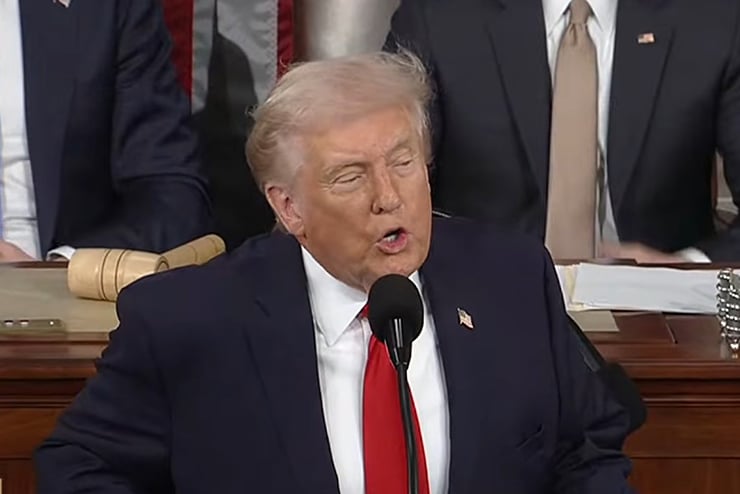
President Trump opened his 2026 State of the Union address stating that, as America approaches the 250th anniversary of American independence, “our nation is back, bigger, better, richer, and stronger than ever before.”
The Constitution requires the president to “from time to time give to the Congress Information of the State of the Union,” a duty first fulfilled in person by George Washington in 1790. Thomas Jefferson later abandoned the speech format in favor of written reports, until Woodrow Wilson revived the live address in 1913 and transformed it into a major instrument of public persuasion. Radio, television, and now digital media have since turned the address into a civic ritual that is part policy report, part political argument, and part national self-definition.
Trump’s framing positioned the coming semiquincentennial as a referendum on whether the United States remains a sovereign constitutional republic grounded in family, faith, and national identity.
Nowhere was the contrast clearer between his vision and that of members of the Democratic Party than in their outraged reaction to his remarks on immigration and border enforcement. Trump declared plainly, “Today our border is secure,” after the Biden years, which he described as an era when “millions and millions of illegal aliens poured across our borders.” He tied immigration enforcement directly to American sovereignty, stating that the “first duty of the American government is to protect American citizens, not illegal aliens,” and invited legislators to stand if they agreed. Most Republicans stood up and clapped; most Democrats did not. That moment distilled the political divide: one vision prioritizes national citizenship and territorial control, while the other appears reckless and lawless.
This sovereignty argument extended beyond immigration into economic policy. Trump credited tariffs with driving investment and restoring leverage in global trade, arguing they brought “hundreds of billions of dollars” into the United States and would remain in place through alternative statutory authority despite judicial challenges. Economic nationalism, in this framing, is not isolationism but resilience in strengthening domestic industry, protecting workers, and reducing dependence on foreign supply chains.
Affordability formed the domestic centerpiece of the address. Trump cited declining inflation, lower gasoline prices, decreasing mortgage costs, and new policies to reduce prescription drug prices and health-care costs.
His proposed reforms emphasize transparency, consumer choice, and redirecting government spending away from entrenched intermediaries toward patients and families. The political message is unmistakable: economic policy must make family formation and homeownership viable again.
The cultural dimension was equally explicit. Trump spoke of a “tremendous renewal in religion, faith, Christianity, and belief in God” and called on Americans to reaffirm that the United States remains “one nation under God.” Approaching the 250th anniversary of America’s independence, he linked civic memory, religious identity, and family stability to national unity.
Taking all of these elements together, the speech presented a coherent governing philosophy: secure borders, economic independence, affordability for working families, institutional accountability, and cultural confidence. Trump framed these not as partisan talking points but as prerequisites for sustaining the American experiment.
As the nation approaches its big independence celebration this July, the debate about the meaning and purpose of the nation is likely to sharpen. The question is not just who governs but what kind of nation Americans intend to remain: one anchored in sovereignty, citizenship, and historical continuity, or one defined primarily by deep state administrative management, lawlessness, and global integration. The answer will shape the republic’s next quarter-millennium.
Leave a Reply