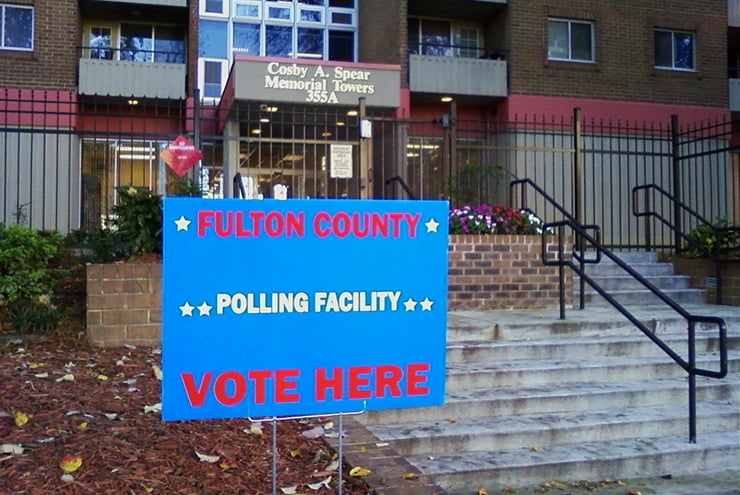
In December 2025, the Justice Department filed a lawsuit against Fulton County, Georgia, seeking access to the 2020 election records, citing the federal law that grants the Justice Department jurisdiction to investigate federal elections. Fulton County refused, leading the Justice Department to infer that these public officials were hiding evidence of a crime.
Thereafter, the Justice Department served a criminal search warrant on the Fulton County Election Records Office. Fulton County immediately filed an emergency motion to return the records. This led to the unsealing of the Justice Department’s search warrant affidavit, giving the public a rare look at the investigators’ suspicions about the election. These include witness accounts of pristine mail-in ballots that lacked the creases typically made to fit the ballots into the transmission envelopes, evidence of vote totals that significantly mismatch the recorded ballots, and evidence of ballots counted more than once.
More recently, Fulton County has demanded the return of election records on the basis that they show how individual voters voted. The “voter privacy” claim is advanced in a memo supporting an emergency motion that demands the Justice Department return the documents and that the court issue an order forbidding the Justice Department from examining the records.
According to Fulton County’s own memorandum, the FBI’s recent search warrant caught Fulton County maintaining a list that would violate the Georgia Constitution’s requirement of a secret ballot. The county argued that, “The seizure of records swept up sensitive voter data, such as personal information and records that show how individuals voted, with no apparent restrictions on how the government may use that information. [Emphasis added]”
Since the invention of paper, the technology for secure, prompt election results has not been improved. The method is simple. Citizens who have registered to vote before Election Day need only present proof of their identity before being furnished a pre-printed ballot. The fact that their votes are cast is recorded, but the document recording their vote is anonymized to prevent public officials from tracking which voters voted which way.
The secret ballot is fundamental to a functioning democracy, and it’s what separates free and fair elections from the compulsory endorsement exercises that the state closely monitors in tyrannical regimes. Even in the United States, at least during the Biden administration, the Federal Emergency Management Administration (FEMA) got caught avoiding its political enemies when handing out aid during a disaster. Public officials would like nothing more than to have access to a list of how their constituents voted. Punishments and rewards would be much easier to assign.
But Fulton County, like much of the country, kept introducing complications into the voting system, leading to gaps in election security. Ballot secrecy is apparently yet another casualty of these innovations. If the FBI can review Fulton County’s records to determine how individual voters voted, then that information was available to the public officials who maintained those records. I’m sure they promised not to look. But the very existence of such records has no purpose other than to inform public officials seeking to discriminate against people who voted the wrong way.
Section II, Paragraph 1 of the Georgia State Constitution reads:
Method of voting. Elections by the people shall be by secret ballot and shall be conducted in accordance with procedures provided by law.
Under the paper method, public officials cannot reconstruct how individual voters voted. Georgia voters have a constitutional right to vote in secret. The one group of people who should not have access to that information is Georgia state public officials. They have the greatest incentive to look. If Georgia maintained such records, they should be placed under immediate suspicion for violating this constitutional prescription and investigated for potential abuse of sensitive data.
Alternatively, it’s possible that the Fulton County public officials do not have any such data but are merely claiming to have it. There are two reasons they might be doing this.
First, they’re desperately grasping at straws to prevent the Justice Department from reviewing the integrity of the 2020 election in Fulton County.
Second, they want voters to think they have access to such documents, which would encourage voters with potential business before the government to vote “the right way.”
Either way, the voters of Georgia and every other state deserve privacy in the voting booth. They should not be forced to participate in an election in which the government gathers and records data on how individual voters voted. As much as election fraud, this kind of record-keeping undermines the freedom and fairness of elections and violates international election standards.
The legacy media has naturally dismissed the witness accounts of fraud as “debunked conspiracy theories.” But they have not, and cannot, debunk Fulton County’s own claim that it kept records of how people voted in apparent violation of the sacred principle of a secret ballot.
Leave a Reply