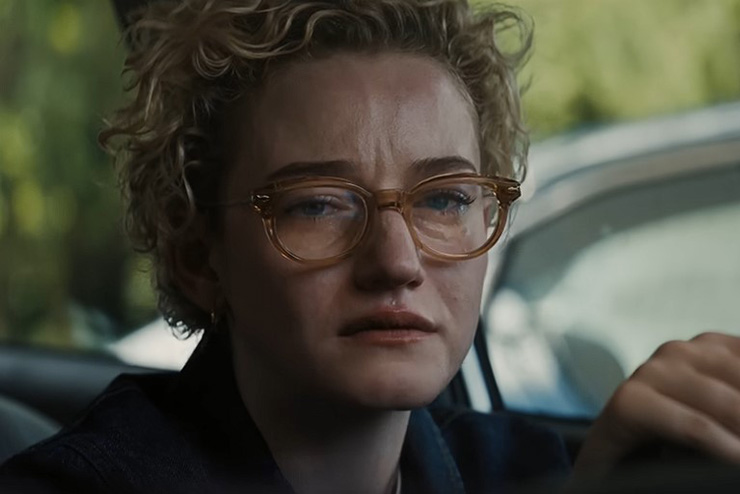
The horrifying premise of the film Weapons has had audiences buzzing for months. There’s nothing scarier than the thought of children inexplicably disappearing from their beds in the middle of the night, especially if you’re a parent. Yet under the direction of comedian Zach Cregger, the film turned out to be one of the most comically witty of the year.
Judging from the jump-scare gore of Cregger’s last hit, Barbarian, I went into the theater expecting pure terror. A chilling introductory scene establishing the premise seemed to confirm my preconception; an eerie childlike voice explains how 17 kids from the same elementary school class disappeared at 2:17 a.m., with only one boy from the class left behind. From there, the story unfolds through a series of vignettes, with various archetypal characters viewing the same events from different vantage points—each one more absurd than the last.
We start with Justine (Julia Garner), the young teacher whose class disappeared and who finds herself the target of the whole town’s ire. At first, she seems like a well-meaning teacher who just cares too much.But, with her incessant boundary crossing, burgeoning alcoholism, and narcissistic jaunts with married men, it becomes clear that although she isn’t a “witch” (as the townspeople write on her car), she’s a comically bad role model for her class. It’s tempting to see it as a poor performance from a typically stellar Garner, until you realize she’s playing the part of a vapid twentysomething whose manipulative put-ons are not as skillful as she imagines.
Next up is Archer (Josh Brolin), a hot-headed contractor investigating his son’s disappearance, who you can just imagine getting arrested at a school board meeting protesting about DEI. Then comes the yin and yang of an incompetent corrupt cop and a loquacious local junkie, a bow-tied gay principal playing house with his even gayer husband, and eventually, the one boy left in the class who’s so quiet and detached it sometimes feels like a parody of The Sixth Sense.
In other films, these archetypes are portrayed as real, gritty, or self-serious and treated with the dignity (or scorn) that our culture affords their identity-box in real life. Yet Weapons sees them all as fair game for bumbling caricatures.
With each suspenseful build up, we get an equally hilarious punchline. The junkie is being stalked by a supernatural presence, or so we are led to believe—until he jumps out of his tent like a rabid monkey, frantically stabbing the unsuspecting cop with a handful of used heroin needles. “Do you have AIDS?!” is all the cop can sputter. There’s no lesson on drug abuse, homelessness, or police brutality—just some raucous fun.
The vignettes eventually collide, coming together to slowly reveal the supernatural threat lurking in the town. As the film reaches its climax, we’re left wondering how Cregger will manage to stick the landing; last year’s Longlegs, after all, delivered 90 minutes of campy horror, only to crumble under the weight of unexpectedly heady themes in the last 10 minutes (I went to see Nicolas Cage in horror-drag, not be lectured about love and sacrifice). Without giving away major spoilers, Weapons’ resolution came with an uninterrupted beat of brevity; no matter how scared you are of ever losing a child, try not to laugh as 17 possessed kids escape their captor and storm violently through an unsuspecting quiet suburb. The entire theater erupted in laughter so loudly you’d think you were at an Eddie Murphy stand-up set.
Unlike Longlegs, Weapons never takes itself too seriously. One can debate whether the film’s title refers to physical weapons, the gamification of violence, or some abstract notion of the weapons we ourselves become when we inflict our trauma back on others. But even Cregger says there’s no real meaning behind it,that it’s left purposefully “vague” as more of a stylistic than thematic choice, and that all interpretations are “legal.” There’s plenty of food for thought—but in the end, it’s all just good-natured, slightly subversive, “fun” horror.
The film’s light tone provides a welcome respite from the pretentious era horror films are going through. Longlegs, which still gave us Cage at his kitschiest best, is hardly the worst example of this trend. Director Ari Aster, horror’s current golden boy, wears an auteur’s arrogance on his sleeve. Hereditary and (to a far lesser degree) Midsommar, are both well-executed, artistic horror films, but with consistently heavy psychological, sexual, and sociopolitical themes, they were made with what amounts to disdain for the casual viewer. Other filmmakers try to turn the horror genre into a vehicle for social commentary, bombarding viewers with propagandistic sermons, such as the oeuvre of Jordan Peele (Get Out, Us). How many asinine allegories must be made on the horror of “systemic racism”? Anything that doesn’t fall into the pretentious and preachy categories is often just slop; it’s quite rare to have a film that’s scary, comically witty, and doesn’t judge the viewer from a self-appointed position of superiority.
If the last decade has shown us anything, it’s that we’ve all become a little too comfortable lording, even Weapon-izing, our sense of self-righteousness over others—moral, intellectual or otherwise. More films that remind us not to take everything so seriously, including ourselves, is certainly a welcome development.
Leave a Reply