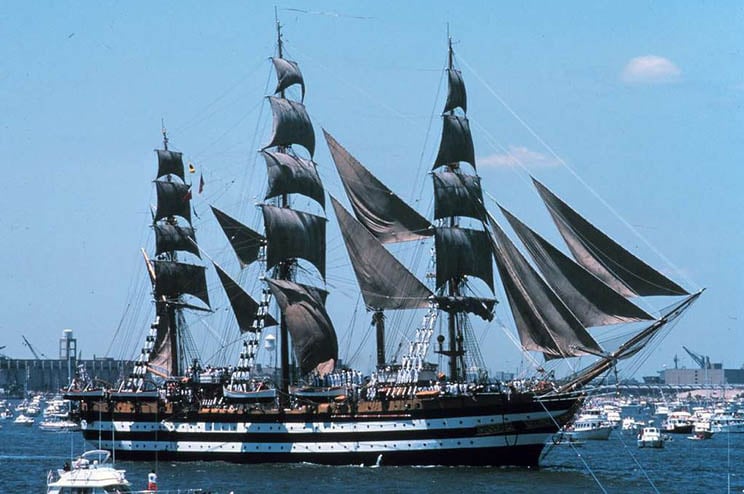
America’s semisequicentennial has me waxing nostalgic. In 1976, New York City was the place to be for America’s bicentennial. Its greatest booster, the columnist Pete Hamill, celebrated the city’s endless delights, notably the fact that the Yankees were in first place in the American League—just like in the good old days of 1921 to 1964. The Operation Sail tall ships parade up the Hudson River was the main attraction. What a display it was! As luck would have it, I held a summer job delivering groceries from a supermarket on 70th Street and West End Avenue. Occupants of the massive Lincoln Towers middle-class housing development rented out space for ordinary citizens to get spectacular views of the flotilla.
The Italian and Israeli armadas impressed me the most. Maybe it was the local connection. New York in the ’70s was not an Italian-Jewish city. Still, in neighborhoods throughout Brooklyn, Queens, the North Bronx, Staten Island, and the Upper West Side, that’s exactly what it was. The Russian contingent, however, was the highlight. It was okay to be impressed. It was 1976. Détente was in full swing. There was no talk, yet, of an Evil Empire. A year earlier, U.S. and USSR astronauts had conducted a rendezvous in space. The mighty Russian fleet was no threat.
Even so, would I go back to the America of 1976? Not a chance! If America in the ’60s was Dante’s Inferno, then the ’70s was London after the Blitz. Once-vital American cities were emptying out on a monumental scale. In the early ’60s, Asheville, North Carolina, my hometown, was jam-packed with shoppers on Saturdays, country folk coming to town. By the ’70s, a jumbo shopping mall in East Asheville, plus duplex movie theaters all over town, had turned downtown into a ghost town. New York, my adopted city, was even more apocalyptic. It seemed the entire Lower East Side, from Greenwich Village to Wall Street, save head shops on St. Mark’s Place, was empty. The Cooper Union area, where Abraham Lincoln gave his famous 1858 House Divided speech, displayed no signs of life. By the time of the bicentennial, the entire country looked to have been overwhelmed by superior forces: despair over Watergate and Vietnam, crime and inflation, and the world’s finest public school system decimated by school busing orders handed down by black-robed tyrants.
Across America, high school race riots robbed mere teenagers of an innocent youth. In New York, the crime wave had befuddled the entire political class. Not even the no-nonsense mayoral administration of Edward Koch could turn the tide. My relatives wanted to know if I had ever been “rolled.” Well, no. I was a young buck and a survivor of my own high school riot. I walked in New York as a prince and a king.
Yet despite all these struggles, the nation held on to something intangible: a common culture, a common language, a shared history, a common music, and literature. There were not yet full-scale assaults on American history in our schools. The Cold War—not a culture war—remained predominant in the minds of most Americans. In those blessed pre-Internet days, I did not own a television set. (This, I highly recommended! Just ask Wendell Berry or Russell Kirk.)
At a friend’s house, I espied a TV movie version of the John Jakes historical novel, Rebels, starring a Mod Squad-style of daring spies: a young white male, young black male, young white female were hiding in the bushes engaged in their trade. Very innocent, just like America itself. The Jakes volumes were both popular and harmless, if not great literature.
But there was my passion—American literature. New York was in frightful decline. No matter. For a culture vulture like me it was the top place to be. You couldn’t take two steps in either direction without running into a Manhattan bookstore. Or so, incredibly, it seemed. There were a few chain stores, but mostly I shopped at independents: the antique store/bookstore on 8th Avenue and 17th Street, the spacious indie on West 8th Street in the Village, a smaller store right across the street, a music store/bookstore on Bleecker Street. But then there was the Mother Church of them all: the famed Scribner’s store on 5th Avenue and 36th Street.
When People magazine did a profile on Susan Sontag, the reporter noticed that his subject couldn’t resist wandering into every bookstore on her route home. Ms. Sontag wasn’t the only one.
America in those years knew it had a history. It also knew it had a literature. One evening I walked into the 8th Street bookstore. When I sauntered out, I knew what I wanted to do with my nervous energy. I wanted to know these things. My horizons had expanded, moving now beyond the Anthony Scaduto biography of Bob Dylan and Anne Charter’s bio on Jack Kerouac.
Ahh, the 8th Street bookstore … What did it have? The panorama of 20th-century American literature: Sherwood Anderson, Ernest Hemingway, F. Scott Fitzgerald, Tom Wolfe, William Faulkner, John Steinbeck, and John Dos Passos here; John Updike, John Cheever, Saul Bellow, and Norman Mailer there. My parents, solid middle-class folk, subscribed to both Time and Life. Updike, Cheever, Bellow, and Mailer, along with Gore Vidal and Joyce Carol Oates, graced their covers. I was highly impressionable. If these authors were on the covers of Time and Life (or Newsweek), I figured they must be good. These gentlemen—and Ms. Oates—had their moments. They weren’t the only ones. In succeeding decades, Wolfe and Wendell Berry were just as profound in dissecting the American scene. I soon learned that my hometown boy, Tom Wolfe, was once King of the Hill. “After the war, everyone was reading Wolfe,” a middle-aged dinner companion told me over pasta. This, too, impressed me greatly. The former Asheville Citizen delivery boy conquers mighty Manhattan!
In every bookstore, the paperback sections under “F”, “H,” and “W” would surely have the novels and short stories of Fitzgerald, Hemingway, and Wolfe all lined up in a row. The “R” section would contain Philip Roth’s novels, displayed with that Bantam rooster on the spine. This was American literature. I was certain it would last forever.
Since the 1990s, however, it seems that the novel has now joined poetry in terminal decline. When was the last time a novelist appeared on the cover of Time? Newsweek and Life are out of the print business. So, too, is the highly literate Saturday Review of Literature. Histories and biographies began to define American letters. An English critic quipped that the West was the first civilization to write its own obituary. Except it wasn’t a joke. As the century waned, Pat Buchanan and Sam Francis were writing more profound insights on American and Western life than the novelists I still admire.
What has been the story of the past half-century? The demographic revolution, the product of both the 1965 and 1980 immigration bills, not to mention illegal immigration, the “Hey hey, Ho ho, Western Civ has got to go” chant? Recently, I had to take a train from my job in Mineola, Long Island to my residence in Bayside, Queens. We transferred at Woodside. The station featured a mural of that neighborhood’s history from pre-Colonial days to the present. One photo had a group of Italian-American youngsters clowning around at a local pizzeria. Italians in Queens? Brooklyn? The Bronx? They were once numerous. They had political clout and were catalysts for a counterrevolution that culminated in James Buckley’s stunning 1970 election to the U.S. Senate.
Today, it’s hard to find conservative Catholic Italians in New York. But why pick on New York? In 1976, New York City’s population was 95 percent American-born. North Carolina, circa 1987, had 16,000 illegal aliens. Now the number is up to 400,000, even though you must give Donald Trump credit for sealing the border.
Is it demographic upheaval or something else? In the late ’60s, the Thomas Jefferson-Sally Hemmings hoax made a comeback. But only briefly. American history is the real story. The history of America has been the attack on the history of America. “Western Civ has got to go” and the academic revolution accompanying that chant were the result of California’s demographic revolution. Were young white males participants in that Jesse Jackson-led march at Stanford? By the late ’80s, did it even matter? The Cold War was over. America needed new scapegoats. They found them in Confederate flags, statues, monuments, and public schools named for Confederate statesmen. Liberals and conservatives, at last, had discovered a fighting cause. By 1992, Christopher Columbus was added to the mix, dramatizing hatred at European civilization for setting sail at all. With Bill Clinton’s intern problems, the Jefferson-Hemmings hoax found a second life. With George Floyd, the whole mess found paydirt.
The demographic revolution went beyond New York and California. Former Chronicles Editor Chilton Williamson Jr. wrote of the “easiness of liberalism.” And how! Demographic upheaval made the war on the white male—his literature and his history—so easy that it isn’t even fair.
There are now endless discussions of what it means to be an American. All of them come back to the country as a creedal nation, an idea. That creed or idea is never successfully defined. It can mean a thousand different things to a thousand different people. For MAGA America, the question is: Where is the real America?
At Chronicles’ robust 50th anniversary dinner, I declared to my tablemates: It starts in Pennsylvania and ends in Nevada. Everyone laughed. The real America, until further notice, is in that continental-sized region. All roads lead to Pat Buchanan. Is America, as Pat asked on many occasions, a serious nation? Are Americans a serious people? In 2024, Donald Trump won 31 states, all of them excluding Alaska, in our America. Why are there not 62 Republican senators? Why would voters in Wisconsin, Nevada, Arizona, and Michigan give their electoral college votes to Trump while also choosing anti-Trump Democratic Party solons?
This essay emphasized literature. America needs the literary equivalent of a Nashville. It needs a publishing center outside of New York, the way Nashville serves as headquarters for country music outside of Los Angeles. It needs a publishing center to become the Scribner’s of the heartland, where a future Hemingway, Faulkner, or Fitzgerald can be encouraged and nurtured by enterprising young editors. A Middle America where young people review books—and a public that reads them.
Leave a Reply