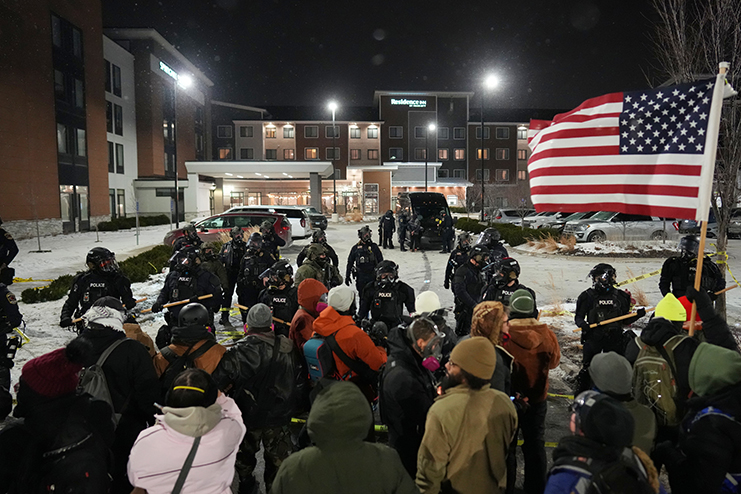
America faces a constitutional stress test. As immigration enforcement accelerates, some states and cities have begun experimenting with resistance to federal authority that goes beyond policy disagreement, to physical interference with law enforcement. The question is no longer whether states may decline to assist federal immigration enforcement—they may—but whether they may obstruct it. The Constitution answers that question clearly: they may not.
A growing and dangerous theory is now circulating in American politics: the idea that states may physically block federal officers, deploy state law enforcement or National Guard units against federal agents, or characterize federal immigration enforcement as an “invasion” justifying state countermeasures. That claim is wrong as a matter of constitutional structure, historical meaning, and settled law.
The Founders designed a system in which states retain meaningful sovereignty, but that does not include veto over federal execution. States may refuse to administer federal programs. They may litigate, protest, and seek political change. What they may not do is impede, burden, or control the operations of federal law or federal officers. The Supremacy Clause in Article VI of the Constitution, stating that the Constitution is the “supreme law of the land,” was written precisely to foreclose that outcome.
This distinction between lawful noncooperation and unlawful obstruction is not academic. It marks the boundary between constitutional dissent and constitutional breakdown. When a state moves from declining assistance to actively blocking federal officers, detaining them, threatening them, or using state force to prevent the execution of federal processes, it crosses the line from spirited federalism into open defiance.
Today’s resistance borrows old language from our constitutional history, bandying about terms such as nullification, interposition, and even invasion, but it also empties those terms of their historical meaning. Although 19th-century doctrine foreclosed nullification as a formal legal power to suspend federal law, conservative constitutional theory has continued to examine the states’ role in challenging federal action through political and legal means. Yet even under those views, no theory supports using state force to block the execution of federal immigration law. Interposition, as James Madison explained repeatedly, was political protest—not operational resistance. It was never a license for governors to deploy force against federal authority.
The use of the term “invasion” to characterize any federal attempt to enforce the law requires even greater discipline. Sustained, large-scale unlawful entry across the southern border can constitute an invasion within the meaning of the Constitution, thereby demanding a federal response to its duty to protect states and, in cases where that duty is unfulfilled, a residual state authority to act defensively remains. But this position cannot be inverted. Federal officers executing federal law are not invaders. Treating domestic law enforcement as foreign hostility collapses the Constitution’s distinction between external threat and internal sovereignty and would imply that a state could have a war power against the United States itself. That is the very outcome the Supremacy Clause exists to prevent.
Nor does resistance to immigration enforcement rest on any natural-rights footing. There is no constitutional or natural right to remain in the United States in violation of federal law. Immigration policy lies at the core of national sovereignty. States may disagree with that policy; they may not obstruct its execution under the guise of some higher law.
When obstruction occurs, the Constitution does not leave the federal government helpless. The executive branch possesses a sequenced set of lawful responses, ranging from judicial and criminal to, in extreme cases, military, to restore the execution of federal law. Federal courts may enjoin state interference. Conspiracies to obstruct federal officers are illegal under federal criminal statutes. The National Guard may be federalized when governors misuse it to defeat federal authority. And where organized resistance renders ordinary enforcement impracticable, the Insurrection Act authorizes decisive action to reestablish the rule of law.
Much has been made of so-called “norms” against the domestic use of military force. Norms may guide discretion, but they do not override law. The Insurrection Act vests judgment in the president precisely because the Constitution does not assume that constitutional order will always be preserved by voluntary compliance.
The American system channels disagreement into courts, elections, and legislation—not blockades, intimidation, or the use of force by individual states. When states test that boundary by blocking federal immigration authority, the response is not improvisation but a constitutional structure that preserves room for principled state objection while denying any unilateral power to suspend federal immigration law.
Federal supremacy is not optional. It is the condition of union. At stake is not immigration policy alone, but whether the United States remains a nation governed by law rather than by jurisdictional standoffs. The Constitution supplies the answer. The question is whether we will follow it.
Leave a Reply