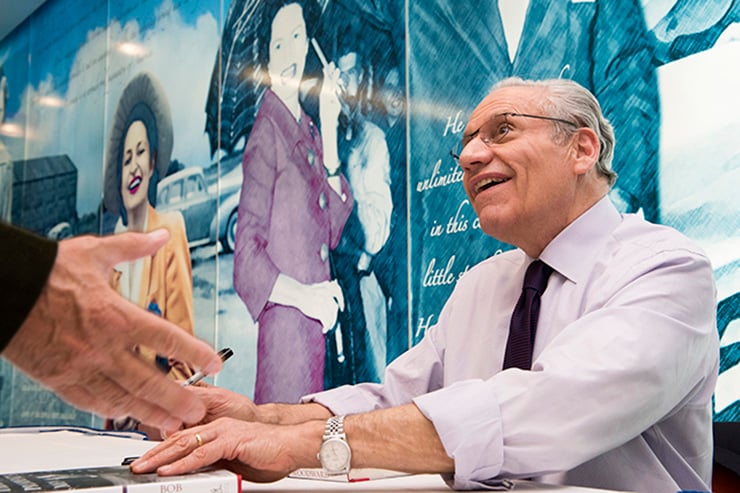
It’s understandable, and rational, that the American people don’t trust the media. Time and time again the media have proven themselves to be untrustworthy.
Still, I sometimes find myself wondering how different things might have been, how the press could have saved itself, had reporters just been willing to work with honor and walk down the painful road of introspection when they were wrong.
That last phrase, “walk down the painful road of introspection,” is not my own. It belongs to Bob Woodward, the “legendary” Washington Post reporter. Woodward became famous for his coverage of Watergate in the 1970s. A lot of conservatives dislike Woodward, and I understand why. Yet if we completely ignore the legacy media we overlook some gold.
In this case, the gold is “The Press vs the President,” a long series of articles by Jeff Gerth published in January 2023 in the Columbia Journalism Review. It is the most comprehensive, well-written, and damning indictment of the media I have ever read, and the kind of reporting that makes one consider all news events in a new light. For example, Director of National Intelligence Tulsi Gabbard’s release of formerly classified documents revealed the truly deep and evil extent of the Russiagate hoax. The documents detail how the intelligence community set up President Trump for failure in 2016 by falsely claiming he was a tool of the Kremlin. The media peddled garbage, ignored contradictory evidence, and sometimes flat-out lied. For me, Gabbard’s revelations put an exclamation point on “The Press vs the President.” (Seriously, go read it.)
One of the people interviewed in Gerth’s series is Bob Woodward. In January 2017, Woodward went on Fox News to dismiss the Steele dossier, which was funded by Hillary Clinton’s campaign and compiled by ex-British spy Christopher Steele, as a “garbage document.” The Steele dossier was opposition research that claimed Trump was hanging out with prostitutes in Moscow and was in the pocket of Putin.
You’d think that such a statement coming from the media’s Watergate hero would have had some effect on the Washington Post—but it didn’t. Jeff Gerth describes what happened next:
After his remarks on Fox, Woodward said he “reached out to people who covered this” at the paper, identifying them only generically as “reporters,” to explain why he was so critical. Asked how they reacted, Woodward said: “To be honest, there was a lack of curiosity on the part of the people at the [Washington] Post about what I had said, why I said this, and I accepted that and I didn’t force it on anyone.
Woodward also told Gerth that the Mueller report would “fizzle” but added that reporters were “never going to declare it’s going to end up dry.”
In 2021, as the Steele dossier was falling apart, Erik Wemple, the media critic for the Post, pleaded with the media, including his own paper, to come clean. “What most dismayed me,” Wemple wrote, “was the failure of MSNBC and CNN to counter and properly address the questions I was asking them.” Wemple concluded that for the media “a reckoning is years overdue.” In case there was any doubt, Wemple made a demand about the fake Russiagate coverage: “Retract the stories.” Of course, they didn’t.
I once wrote in Chronicles that the media today are like drug addicts. Watergate was the first hit, and for the last 50 years they have been trying to relive that high. They just live for the buzz that comes from claiming a conservative scalp—and as Russiagate has proven, they will go to any length to feel the rush.
In this example, Woodward represents the somewhat contrite addict who finally has second thoughts. All the President’s Men is supposed to be a warning about intel agencies working with the president of the United States to torpedo the political opposition. Bob Woodward and Carl Bernstein of the Washington Post uncover a nest of criminality that leads to the White House and where “Everybody is in on it.” Nixon’s advisors, the campaign, the intelligence agencies—everyone was willing to break the law to destroy the Democrats. They used spying, opposition research, and stolen medical files to destroy the left.
Russiagate, in many ways, is a mirror image of Watergate. It was based on opposition research paid for by Hillary Clinton and weaponized by Barack Obama. Thanks to the efforts of Jeff Gerth and reporters like Matt Taibbi, Mollie Hemingway, Sean Davis, Julie Kelly, and Byron York, the truth is coming out. One of the best, Jacob Siegel at Tablet Magazine, has revealed the corruption in the media and government after the way of Woodard and Bernstein. America’s ruling party today “is run by the most untalented and incompetent people ever assembled in the country’s history,” Siegel said in a recent interview. This is a direct echo of what Mark Felt, Woodward’s source for many Watergate stories said about Nixon’s handlers: “The truth is these are not very bright people.”
The Russiagate hoax has begun transcending the typical narrative of political warfare and entered the realm of metaphysical evil. John Brennan, the former CIA head who helped Obama launch Russiagate, is a demonstrably evil man. And the lessons are timeless.
Similarly, a newly published analysis of All the President’s Men by the British Film Institute argues that the film transcends its time and touches on eternal themes. In BFI Film Classics: All the President’s Men, authors and film scholars Robert Ray and Christian Keathley posit that Director Alan Pakula did so many counterintuitive things in making it that they elevated the story to the realm or myth and archetype. They intentionally made the film challenging to follow, and used a cinematographer, Gordon Willis, who used long nocturnal shots of buildings in a style that is more contemplative than action-oriented. Director Alan Pakula shot the film from angles that made it difficult for viewers to even know where Woodward and Bernstein’s desks stood in relation to top editor Ben Bradlee’s office. The result is something more like art photography than a typical thriller. Keathley and Ray argue that “for all the film’s meticulous recreation of reality … the people making it proved repeatedly willing to abandon both continuity and credibility for the sake of an aesthetically powerful moment.”
All the President’s Men also does something unheard of in today’s films. It allows the camera to be still. In one of the movie’s most famous scenes, Woodward tries to extract information from two sources that he’s trying to talk to on the phone at the same time. It goes on for six minutes and is more riveting than any Marvel film produced in the last 10 years. It’s one of the reasons why the film, even more than the events of Watergate, made Woodward and Bernstein heroes.
Today, of course, such behavior would get them banned from CNN, the Washington Post and Morning Joe.
Leave a Reply