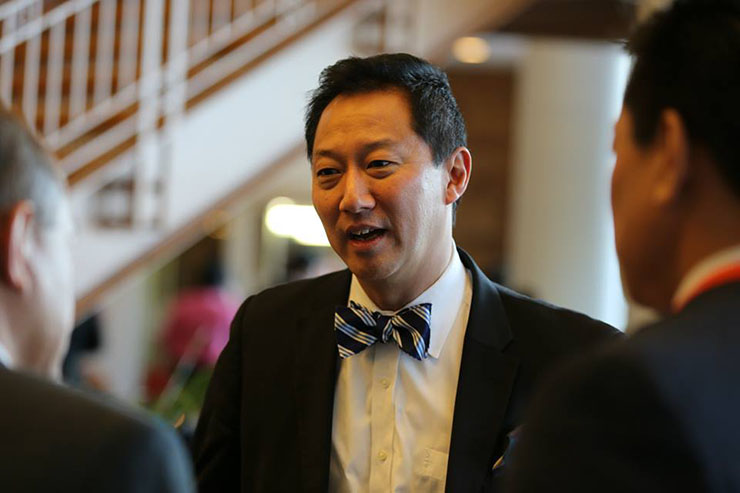
In June, champions of liberty in Florida and across the country rejoiced when the state university system’s board of governors, in a decisive 10-6 vote, rejected the candidacy of former University of Michigan president and noted DEI theorist Santa J. Ono for president of the University of Florida. Ono, who was curiously the only finalist for the position, had been endorsed in unanimous votes by UF’s board of trustees and its search committee.
Thanks to Ono’s rejection at the final level of the state system’s hiring process, more than 54,000 University of Florida students, as well as UF’s faculty and staff, will continue to be evaluated on the basis of their academic and professional merits rather than on their race, heritage, or gender. This welcome development is consistent with state and federal laws that proscribe race-based and other DEI considerations and prohibit radical gender ideology, which Ono’s past statements also appear to support.
Ono left the board of governors meeting jobless and humiliated, but that may not be the end of the matter. On July 3, all 13 University of Florida trustees sent a petulant, self-pitying, and revealingly defensive letter to Florida Senator Rick Scott as well as Florida Congressmen Byron Donalds and Greg Steube in response to their queries about UF’s hiring process. The trustees’ reply questioned the legal and procedural basis of the board of governors’ role in process, attempted to refute widespread evidence documenting Ono’s commitment to DEI alongside other controversial elements of his record, and tried to justify widely criticized aspects of the board of trustees’ own role in the process. The letter, a copy of which was provided to me, drones on for seven single-spaced pages.
The letter’s arguments have little foundation in fact. To begin with, the trustees erroneously claim that the “sole statutory mandate of the Board of Governors is to ‘confirm’ presidential selections … not to conduct a de novo and duplicative vetting process.” On that basis, the trustees suggest that the processing of Ono’s candidacy “raises important questions about consistency, fairness, and institutional roles as well as the delegated authority of the Board of Governors under Florida law.” They further insist that the process “warrants broader scrutiny … as our system moves forward,” presumably in UF’s renewed presidential search and, possibly, in other executive hiring processes at Florida state institutions.
The board of governors, however, has no “mandate” or other authority under Florida “statute.” Its extensive powers are clearly enumerated in Florida’s state constitution, which states that the governors:
shall operate, regulate, control, and be fully responsible for the management of the whole university system. These responsibilities shall include, but not be limited to, defining the distinctive mission of each constituent university and its articulation with free public schools and community colleges, ensuring the well-planned coordination and operation of the system, and avoiding wasteful duplication of facilities or programs.
No state constitutional language substantiates the letter’s false assertion that the board of governors’ role is limited to “confirming” presidential selections made by boards of trustees, nor does it prohibit the governors from performing either a “de novo” or “duplicative” vetting process for any issue, including presidential selections. To the contrary, the constitutional language assigning the governors “full responsibility” over the “whole university system” suggests that they should perform these functions, among many others.
Even if that were not the case, in processing Ono’s candidacy the board of governors performed no separate “vetting” involving an investigation. In its June meeting, the governors held a procedurally required public hearing that was livestreamed in an open access format available worldwide (I personally watched it from London via internet). That meeting afforded ample opportunity for the general public to express opinions on Ono’s candidacy, allowed the governors to ask him questions about his record and beliefs, gave Ono the opportunity to respond to those questions, and proceeded to an orderly open vote in which his candidacy was rejected. In the trustees’ meandering detachment from reality, their letter claims that “Board of Governors members who opposed Dr. Ono” never “met with him, spoke with him, or gave him a fair opportunity to address the concerns they raised.” In reality, they did exactly that, in public and with the entire world able to watch.
The trustees further whined that objections to Ono’s candidacy were “not grounded in facts.” It is exceptionally well established, however, that in Ono’s previous position as president of the University of British Columbia, he launched a “President’s Task Force on Anti-Racism and Inclusive Excellence” which created one of the most influential templates for implementing DEI policies across global academic life, provided for race-based hiring and admissions, and imposed a “zero-tolerance” policy for faculty and staff who resisted mandatory DEI training.
At Michigan, as recently as March 2023 Ono introduced a program called “DEI 2.0,” which sought to “fully institutionalize DEI” in every aspect of campus life with the intent to change “who has power, influence, and voice in priorities and decision-making.” The New York Times reported that Ono’s administration “doubled down” on DEI even while many other universities, including Florida’s entire system, were actively dismantling it.
The Anti-Defamation League gave Michigan under Ono’s leadership a grade of “F,” in part because he allowed a pro-Hamas camp to continue for 30 days.
These facts about Ono’s record are not “selectively edited” as the trustees complain; rather they substantiate his long pattern of enthusiastic support for discriminatory and now-unlawful ideologies that voters rejected in Florida and nationally. The trustees’ unwarranted and outsized faith in Ono appears to have rested on nothing more than his doubtful personal assurances that he had suddenly changed his mind about DEI, assurances that fortunately failed to convince a majority of the board of governors.
The trustees further defend Ono’s prospective annual salary of $3 million, remuneration that would have made him, without warrant, the highest paid public university president in America. Their justification cites undisclosed “expert” advice and the fact that other Florida state institutional salaries may rise to $2 million, or a third less than what Ono stood to earn. While these arguments are unconvincing on their face, they ignore that Ono was paid just $1.3 million in his previous position at Michigan—a job he held for only seven months before resigning to apply for the UF job—and that more than doubling his salary may well have motivated Ono to say anything necessary to get the job.
By voting unanimously to hire Santa Ono, UF’s trustees have already signaled that they are willing to risk all Florida has achieved in removing woke ideology from higher education over the past several years. For that reason alone, every single one of them should resign in disgrace and never again play any role in public life in our state. Their dishonest, self-serving, and manipulative letter to Florida’s congressional representatives confirms that they are willing to continue taking such risks, apparently while also attempting to undermine and minimize the board of governors’ constitutional power to stop them in the future. As UF resumes its presidential search, the entire nation should watch and bear microscopic witness to every aspect of the process.
Leave a Reply