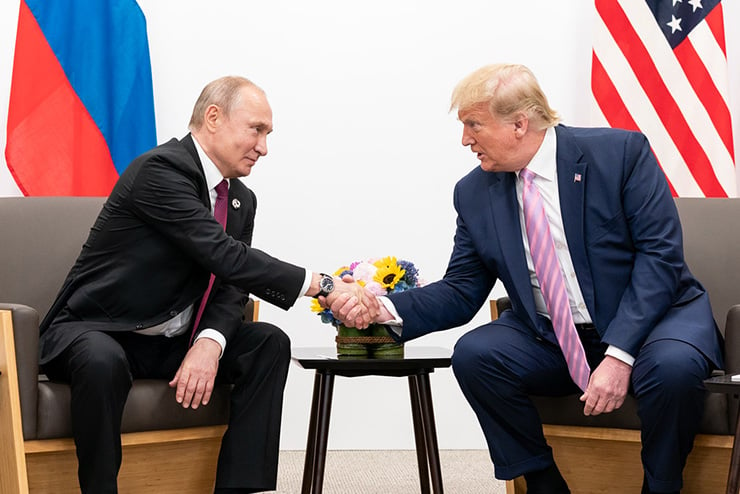
President Donald Trump is expected to meet with Russian President Vladimir Putin tomorrow in Alaska to discuss proposals for ending the war in Ukraine. Meanwhile, the president of Ukraine, Volodymyr Zelensky, has softened his position after initially refusing to be party to any peace deal recognizing Russian annexation of land conquered during the war. Zelensky and many of his supporters expressed concern over “rewarding” Russian aggression and compared any such concession to the Munich agreement that ratified Nazi aggression in the former Czechoslovakia. Such concessions make future Russian aggression more likely, they warn.
But this is not Munich, after which Hitler marched unopposed into the former Czechoslovakia following the flimsy peace agreement that led to dishonor and war. Even then, the world powers lacked the will and likely the means to use force to stop the Germans with or without an agreement. The shame of Munich was in legitimizing Hitler’s aggression.
Putin’s invasion of Ukraine, in contrast, has been vigorously and valiantly opposed. That there is any Ukraine left to save is a testament to the courage and tenacity of the Ukrainian people. The Ukrainians, with the help of their Western allies, stopped Russia from the takeover of what had been a part of the former Soviet Republic. Their defense defied conventional wisdom, which held that Ukraine would likely fall within weeks. After the initial invasion, the front has largely remained static with the Ukrainians slowly giving up inches—at great cost to both sides.
Zelensky cannot be faulted for not wanting to settle the war before all Ukrainian land is restored. In the eyes of the West, it’s not fair or just that the Russians would benefit in any way from the attack. But this is not a court case in which rational and moral arguments will result in a fair outcome as decided by a third party with absolute power over all concerned. This is a war. There’s no judge and there’s no justice. The terms of peace in this war, and indeed in every war, are an extrapolation of what will happen if the war continues without peace. Both sides must use strategic leverage to extract terms. Fairness is irrelevant. It’s not the way we want the world to work. But that’s how wars are settled.
Some still cling to hope for a dramatic ending comparable to the ending of World War II, in which the allies totally vanquished those who initiated hostilities. To achieve this would require a dramatic escalation of the forces the West has committed to the theater. World War II ended the way it did because the German Eastern Front collapsed, leading to a nearly defenseless Germany. The American Civil War ended with a total Northern victory for the same reason after the North mustered overwhelming force that ground down the South at great cost. Both wars are the exception, not the rule. Most wars are settled with some dirty compromise that leaves the injured party unsatisfied. More typically, the end of war looks more like the messiness of the Korean War or an 18th-century dynastic conflict.
Escalating this war to totally defeat Russia means committing the sons and daughters of Europe and the West. Our meager birthrates mean that every soldier’s death is the potential end of a family. That’s what Ukraine and Russia are experiencing now. Neither country will soon recover from the loss of their young men. Both sides are suffering immensely.
My heart goes out to the widows and parents of Ukraine who have lost everything. The grief must be unbearable. But the destruction of Ukrainian families is not a justification for spreading misery to my own country and my own son. There are still living men on both sides who have not yet fallen in the worst slaughter in Europe since World War II. More such losses must be avoided.
Putin has his own explanation for why he invaded Ukraine—the ethnic Russians in Ukraine were under attack, and NATO’s eastward expansion continued despite past guarantees to the contrary. I understand the fear some have about appearing to reward the invasion. But the map lines drawn in blood are not worth moving just a little by shedding even more blood. I have low expectations but high hopes for both Putin and Zelensky, who each have questions of ego and delicate domestic matters at stake if they lose face in a peace agreement. The peace, if one is to be had, will be ugly and not at all what a fair judge would award if a judge were in charge. Fairness, unfortunately, is irrelevant.
Realistically, the Russians will probably be entitled to demand the territory they currently occupy. Before one huffs in outrage at this prospect, he should consider that the land under his feet was, at one time, taken by somebody through force. We’d like to think that we’ve evolved beyond the necessity of rewarding brute force. But unless another power is willing to exert more force to dislodge the Russians, the spoils of war will go to the power that controls the territory. Setting aside the state dinners and embassy protocols, all diplomacy is an extension of that rule.
Unlike at the end of World War II, there has been no general collapse of either belligerent’s frontline, which could lead to total victory—though the Russians appear on the verge of a breakout in Eastern Donetsk. Unless we are willing to watch the horrific consequences that would ensue should the war grind on until that happens, a negotiated compromise is the only alternative.
Undoubtedly, bloodthirsty chicken hawks will condemn my willingness to appease a dictator. But I’m also a father and I’m paying attention to reality. I don’t want any more fathers to bury their sons in a hopeless pursuit of total victory. It’s time for this insanity to end.
Leave a Reply