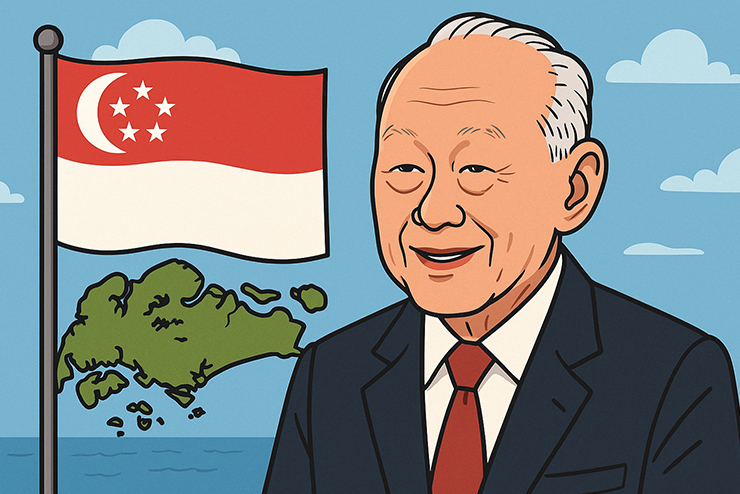
High up on my Bucket List is the name “Singapore.” Fascinated by things Chinese since my college days, I have lived in Taiwan, Hong Kong, and mainland China, and mingled considerably with Overseas Chinese in Britain, the U.S.A., and Thailand; but I have never set foot in Singapore. A visit would complete the set.
So far as I can judge, it would also be enjoyable. Singapore, knowledgeable friends tell me, is nothing like as expensive and snooty as that 2018 movie Crazy Rich Asians led us to believe. Sure, the place is well-off: ranked first in the world by GDP per capita, but with an inequality index only a tick higher than ours, along with reasonably priced good hotels, attractions, and activities.
The climate’s agreeable if you avoid monsoon season—heck, the place is only 85 miles from the equator. It’s easy on the eye: lots of parks, lawns, and trees. The crime rate is one of the world’s lowest, in defiance of V. S. Naipaul’s quip that the Orient begins where you have to start watching your luggage. Corruption? Singapore is the world’s third-least corrupt country, ranked between Finland and New Zealand. And Singapore has the appeal (to me) of being a geographical oddity. She is remarkably small for a sovereign nation, with a land area less than 8 percent of Puerto Rico’s. The main island group, separated from the Malay Peninsula by a strait a few miles wide, measures 17 miles north-to-south, 28 miles west-to-east. (That’s ignoring Pedra Branca, a tiny outcrop of rocks 25 miles offshore, just big enough to support a lighthouse and a meteorological station.)
Singapore’s 60th birthday was Aug. 9 of this year. “All of a sudden, on 9 August 1965, we were on our own as an independent nation,” Lee Kuan Yew wrote in his memoir, From Third World to First: The Singapore Story: 1965-2000 (hereinafter FTWTF). “We had been asked to leave Malaysia and go our own way with no signposts to our next destination.” Note that the date of independence is written British-style. Lee, the nation’s first prime minister, grew up speaking English and studied law at Cambridge University. Born in 1923, he began learning Chinese at age 32.
Lee, who died at age 91 in 2015, was, in my opinion, one of the greatest statesmen of the past 100 years, and the success of Singapore under his leadership is one of the most politically instructive stories.
At independence that August 1965, Singapore’s prospects looked bleak. Britain was winding down her empire and preparing to withdraw her troops. As well as protecting the city-state from unfriendly neighbors to the immediate north (Malaysia) and south (Indonesia), those troops had supported 70,000 jobs and 20 percent of Singapore’s GDP. Nobody gave Singapore much of a chance, militarily or economically, with Britain gone.
It didn’t help that the place is multicultural, with a base population of Chinese, Malay, Indian, and “other” in percentages of roughly 74, 14, 9, and 3. The Chinese were, of course, commercially dominant—a fact much resented by the Malays. They also suspected Singaporean Chinese of acting as agents for Communist China’s pursuit of its own regional interests. There had been some savage race riots in 1964, which were a causative factor in the next year’s independence.
In the 35 years covered by FTWTF, Lee lifted Singapore from this manifold hopelessness to, yes, First World status. He tackled the multicultural problem head-on: he passed home-ownership laws to prevent ethnic concentrations, abolished jury trials (in which verdicts were swayed by ethnic prejudice), and enacted electoral rules favoring his own multi-ethnic party. The now-formidable Singapore Armed Forces—comprised of male conscripts and female volunteers—were created from scratch to replace the departed British.
The penal code is strict, with both capital and corporal punishment; around 30 people are hanged every year for murder or drug offenses. There have been restraints on civil liberties, most famously a prohibition on the sale of chewing gum. (An indoor smoking ban had to be temporarily suspended when Chinese head of state Deng Xiaoping came calling.)
A politician’s own account of his career should, of course, be read with some skepticism. There is a case to be made against Lee, and his critics have been making it for decades. Ian Buruma made it at scathing length in his 2001 book Bad Elements in a chapter titled “Chinese Disneyland.” The overall shape of the critiques was captured by a 1995 New York Times headline comparing “clean and mean” Singapore with “filthy and free” Taiwan. Lee himself was well aware of this negativity—he mentioned that Times headline in FTWTF. His responses were unapologetic and unembarrassed. The most-quoted of them is from a 2005 interview with Germany’s Der Spiegel. When the interviewer asked if Singapore would maintain her authoritarian distance from British-style democracy, Lee’s answer included the following:
In multiracial societies, you don‘t vote in accordance with your economic interests and social interests, you vote in accordance with race and religion. Supposing I‘d run [Britain’s] system here … I would have a constant clash in my Parliament which cannot be resolved…
Pragmatism and common sense, meritocracy and robust law enforcement, indifference to ideology: Lee was a politician to admire and respect. Congratulations to the fortunate people of Singapore on their nation’s 60th birthday! ◆
Leave a Reply