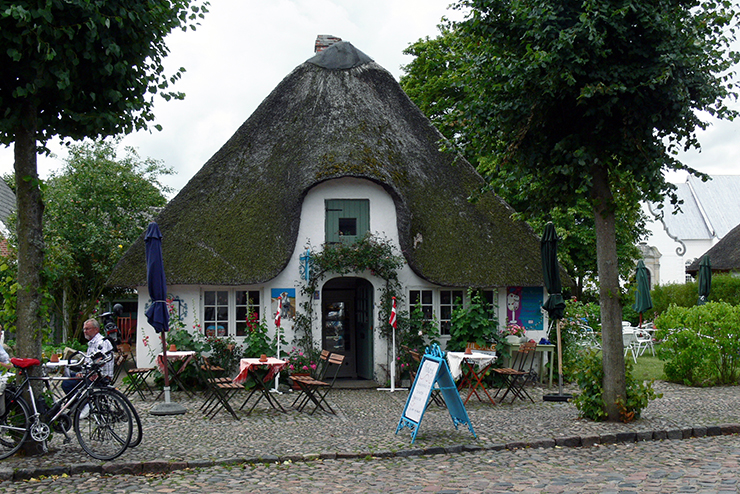
I’m sitting under the thatched roof of a house that is probably 200 years old in a Danish village called Udby. It’s hard to find much information about this place, even in the digital age, when all the world’s knowledge is allegedly available at one’s fingertips. Artificial intelligence is not very helpful in this case because it only knows what humans have thrown onto the canvas of the Internet. Even ChatGPT sounds like a sophomore trying desperately to convince a professor of his having done the reading the night before the exam. “Like many villages in Denmark, Udby’s history can be traced back to medieval times, though detailed historical records specifically for Udby might be scarce,” the machine says, revealing nothing I don’t already know.
The ground around this place is covered in fruit that looks like little red jewels. These are “mirabelles” and taste like plums. The internet reception here is not great, so I would not have known that they are edible had it not been for my father-in-law, who seems to be able to name every plant, tree, and fungus in the wild. It is remarkable to observe so much skill and knowledge cultivated over a lifetime. There are things that AI just cannot help you with on the spot—like avoiding the ignominy of death by dysentery. In contrast, it seems there are few things my father-in-law cannot illuminate. For example, he explained the benefits of thatched roofs—it has great insulation properties—and why much of the reeds used comes from Poland, which supplies them at cheaper price. The Poles are good at a couple things, according to my father-in-law, one of which is supplying thatch, and the other is stealing German cars.
The Poles deserve some charity. Jules Verne thought so, too. He had initially conceived of Captain Nemo in Twenty Thousand Leagues Under the Sea as a Polish noble who lost his family during the January Uprising of 1863, when Russian forces brutally quashed a Polish insurrection. There’s an American angle to the story as well: Nemo’s vessel, the Nautilus, was inspired by and named for one of the earliest submarines, constructed in 1800 by Robert Fulton, who worked on the design while living in France, which is why Verne was familiar with it. The French author made the Nautilus not only a vessel but a character in its own right, close to 70 years later—just after the Danes, following the Second Schleswig War with Prussia and Germany in 1864, began setting sail for America and scattering with the wind across the Midwest, seeding cities with Danish names, like Viborg in South Dakota.
I got to thinking about these confluences between America and Europe after talking with a friend who is an artist in Milan. She wants to buy a home in Miami because she believes the United States is the artistic live wire of the world. I had to scratch my head. As a resident of that Italian city, she is surrounded by a glorious inheritance stretching back to the birth of European civilization. “Yes,” she said, “it is like living in a museum.” And she’s right. There is a sclerosis that plagues the Old World.
European hubs can seem like little more than pleasant tourist destinations. But then again, the United States has become a hub for world-class grifters pretending to be the avant-garde. When I pressed my friend on what specifically excites her about America, the answer was that it is not Europe.
It’s funny because I sometimes feel the same way, but in reverse, which is why I suspect that what people on both sides of the Atlantic seem to be straining against cultural sterilization and homogenization.
The world isn’t just getting smaller. It’s becoming blander. There’s a stifling sameness setting in, but this phenomenon is not exactly new. Back in 1992, Rutgers political science professor Benjamin Barber coined the term “McWorld” to describe the effects of international commercialization. In a critical sense, it refers to the process by which all the world attains a sameness that plows under any genuine diversity of thought and tastes. In our time, the threat is more cognitive than corporate.
Last year, the Massachusetts Institute of Technology gathered some 50 students from universities around Boston and split them into three groups as part of an experiment. Each cohort was asked to respond with an SAT-style essay to a series of prompts that included questions such as, “Must our achievements benefit others in order to make us truly happy?” One group used nothing but their wits, another was allowed to use Google to research its answers, and the final group was allowed to use ChatGPT.
Researchers found that the group that relied on AI to write their responses demonstrated weaker brain activity. In particular, the parts of the brain that are associated with creativity and memory were subdued, illustrating the “cognitive cost” of outsourcing intellectual endeavors to machines. If the brain is like a Christmas tree, these people were a few bulbs short.
But if letting large language models do our thinking is making us dimmer, it is also making us all the same. Researchers found that those individuals who leaned on ChatGPT tended to use the same words and ideas. “The output was very, very similar for all of these different people, coming in on different days, talking about high-level personal, societal topics, and it was skewed in some specific directions,” said Nataliya Kosmyna, a scientist at MIT Media Lab. A similar study published by a team of researchers at Cornell found that AI is indeed homogenizing users.
In the Cornell experiment, two groups, one American and one Indian, answered prompts that were designed to elicit responses drawing on their cultural backgrounds. What these researchers found was that American and Indian participants who used ChatGPT to craft their replies “became more similar.” For example, AI users tended to say that their food of choice was pizza, followed by sushi. They also generally gave less knowledgeable answers. For instance, instead of explaining which specific ingredients made their favorite dishes so special, their answers consisted of vague statements about “rich flavors and spices.” It seems that their replies were essentially just regurgitated AI summaries that provided them with only the shallowest level of information.
Indeed, this phenomenon—ripping a summary off the page and running with it—has become so widespread that it is having devastating results for the sources that AI gleans for its answers. According to Authoritas, an analytics firm, sites that were previously ranked first in a search result could lose as much as 79 percent of their traffic to AI summaries. Why clickthrough when you’ve got an overview in front of you? Why deepen your knowledge beyond the bare minimum necessary?
The people who want to find a way to escape the exhaustion, the sameness, the blandness on both sides of the Atlantic are going to have to give themselves over to creative and intellectual efforts. There is no “political” solution to what’s coming in the next decade, when humanity will sort itself between those who surrender their minds and bodies to algorithms and malaise, and those who want to remain human in the most essential sense of that term.
The pioneers won’t be like the Danes, who set out for a new American horizon. They will be the people who cultivate and fortify their inner lives to rediscover and steward old ways of doing and knowing so they may navigate an uncertain future. It will also necessitate an emphasis on physical space, a mingling of people on both sides of the pond who aspire to excellence. The answer isn’t in locating oneself in Miami or Milan but in the people who live in these places and want to devote themselves to something higher. I think that these things will be among the only meaningful projects and sources of distinction.
It is a cliché to say that left and right categories are outdated—cliché because, despite how many times those labels are declared dead, we continue to use them to describe where one thing stands relative to another. I’ve said as much before and have continued to use the terms myself because they seem as inescapable as up and down, black and white. And yet, it is true. Few people would deny that these terms do not accurately define the new theater of war, which features an enemy that Ernst Jünger called “automatism”—the deterioration of human life that paradoxically results from the quest to be emancipated, made totally free and autonomous through technology. In Jünger’s view, this kind of radical autonomy only makes us more susceptible to slavery. Put another way, individuals who are technically free but not rooted end up becoming automatons.
The parable of the sower who scatters seeds across a field comes to mind. “Some fell upon stony places, where they had not much earth: and forthwith they sprung up, because they had no deepness of earth.” Shallow soil enables growth, but weak roots cannot withstand the elements. What we need are roots. But growing them will take hard work and time. For his part, Jünger did not believe it was something that could be done at scale by the masses. “The chains of technology can be broken—and it is the individual that has this power,” he wrote in The Forest Passage. Though it is open to everyone, it is an undertaking for the few, for those willing to go through the pain of building and cultivating. It will, in other words, require a sense of purpose and patience.
The patience of a glacier like the ones that shaped the Danish landscape during the last Ice Age, my father-in-law says as we drive toward the coast of the Baltic Sea. He says that it is not difficult to find evidence of older civilizations here, and that careful hands have preserved the bits and pieces. I wonder if we will do the same. ◆
Leave a Reply