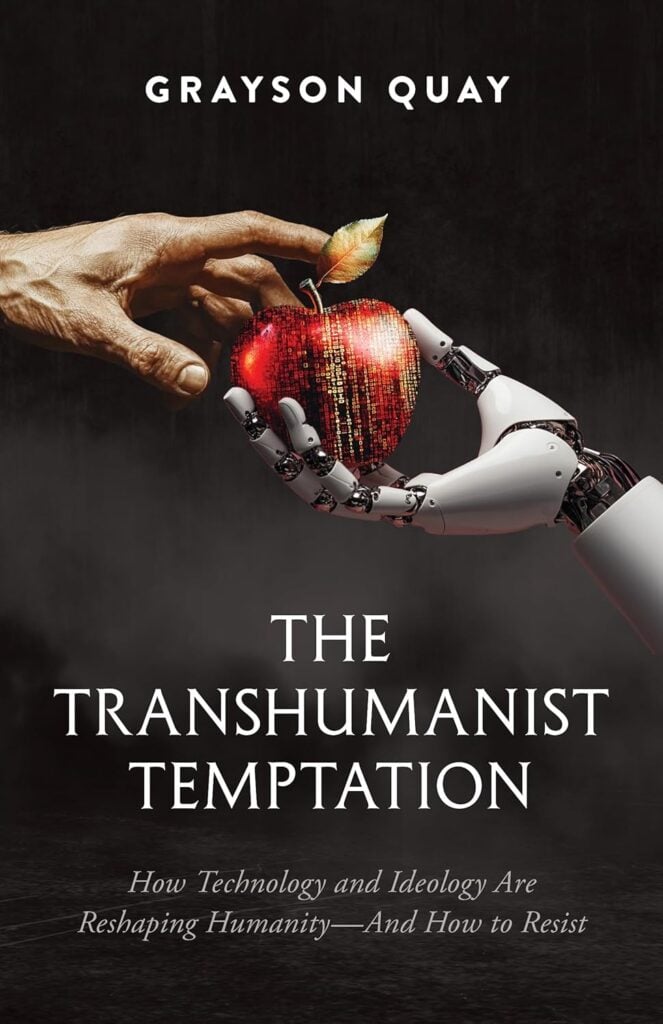
The Transhumanist Temptation: How Technology and Ideology are Reshaping Humanity—And How to Resist
by Grayson Quay
Crisis Publications
240 pp. $24.95
The first indication that the whirlwind romance between the tech bros and MAGA may be at an end was when Elon Musk exited the Trump administration amid fiery accusations and much bad blood. The feud was predictable—to the extent that we know the real sources of the duo’s falling out at all. By some reports, Musk’s futuristic love for electric vehicles butted up against Trump and his base’s love for commercial liberty.
Yet, unfortunately, the tech-futurists’ hold on MAGA is unlikely to end as easy as that. While Musk was notably absent, Trump held a meeting with tech leaders at the White House in September announcing an “AI action plan” that included a government and technocrat partnership in “AI education,” a pet cause of First Lady Melania Trump.
“This is a most incredible time,” one CEO salivated,
AI is going to change everything—you hear all of us saying that—but the fact that you are our President and you recognized this right away, and you’ve unleashed American innovation and creativity—all the work you’re doing in basically every cabinet post in addition to what’s coming out of the White House—is making it possible for America to win.
For the lay observer, the concept of AI was barely contemplated as recently as five years ago, yet now CEOs are positively giddy at the prospect of achieving the power AI “innovation” offers them. And they aren’t wrong about that. AI is the culmination of a living transhumanist nightmare which Grayson Quay discusses in his seminal book, The Transhumanist Temptation: How Technology and Ideology are Reshaping Humanity—And How to Resist.
The CEOs who met with Trump, such as Sam Altman, herald a future in which humans beings can augment their own capabilities by “merging with AI.” Quay sees this admission as part of a transhumanist effort to redefine humanity as “nothing more than information processing.” By this definition, a sentient and self-conscious processor that is better at processing information than flesh-and-blood humans is simply a better sort of human. For technocrats specializing in the AI revolution, AI represents the final triumph of technology over our human failings.
“We’re still in the early stages, of course,” Quay writes. “But as interactions with these programs and algorithms replicate, replace, and reshape human interactions, we’ll struggle to maintain both our own humanity and our appreciation for that of our neighbors.”
This disturbing trend did not materialize out of the blue, Quay contends. Tracing the transhumanist impulse all the way back to the birth control pill and even free market economics, Quay argues that, “we’ve abandoned God to pursue spiritualities of self-empowerment.”
When it comes to the realities of childbearing and childbirth, the self-actualized modern woman encounters a cruel reminder of her own lack of agency. Even a “planned” pregnancy is often accompanied by all manner of unpleasant realities, and sometimes even horrors. Pregnancies are uncomfortable to the point that work and social life often suffer. Birth is excruciatingly painful, and even the modern innovations that relieve much of this pain are riddled with their own limitations. A pregnant woman faces the “choice” (if she even is afforded a choice in the event of an emergency that requires deviation from her birth preferences) of intensely painful labor, a 6-inch needle through her spine, or a surgery that involves cutting through 7 layers of tissue—and, in rare cases, a woman must endure all three.
“To the transhumanist, there is something fundamentally undignified about embodiment … The transhumanist wishes to choose her body’s form and exercise full control over all its functions,” Quay writes. “The denial of either feels like a violation of personal dignity. The swellings, cravings, aches, and indignities that a woman of the nineteenth century might have regarded as routine, a woman of the twenty-first regards as a direct affront.”
From such a mentality comes a culture where the birth control pill is prescribed to girls as soon as the signs of her own budding womanhood manifest themselves. The pill does not, as Quay quotes author Mary Harrington saying, “fix something that’s wrong with me, like a broken arm,” but instead alters a natural function of human biology which the individual wishes were designed differently than it is. This is perhaps also why most of female and reproductive medicine is focused around preventing pregnancy and quelling a woman’s capacity to reproduce instead of making pregnancy easier and healthier.
But The Transhumanist Temptation is more than a screed against the usual right-wing enemies. Chapter 12 addresses “right wing transhumanisms” followed by a chapter examining the relationship between capitalism and transhumanism. Besides the more obvious dalliance between tech bros and the modern American right mentioned above, the internet phenomenon known as “BAPism,” inspired by the writer otherwise known as the Bronze Age Pervert, bemoans a society in which the strong are forced to live alongside the weak, and worse, the weak are allowed to procreate despite their genetic inferiority.
“Alamariu [the real name of Bronze Age Pervert] thus returns to the original form of modern transhumanism: the belief that by eliminating bad genes (of the individuals who carry them), humanity can elevate itself to a higher state of being,” Quay writes.
This mentality is directly opposed not only to, “the Christian proclamation that all people are God’s children made in His image,” but also the history of Christendom which includes, Quay points out, Christians who rescued “malformed infants from Roman garbage dumps.”
These sorts of right-wingers have a surprising amount in common with left-wing feminists when it comes to questions like the birth control pill. The more forthright of these right-wingers would candidly admit that they do not oppose abortion as much as they oppose aborting white babies and not aborting “unwanted welfare ghetto babies.”
Ever since the fall of the Berlin Wall and the West’s defeat of communism, the right in America has defined itself almost exclusively in terms of the market and our attitudes towards it. Only in the last few years have different segments of conservatism—such as common good integralism, nationalism, and populism—popped up to deny that whatever is good for the “market” is necessarily good for the people. “GDP go up” is not always the best indicator for human flourishing. The right must resist its obsession with capitalism if it wishes also to resist the coming AI apocalypse and transhumanist takeover of society.
“As we gain greater power to alter, augment and discarnate ourselves, we also face greater pressure to do so in response to marketing, social trends, and economic necessity,” Quay says. “And the logic of pure capitalism offers no basis for resisting these pressures.”
Quay’s solution to the growing success of transhumanism is “one in which humanity either intentionally represses or unintentionally destroys its technological capacities.”
We must also hope that younger generations—by which I mean generations Z and alpha—realize, before it is too late, that many of the technological triumphs we celebrate have not, in fact, liberated them, but very often have the effect of enslaving them. It would be worthwhile for a statistician to quantify the generational breakdown regarding attitudes towards transhumanist advancements, but since the younger generation is also the generation that will suffer most of the bad consequences of these technological innovations, their opinions are especially interesting. My own sense is that there is more skepticism among the young—and since the young are the people who, as a group, are generally more conversant with technology, it seems to me that older generations should be listening.
Leave a Reply