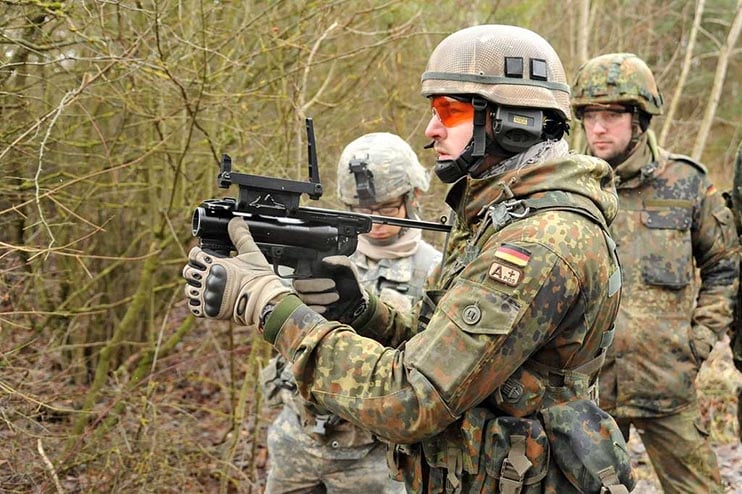
Germany seems chronically unable to become a “normal” country. Its lingering state of angst and political neurosis is a curious and arguably unique phenomenon for a major European nation. It stems from a mix of its late national unification, the trauma of the Great War and the ensuing Versailles order, the dark legacy of the Nazi regime, and the even greater trauma of another defeat. Then came the postwar foundational ethos of institutionalized collective guilt and shame, with liberal-democratic denazification morphing into outright degermanization.
Post-1945 political structures in the West German Federal Republic were based on the dubious concept of militant, or self-defensive democracy. The premise was that democracy is both sacred and fragile—as evidenced by the Weimar Republic—and thus it needs robust protection by its self-appointed guardians who control the media, the academy, and above all the political process itself.
In East Germany, the apparatus of control was crudely Pavlovian—symbolized by the Berlin Wall—but it was unable to penetrate the collective public consciousness of the people. Denizens of the five eastern provinces remain among the freest-thinking Germans to this day: having endured 45 years of Marxist-Leninist indoctrination, they are resistant to its velvety twin, the liberal-democratic manipulation. They despised the commissars; they equally dislike western German neurotics whose obsessively catastrophic scenarios—including environmental collapse and the return of Nazism—serve as mechanisms for a moral safety net that swiftly translates into political and judicial oppression.
Right now, the Federal Republic is in a state of economic, social, demographic, and moral crisis unprecedented since its creation in 1949. At the same time, paradoxically, Germany is pursuing a massive rearmament program.
To a casual observer, it may seem that Germany’s decision to dramatically increase its military spending should be good news for the United States and for President Donald J. Trump. After all, he has frequently and justifiably criticized European NATO allies for spending too little on defense, arguing that the United States bears an unfair financial burden by subsidizing European security.
But Germany’s elite class is not calling for rearmament to satisfy President Trump or take up its fair share of NATO security. Instead, it has normalized the prospect of a war with Russia in the not-too-distant future. It has also revived the notion that Germany is, once again, the epicenter of Europe, the Old Continent’s geopolitical heartland.
The temptation to draw a parallel with the 1930s is almost overwhelming: Rearmament appears as the solution to economic crisis. The process, heralded immediately after Russia’s invasion of Ukraine, is summed up in the unmistakably Teutonic term Zeitenwende, or “epochal turning point.” On Feb. 27, 2022, just three days after the start of the Russian “special operation” in Ukraine, Chancellor Olaf Scholz gave a speech to the Bundestag announcing this turning point in Germany’s security and defense policy, and announcing that €100 billion (US$115 billion) would be spent to reequip the German military.
It would be naïve to assume that Herr Scholz, an uninspiring mediocrity, could have conjured a brand-new grand-strategic concept in the mere three days between the entry of Russian tanks into Ukraine and his address to the Bundestag. Furthermore, just one day after his announcement, the opposition Christian Democrats (CDU/CSU) declared their support for the new policy, announcing their readiness to approve the constitutional amendment necessary to finance the special fund through further budgetary borrowing.
Four and a half years later, Friedrich Merz is the most unpopular chancellor in the history of the Federal Republic and the least-liked head of government in the world, with dissatisfaction in his rule reaching up to 80 percent in polls. His rickety red-black (CDU/CSU-SPD) coalition was created primarily as a bulwark against the rise of the right-wing populist party, Alternative für Deutschland (AfD), but he is acting like a national leader fully empowered to bring his predecessor’s notion of Zeitenwende to a whole new level. In May 2025, Merz declared his intention to make the German military the “most powerful conventional army in Europe,” technologically superior over any likely adversary (meaning, of course, Russia) by 2039.
Over the next decade, Germany intends to increase its military strength to almost half a million active and reserve personnel, more than double current levels. By 2029, the defense budget will reach €160 billion (US$185 billion, more than triple the sum allocated in 2022. Dozens of new weapons programs are pending, including armored fighting vehicles, fifth generation fighters, satellites, long-range missiles, air defense systems, and thousands of drones. No other European country has the industrial capacity, economic strength, and fiscal space to sustain a comparable effort.
The formal rationale for this massive expansion is the Russian threat, of course, but on closer scrutiny it turns out to be entirely bogus. After more than 1,600 days—far longer than the Great Patriotic War of World War II—Russian forces are unable to reach the left bank of the Dnieper River, or to recover the provincial capital of Kherson, which they took in the opening stages of the operation, let alone to advance on the key Black Sea port of Odessa. Even the major city of Kharkov, right at its doorstep, remains out of Russia’s reach.
German planners cannot be unaware of the absurdity of the claim that, once they finish off Ukraine—which entails taking tens of thousands of square miles to the Polish border, including Kiev—Russian divisions will attack Eastern and Central Europe, roll over the three Baltic republics, followed by Poland (which has the third largest NATO army), and then burst into the North German plain.
The notion is simply ridiculous. Something deeper is at work. German rearmament heralds a major psychological, cultural, and geopolitical turning point. The post-World War II taboos are being shattered, but not in the name of any meaningful revival of the discrete German national identity and national interest. It is far worse than that.
The Zeitenwende was enacted last April in the first-ever codified military strategy of the Federal Republic of Germany, a close equivalent of the U.S. National Security Strategy. Its subtitle is “Responsibility for Europe” (Verantwortung für Europa), which is a deliberately ambiguous, and at the same time deeply misleading formulation.
The document suggests that Germany is selflessly making a major strategic U-turn, which entails economic sacrifices and painful choices regarding resource allocation, for the sake of some vaguely defined pan-European solidarity and the German strategists’ sense of responsibility for the long-term security of other Europeans. The trouble is that no such “responsibility” has ever been codified, or granted by any European nation, to the German military. That is malarkey. In reality, Germany’s rearmament is an ideological project in the service of what its post-national ruling elite considers its own best interest.
As the German affairs analyst Giacomo Mariotto pointed out in the excellent Italian geopolitical magazine Limes, Bundeswehr Major General Jürgen-Joachim von Sandrart unwittingly exposed the mendacious reasoning behind the Responsibility for Europe. To deal with “a much less present America, if not completely out of the picture,” the answer cannot be some European army doomed to failure due to the “impossibility of reaching an agreement.” The true solution is an “army of Europeans,” built not on the fusion of military sovereignties, but on the “ever closer integration” of national armed forces.
This proposed architecture cannot sustain itself without a firm backbone, and that role—unsurprisingly—should belong to the Federal Republic of Germany, a “framework nation” that, naturally and without any hegemonistic intent of course, draws neighboring countries into its industrial and military orbit. This centrality is not spelled out, but it is hinted at and built in practice through fiscal resources, manufacturing capacity, technological superiority, and demographic weight. Mariotto calls it Ankergeopolitik (“the geopolitics of the anchor state”), which is a new term perfectly befitting the new German strategy.
The underlying concept is familiar to those who know the German geopolitical theory of a century ago. Mitteleuropa was General Karl Haushofer’s geopolitical concept envisioning a self-sufficient, German-dominated central European core that would serve as the anchor for a broader Eurasian continental bloc. It was designed to counter the global dominance of Anglo-American maritime superpowers. Its most notable feature was the insistence on the need for a Russian-German continental alliance, however, which is radically at odds with the current German postmodern state project.
Haushofer divided the globe into self-contained continental spheres of influence, with Mitteleuropa acting as the economic and political heart of the Eurasian landmass. But unlike Merz and his cohorts, he advocated for a strategic axis linking Berlin, Moscow, and Tokyo to unite land powers against sea-based Anglo-American empires. Heavily inspired by Sir Halford Mackinder’s Heartland theory, Haushofer viewed control of the Eurasian land-pivot, starting with Mitteleuropa, as the stepping stone to continental power.
Exactly a century later, we are witnessing a revolution in the heart of the Old Continent that seems designed to produce long-lasting effects. The symptoms are difficult to decipher. They are not based on the classic nationalist notion of Germany’s supposed mission, either in its pre-1918 imperialist guise or in its national-socialist form, which came a generation later.
The current process takes the hybrid form of an unprecedented and untested entity: a post-national liberal state that exercises power in pursuit of an ideological framework radically opposed to the notions of national greatness, let alone ethnic or racial coherence. We have the usual German arrogance and audacity, but this time in the service of what, exactly?
We are in uncharted territory here, but intuitively we sense that the project has the underlying, unstated objective of disarming and declawing those true German patriots (the populist AfD!) who are sick and tired of the Freudian-Orwellian engineering to which their nation has been subjected since 1945. They are surely willing to see their nation lead a pan-European effort to regain some control over their destinies, and stop Muslim immigration first and foremost, but that concept is some light years away from what Merz and his cohorts have in mind.
What the elite class has in mind is the Ankergeopolitik (anchor geopolitics) that postulates the leadership of a liberal, multicultural Germany in a post-heroic, post-national European society. That leadership is supposed to belong to a nation declawed, disarmed at heart, intrinsically resistant to any notion of sacrifice.
There is a problem, however. The Bundeswehr cannot become capable of fighting a real war with gays, women, and transgenders in uniform, not to mention increasing numbers of Turks, Arabs, and other “new Germans” in the ranks, whose acceptance compensates (for now) for the reluctance of real young Germans to answer the call. All along, any revival of the old martial spirit, when the German army was by far the best and most effective fighting force in the world (1870-1942), is ideologically verboten, of course.
The war in Ukraine did not trigger German rearmament, but it opened a window of opportunity for its elite class to triumphally pass the point of no return. On current form, the result will be another tragedy for Germany, for Russia, and for the rest of Europe.
Germany is dangerous because it is still very powerful, and because its ruling elite—as always—takes ideas very seriously. Ideas have consequences. In German hands, they tend to turn deadly. The bipartisan CSU/CDU-SPD effort to neutralize the political enemy at home (AfD) by kidnapping the mantle of national greatness in the name of a post-national utopia is pleasing to the liberal German mainstream, which hates Russia mostly because it is stubbornly white, devoutly Christian, and resistant to weaponized homosexuality.
There is a paranoid, hysterical quality to the public discourse on Russia and all things Russian in today’s Germany. Its corporate media machine and its deep state have abdicated reason and common decency in favor of raw hate and fear-mongering. We have not seen anything like it since the darkest days of the state-sponsored Jew-bashing in the 1930s.
The roots of Russophobia’s emotional appeal to the German elite are clear. It comes as a huge mental relief to the ultrasensitive liberal mind to be able to hate an outside group with impunity, and even to appear virtuous in the process. Of course, the object of that animus is a white, Christian, European Russia that stubbornly refuses to be postmodernized. It refuses to become gripped by the self-hating, morbid introspection typical of Germany. It is, outrageously, a nation not ashamed of its past and unwilling to surrender its future to alien multitudes; a nation where nobody obsesses over migrant rights, transgender pronouns, Islamophobia, microaggressions, and other “issues” indicative of a society’s moral and intellectual collapse.
The Russophobes’ narrative, in Germany and all over the collective West, is unrelated to Russia’s actual policies. It reflects a deep odium of the elite class towards Russia as such. For them, Russia has become the ultimate “other.” Yet another war with Russia would permanently ruin Germany, far more than did the Armistice of November 1918 and its Versailles aftermath, or the Yalta deal of February 1945. Fighting that war under the rainbow flag and in the name of “responsibility” for the Europe of Ursula von der Leyen and Kaja Kallas would be ironic and criminal in equal measure.
The melancholy fact is that Germany and Russia are in fact natural allies, two eminently compatible telurocratic powers. As per Carl Schmitt, they have a common interest in resisting the social chaos and utter moral decrepitude emanating from the morbidly self-destructive yet unabashedly thalassocratic Anglosphere embodied in today’s United States of America.
There is nothing intrinsically wrong with the pending remilitarization of Germany. It would have been welcome news indeed had the German rearmament program been aligned to Trump’s concept of “European security,” a vision which is recognizably realist in its strategic assumptions and operational principles. This is not the case, however.
The problem is that the “turning point,” announced by Scholz in 2022 and currently pursued by Merz, is not an old-fashioned budgetary adjustment based on the assessment of the country’s national interests. It is, instead, an ideological project in response to the prodding of Germany’s own brand of Euro-integralists and globalists. In view of the antinational, obsessively antifascist, and pro-Third World immigration program of the German political establishment (and there is not an iota of difference here between the CDU/CSU “right” and the SPD or Green “left”) Germany can rearm only if it is accepted that no national interest would be served, and that the remilitarization program would be conducted under the clearly post-national banner of “responsibility for Europe,” which is just another way of restating the globalist agenda.
This framework is deeply detrimental to the American interest. It presupposes, absurdly, that any coming war with Russia is inevitable and even necessary. The unstated assumption of the promoters of this self-fulfilling prophecy is not geopolitical. It is the clearly present sense that it is intolerable to allow for the continued existence of Russia as an overwhelmingly white and Christian nation, untainted by self-hate, resistant to the immigrant deluge, and adverse to the propagation of politicized homosexuality. That is the real Russian “threat.”
The United States must not allow a collection of self-appointed, decrepit, and midwit European “elites,” who are Trumpophobic to the bone to drag it into a conflict with Russia in order to satisfy their culturally and morally moribund view of the world. In view of the only real global challenge we face—which is in the Asia-Pacific region—that would mean wasting American resources in the wrong place, at the wrong time, and against the wrong enemy.
Germany’s rearmament, inspired by its leaders’ self-proclaimed “responsibility for Europe,” is the diametrical opposite of what Trump’s America is supposed to stand for, geostrategically and culturally. Their Europe is currently ruled by a regime of anarchotyranny even darker than the phenomenon that the late Sam Francis was describing when he coined the term. It is essential that the Trump administration continue what it has started in distancing itself from this grotesque caricature of Europe, which is inherently anti-Western and anti-American, as well as rabidly anti-European.
Leave a Reply