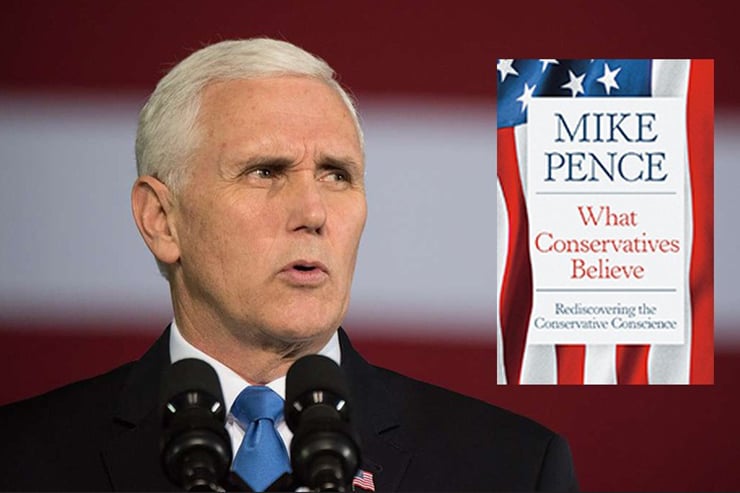
“Will we remain a party of conservative beliefs, or will we follow the siren song of populism?” asked former Vice President Mike Pence in a recent Wall Street Journal op-ed adapted from his dud of a new book, What Conservatives Believe: Rediscovering the Conservative Conscience. One could easily wonder what conservatives have to learn from a man who polled so abysmally in the campaign for the 2024 Republican presidential nomination that he was one of the very first candidates to drop out as President Trump rode the “populist” wave all the way back to the White House.
The false dichotomy of Pence’s question, which rests on the dubious premise that “conservative beliefs” and the ideas he calls “populism” diverge to the point of incompatibility, reveals the sad truth: What Mike Pence does not know about conservatism could fill the vast plains of the Midwest.
Readers appear to agree. Less than two months after the release of What Conservatives Believe, according to its Amazon listing, which advertises it at a 42 percent discount, Pence’s book languishes in 73rd place among books about conservatism, with overall sales registering below more than 56,000 other commercial titles. What Conservatives Believe has turned out to be considerably less popular than the former vice president’s first book, So Help Me God, a 2022 memoir that landed on the New York Times bestseller list at least in part because, as a spokesman later admitted, Pence’s associated PAC spent $91,000 to purchase thousands of copies of it.
This time around, the deficiencies of Pence’s analysis are readily apparent from his Wall Street Journal op-ed. The “siren song” of populism, he argues, “would replace our faith in limited government and traditional values with an agenda stitched together by opinion polls, personal grievances and performative outrage.” “Populists,” he says, “follow urges, not principles. They would erode our commitment to the Constitution and abandon U.S. leadership in the world.”
In the very next paragraph, however, Pence concedes that “the failures of big government and public officials who have broken our trust” generated populism’s rise. He gives short shrift to the kaleidoscopic range of perspectives that led Americans to reject establishment candidates of both parties in 2016 and 2024, but acknowledges that globalization, economic change, drug addiction, and attacks on traditional values played definite roles.
Despite his swipe at “populism,” Pence either fails to comprehend or willingly ignores that taking a stand on all these topics—and many others he did not mention—does and ultimately must rest on clearly discernible principles. Supporting economic measures to reshore domestic manufacturing, incentivizing job-creating foreign investment, placing U.S. interests ahead of foreign interests, seeking to end socially destructive drug abuse, and wanting one’s values upheld rather than cast down are fundamentally all positions of principle that follow from empirical analysis and rational evaluations of the common good. The true distinction is that those principles are not Pence’s principles—a motley and outdated assortment of priorities that both Republican and Democratic leaders adapted after World War II to refloat devastated foreign markets, buy Cold War foreign allegiances, and amplify economic issues that they believed vital in electoral politics.
Equally unconvincingly, Pence argues that Trump’s emphasis on “common sense” also departs from the “principles” he believes should lie at the heart of the conservative movement. Why Pence thinks it would be a good idea to dissociate his ideology from common sense is anybody’s guess, but once again his argument degenerates into an assertion of what he and the tiny minority of Republicans who support him believe to be correct principles over the contradictory or clashing ideas of the vast majority of Republicans who despise him and support Trump.
Ultimately, Pence’s hollow appeal to “principle” is far more about the power to shape American conservatism than to advance pretensions to unyielding ethical or philosophical truth. He felt the power dynamics perhaps more acutely than any other anti-Trump conservative on Jan. 6, 2021, when he resisted calls not to certify the 2020 election results by appealing in yet another case to “principles” that allowed him to avoid controversy. It did not help him in the long run.
When he ran for president in 2024, Republicans remained almost totally unconvinced and registered their resentment in his low polling. Nor was the country at large convinced. An Associated Press-NORC Center for Public Affairs Research poll released just weeks before Pence dropped out found that 57 percent of American adults viewed him negatively, while only 28 percent held a positive view.
Appealing to what he called “principle” on Jan. 6 is almost certainly what Mike Pence will remain best known for. His new book, which is endorsed by vocal but superannuated conservative figures such as George Will, Paul Ryan, Phil Gramm, Mitch Daniels, and other names ousted from prominence and influence in the GOP a decade or more ago, is but one prong in a strategy to build up think tanks, media posts, and other artifacts of outsized establishment influence to try to counter the populist tide favored by conservative nationalists now who control the commanding heights of electoral politics.
But what hope does this fading GOP establishment have? Its neoconservative leaders never bothered to mentor protégés, cultivate acolytes, or delegate power. Now they find themselves without successors as real power in the GOP fluctuates with no reference to them between different strands of Trumpism. “It’s become clear to me: This is not my time,” Pence said when he withdrew from the 2024 primary after less than five months of campaigning. In all likelihood, it never will be.
Leave a Reply