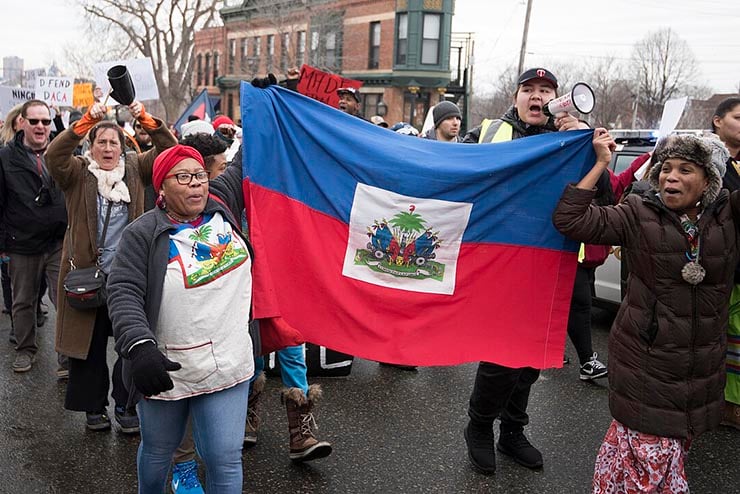
In the dog days of summer, the chaos of January’s immigration enforcement operation in Minneapolis has begun to recede from the national consciousness. As it turns out, Minneapolis may just have been the opening act in a larger, more dramatic event coming soon.
As Immigration and Customs Enforcement (ICE) prepares focused interior operations to locate and remove Haitian nationals whose Temporary Protected Status (TPS) is now ending, a familiar script is already loading. Expect the same media outlets and anti-borders politicians who turned the Minneapolis clashes into a national morality play to treat any confrontation involving Haitian migrants or protesters as the next referendum on the Trump administration’s deportation plans. Minneapolis was not an aberration; it was a dress rehearsal.
More than 300,000 Haitians have lost TPS protections and work authorization after the Supreme Court cleared the path for termination. TPS has functioned in practice as a de facto amnesty program. Repeated extensions and redesignations under the Biden administration turned a humanitarian pause into a long-term presence for large populations that arrived or remained after conditions that originally justified the designation.
Renée Good and Alex Pretti lost their lives in Minneapolis after attempting to disrupt federal immigration operations and endanger the lives of agents. The corporate media immediately weaponized those tragedies. Footage was selectively framed, agents were cast as aggressors, and the underlying policy—removing people without legal status—was ignored in favor of a narrative featuring ICE agents as Trump’s Gestapo run amok.
With midterm elections approaching, the media’s incentives to distort the immigration narrative have only increased. Any arrest, any violence outside a worksite in Springfield, Ohio, South Florida, or Indiana, any image of those in ICE custody being processed will be widely distributed on social media. The mainstream media will not be subtle in proclaiming the arrest of black Haitian nationals by largely white and Latino agents to be evidence of institutional racism and ethnic cleansing. If a Haitian national or a protester dies in a scuffle with ICE, the deceased will be elevated to martyr status, regardless of the circumstances.
The far larger and often downplayed story is how millions of noncitizens were allowed to enter and remain under the Biden administration through a web of parole programs, repeated TPS expansions, catch-and-release policies, and lax interior enforcement. Haiti’s TPS redesignations and extensions created pathways that many used as tickets to permanent residency. Beyond the lofty politician-speak about how we should be “welcoming” to the world, illegal immigration has clearly harmed U.S. citizens and legal residents.
“How have U.S. citizens been harmed?” critics will ask, in full gaslight mode. In brief, there is now greater competition in labor markets in lower-skill sectors, contributing to wage pressure for the most vulnerable American workers. Housing costs in cities and towns rose under the weight of sudden demand. Schools and hospitals report overcrowding and strained budgets. The cost of taxpayer funded social service programs skyrocketed, as they were asked to provide education, emergency care, and financial support for illegal immigrant populations way beyond the scope of their budgets.
All this is before any mention of criminal activity by TPS recipients. In August 2023 Hermanio Joseph, a Haitian national in the U.S. under TPS status, drove into oncoming traffic and struck a school bus in Springfield, Ohio, killing 11-year-old Aiden Clark and injuring others. He was convicted in 2024 of involuntary manslaughter and vehicular homicide and sentenced to 9-13.5 years in prison.
More recently, Rolbert Joachin, also a Haitian national with TPS status, was charged with murder for repeatedly striking a naturalized citizen and mother of two in the head with a hammer and killing her outside a Florida convenience store in April.
Does this mean every Haitian in the U.S. under TPS status is a violent criminal? Of course not, but it shows the deadly consequences when humanitarian programs are manipulated to fulfill an anti-borders agenda.
As operations ramp up in the coming days, clashes are possible. Protesters will coordinate and cell phone cameras will be recording. Politicians seeking midterm advantage will declare any unpleasant image proof that deportation itself is illegitimate.
When that happens, it should be remembered that ICE’s forthcoming operations are not the origin of the ensuing controversy. They are the belated attempt to close a chapter that should never have been allowed to stretch on for so long. The media and political class that spent years treating TPS as a bridge to permanence will now spend the midterm season searching for the next Renée Good or Alex Pretti. The public should recognize this performance for what it is—and keep its attention on the policy choices that made mass removal necessary in the first place.
Leave a Reply