The Cantor of Western Decline
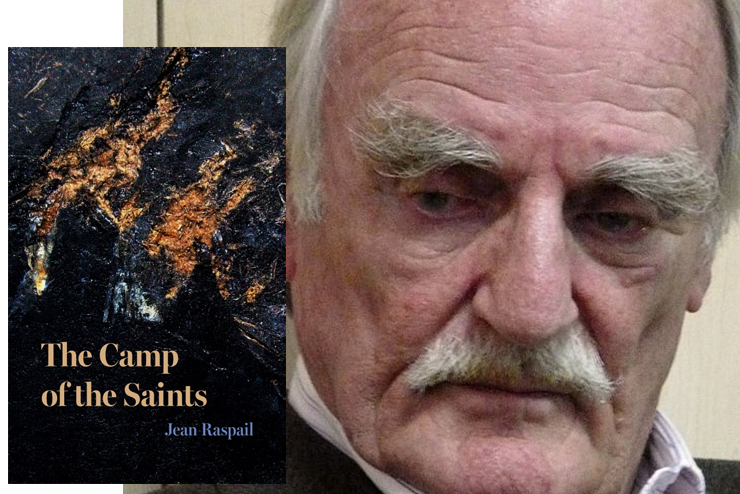
Like many writers and artists, Jean Raspail eludes easy typecasting. He’s most famous for The Camp of the Saints, a novel that careless readers interpret as a xenophobic screed. Yet he made his reputation as a writer of travel stories, recounting the plights of vanishing aboriginal peoples around the world, in a tenor akin to other postcolonial writers. He was certainly a Catholic traditionalist, but he drew insights from other religions. Because he was never involved in politics and his books aren’t really about politics, it’s hard to classify him as a man of the political right. “I’m a novelist,” he wrote in an earlier preface for The Camp of the Saints. “I don’t have a theory and I don’t have a system or ideology to offer or to defend.”
Nevertheless, Raspail’s works do evince “metapolitics,” what Joseph de Maistre called the “metaphysics of politics.” They show the intuitions and insights required to grasp deeper realities, or at the very least, identify the ones that are missing from the present. For the first time in a generation, English speakers can discover Raspail’s metapolitics for themselves. His most famous novel, The Camp of the Saints, is now back in print, with a fresh new English translation by Ethan Rundell published by Vauban Books. Read alongside Raspail’s other works, it captures his determination to preserve and pass on the best of Western civilization, especially during moments of catastrophe.
Jean Raspail was born in 1925 in Chemillé-sur-Dême, a town in the Loire Valley. The youngest of four children, he was a solitary child: by the time he was eight, his siblings had married and left the house. His family, bourgeois and Catholic, was well-connected to Parisian commercial and civic life, and so he grew up in the city’s affluent 16th arrondissement, attending the best Catholic schools.
Raspail, however, never felt at home in this milieu. A restless student, he found his summer vacations spent outside the city far more formative. They nourished his provincial roots and his imaginative connections to the distant past. Legend had it that the family was descended from Visigoths vanquished by the Frankish armies of Clovis in 507. Tall, blue-eyed, and fair-haired, Raspail seemed to embody that ancient heritage that endured long after defeat.
Scoutisme, the French Scouting movement, played a particularly important role in forming his character. Now best known for teaching leadership and appreciation for the outdoors, Robert Baden-Powell’s scouting movement was, in fact, founded upon Christian virtues and practice. Unlike many other scouting movements, French scouting embraced Baden-Powell’s explicitly spiritual outlook. The Scouts de France was founded in 1920 by the Jesuit priest Fr. Jacques Sevin, who was later beatified. It blended the precepts of scouting, Catholicism, and the nation’s oldest chivalric customs. Properly done, scoutisme was meant to turn fidgety boys into self-disciplined men, whose love of adventure and pursuit of the noble are coupled with a mission to help others discover their roots and origins. Whereas French schooling failed to shape Raspail, scoutisme did.
After the war, he and some scouting friends wanted to go on a canoe trip in the New World. By 1949, this adventure had turned into something much more ambitious: a 200-day, 3,000-mile canoe journey from Trois-Rivières to New Orléans, inspired by the 1673 voyage of Fr. Jacques Marquette and Louis Joliet. This voyage instilled in him a love not just for New France and its history, but an appreciation for the indigenous peoples of North America who lived alongside the French Canadians.
In 1951, Raspail embarked on another adventure across the entire New World, journeying by car from Tierra del Fuego to Alaska. During this voyage, he passed through Chilean Patagonia and learned of the Alakalufs, also known as the Kawésqar, a vanishing indigenous people who would feature in many of his works. As Raspail wrote his travel stories, he began trying his hand at fiction. His first novel was published in 1958. The Camp of the Saints, which appeared in 1973, was his third.
Raspail developed his devoted following during the 1970s, when he began reimagining Patagonia as a kingdom with a mesmerizing, if anguished and eccentric, history, christened by the leadership of a kind of holy fool. His entry into literary distinction came in 1981 with the imagined biography of one such figure: Moi, Antoine de Tounens, roi de Patagonie (I, Antoine de Tounens, King of Patagonia). This book won the Grand Prix de Roman de l’Académie Française and was adapted into a television series.
At the height of his fame in the 1980s and 1990s, Raspail was widely admired across the political spectrum. Left-wing intellectuals and politicians appreciated his literary talents, and reading his books became a rite of passage amongst younger French Catholics. In 2000, Raspail was nearly inducted into the Académie Française but lost in a close vote. In 2003, he received the Grand Prix de Littérature de l’Académie Française, the Academy’s prize for lifetime literary achievement. He died in 2020, leaving behind nearly 40 books and over a dozen novels, as well as his wife of nearly 70 years, Aliette, and their two children, Quentin and Marion.
Raspail’s best novels represent an unusual kind of historical fiction. They encompass historical events that veer off into the realm of fantasy, of historical counterfactuals that recount the sudden resurfacing of long-lost dynasties or peoples. L’Anneau du pêcheur (The Ring of the Fisherman) envisages the resurgent lineage of the Avignon papacy. Qui se souvient des hommes… (Who will remember the people…), portrays the Alakalufs on the cusp of extinction, with a language that has no word for happiness, but hundreds to express suffering. Pêcheur de lunes (Fisher of Moons) depicts the remnants of the Ainu of Northern Japan and Russia. Sire, a theological thriller, imagines a king of France crowned in contemporary Europe, as the regalia of the lost Arthurian world reemerge. Like other 20th-century European writers, Raspail enjoyed mixing real and fictitious places, often gesturing toward the old, aristocratic Europe that vanished after the world wars.
By gesturing through fiction toward these lost kingdoms, Raspail provides a kind of literary royalism. This is intended not to offer up monarchy as a readily applicable political program, but rather as a transcendent, poetic refuge from the banality of modern politics. It captures at once a regret for what is lost, a dream for what may come, and perhaps most importantly, a defiance of the follies of the present.
As a young man following in the footsteps of Fr. Marquette, Raspail met a man, “Bill,” who chided him and his friends for their admiration for indigenous North Americans, for their naïve Indianisme. “In Europe,” he told them, “dreams of the past take up too much place in your life. Here, we don’t talk of the past, but of the dam and the hydroelectric plant.” Raspail’s whole literary career could be described as a revolt against this attitude. Countering those who spurn the past and hail technological conformity, Raspail told the stories of the disappearing principalities and peoples whom progressives consigned to extinction.
Raspail sensed that modern conformism made us embarrassed of nobility. “Dreams of grandeur and of conquest,” he wrote, “are henceforth doomed to remain buried deep within our hearts, and everyone keeps their truth secret, for fear that it will dissolve into dust if it comes in contact with reality.” Literary royalism struggles against this, communicating and transmitting spiritual and political greatness against the tide of modern times. Yet in Raspail’s novels, it never seems to end well. Herein lies his almost pagan pessimism. At the end of Moi, Antoine de Tounens, the narrator asks whether the Antoine de Tounens has the courage “to once again dress up in fantasies the definitive downfall of all his hopes.” It’s a charming, endearing picture, but it’s a tragic one. Embracing the noble precisely because it is absurd is not exactly a practical activity. There is an earnest desire to escape from mediocrity and uniformity, and many characters pursue this goal. Yet there is no real confidence one can get away from one’s present situation.
It would be simple, but too neat, to place Raspail in the canon of 20th-century French Catholic writers, the best of whom express deep pessimism about the modern age. In Raspail’s writings, tragedy cuts much deeper. His Catholic readers complain that his novels are devoid of hope. That’s not quite right, yet these readers do notice how Raspail’s spiritual outlook is shaped by deep hostility to the theology of progressive optimism; so often, our hopes do come to dust when they meet the tribulations of the real world.
Other times, his novels seem laden with black, satirical humor, indicating a detachment from the world that seems laced with permanent cynicism about the human condition. This has resonances of postwar French existentialism, but the spirit of Raspail is closer to another group of postwar writers, called “les Hussards.” Fiercely nonconformist and often contrarian and conservative in their political opinions, the Hussards opposed Charles de Gaulle for abandoning the colony of French Algeria. They defied the left’s subordination of art to political objectives and emphasized style instead. Raspail has a touch of their irreverence.
Yet this irreverence is directed at the present to favor the past. Modern New York, he judged, was “a desert,” because “we no longer run into an Algonquin.” Pessimism never overwhelms Raspail’s love of places and peoples distant in time and space.
This love shapes Raspail’s determination to transmit the memory of almost vanished nations. Chanting this polyphonic hymn to the nobility and fragility of the world’s peoples, Raspail affirms the particularity of cultures and civilizations. Postwar existentialists mixed their tirades against social conventions with Marxist gestures, sketching a deconstructionist, liberationist project they hoped would have universal appeal. In Raspail, by contrast, there’s no agenda for imposing the latest Western political fashions across the globe. The world cannot be refitted into the model of the “dam and the hydroelectric plant.” Had Raspail kept his study of indigenous tribes to the far-off places unfamiliar to most Westerners, he might have preserved an unblemished reputation as a novelist and writer with arguably anti-colonialist sympathies.
Yet in one early work, he committed an unpardonable offense. He wondered whether the fate of the indigenous peoples of Europe would be like that of those peoples who had vanished in the wake of European colonization. Now, as Europeans retreated from their empires, were they just as vulnerable, just as liable to vanish from history—and just as deserving of a lament? Sometime in the 1960s and ’70s, such thinking became taboo. And so for better or worse, all of Raspail’s literary oeuvre is now measured by the one novel that took up those questions and which dared to imagine the end of European and Western civilization.
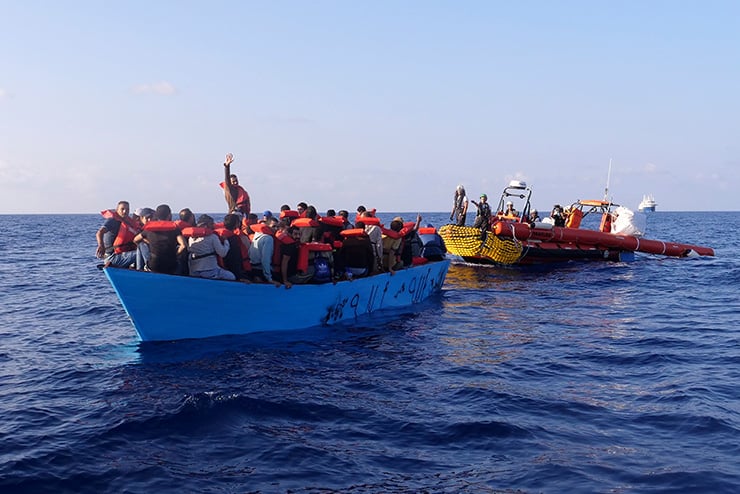
The Camp of the Saints is best read as a long thought experiment, a fictional depiction of the civilizational consequences of Western self-loathing. Its plot concerns a fleet of 1 million migrants who depart India, landing on the shores of southern France. As the novel begins, the armada arrives on the French shore. While the other villagers have fled, a retired professor remains, looking on from his seaside cottage. A miscreant vows to lead a band of migrants to pillage the professor’s home. The professor shoots him. This startling beginning shows the real struggle that frames the novel. Raspail was perfectly capable of describing non-Western peoples accurately, fairly, and compassionately. But this is not his task in The Camp of the Saints. The migrants are a backdrop to a deeper struggle being fought within the West itself.
After this beginning, the novel recounts how the migrants arrived on the shores of France. Westerners are the engineers of their own destruction. It’s a Western assembly of notables gathered in India that organizes the expedition and helps provision and launch the ships. The left-wing intelligentsia herald the coming of the migrants as the dawn of a new age of multiculturalism, stoking a media frenzy to support the landing and deploying their own form of cancel culture against opponents. The intelligentsia shrinks the Overton window by portraying mass immigration as both morally obligatory and inevitable.
Then there’s the treason of the Church, which Raspail mocked with incisive prescience. The sitting pope, a Latin American, spends his time flying around on humanitarian missions. In the novel, Catholicism disdains national and civilizational particularity and renders the faith indistinguishable from the moral universalism of nonbelievers. Churchmen see the influx of migrants as the Second Coming, a final triumph of the weak over the strong that will atone for the West’s sins. The French right-wing opposes this surrender. Yet Raspail cleverly satirizes them for their eccentricity and inefficacy.
French authorities, discussing what to do about the armada, are thereby paralyzed. They persuade themselves of their own illegitimacy and refuse to resist. When the migrants alight from their boats and wade ashore, the West has already capitulated. Alternating between tragedy and black humor, the novel’s final segment recounts the fate of those who defy the new consensus. One brave colonel leads a small band of resisters, including the professor. They set up their own government in his village. But their insurgency cannot survive the new order. The novel ends as it begins, with white-on-white violence. The French air force bombs their village, leaving no survivors.
The novel’s prophetic power certainly comes from anticipating the upheavals caused by mass immigration. It also grasps the underlying logic of the ideology of decolonization embraced by so many Westerners during the postwar period, which in recent years has become toxic. According to the advocates of decolonization, self-determination is not enough. Decolonization must be allowed to culminate in reverse colonization, with accompanying violence. The process is helped along by Westerners who are taught to despise themselves and who think the world would be better off if they vanished. To be free, the formerly colonized people must conquer and colonize their former oppressors. Their former oppressors—the whites—need to acknowledge that they do not deserve a future. They must disappear.
The Camp of the Saints pulls back the veil on the depth of the West’s spiritual crisis. The novel shows how the West’s destruction is rooted in a deep spiritual sickness that leaves it helpless before its enemies:
Two opposing camps. One believes in miracles. The other no longer does. The one that will raise mountains is the one that has kept its faith. It will conquer. Mortal doubt has sapped all energy in the other. It will be conquered.
In exploring this theme of spiritual effacement, Raspail anticipated the novels of Michel Houellebecq, who explores similar themes. Houellebecq is haunted by God—or more precisely, by his absence. In Houellebecq’s novels, a spiritually aware reader intuits that affirming the Christian creed would solve many of the characters’ difficulties. Yet the conditions necessary to support Christian belief no longer exist. This is why we sink so low, why even our most intense pleasures are so ephemeral and meaningless.
There’s a similar thread in Raspail’s work. Characters appear who are devoted to desecration (in The Camp of the Saints, this is the function played by the politician and intellectual Clément Dio). Like Houellebecq, Raspail offered his readers discomforting portrayals of the macabre and grotesque. These reveal a world that has lost sight of the transcendent and where, like Houellebecq, Raspail rubbed our nose in the dirt of an ignoble world, where excellence and self-worth have been abolished.
The Camp of the Saints is also haunted by the absence of properly ordered charity. The choice seems to be between a crude particularism that alternates between love of pleasure and love of violence, and naïve universalism that ultimately legitimates violence against those who love their own.
Raspail’s later, more mature works are literary explorations that take us beyond the novel’s dilemma. Just like The Camp of the Saints, these later novels about cultural destruction show what survivors and resisters would do in the wake of civilizational catastrophe. Just like The Camp of the Saints, they describe little platoons of resisters who try to save a culture threatened with extinction, to protect the fragile roots of traditions touched by the deep frost of modernity. These resisters, however, rarely win. Their numbers diminish, and their historic territories are lost. But their very resistance, along with the spiritual integrity they manifest, assures the transmission of what is noble, even if those who endure must go underground for centuries. They bury their dead, but not to forget them; they bury them with the hope of seeing them rise again.
Raspail is a fitting Cassandra for our era, but not just for anticipating the drama of mass migration. About the West and about much of mankind, Raspail is a pessimist, a chronicler of lost peoples and lost causes. We are meant to feel their lack. In some ages, we can and should hope for great deeds and noble exploits, the testament of which is a monument more lasting than bronze. In other times, the lasting monuments are the eloquent remembrance of what we have lost, built in rebellion against forgetfulness. That’s not the final victory, but it is a victory nevertheless.
Leave a Reply