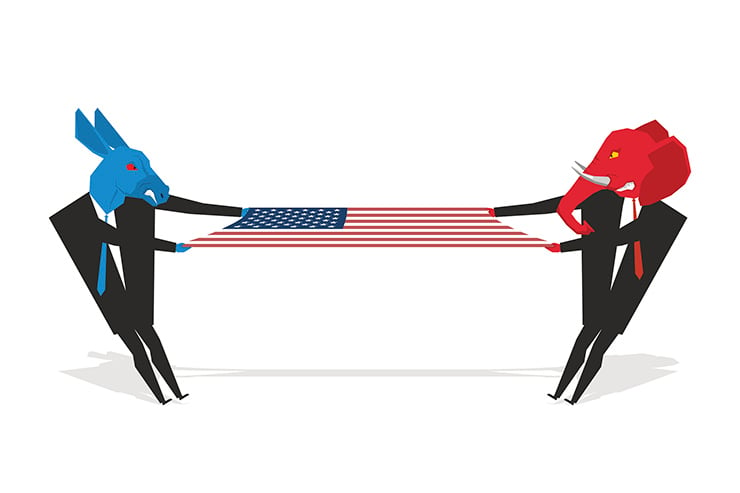
Two things are certain about American politics. President Donald Trump is intensely unpopular, and so is the Democratic Party, if not more so.
Most people feel trapped between an administration that has so far failed to lift the boats of the beleaguered middle, and an opposition party, such as it is, that gives them no cause for confidence. This dilemma is borne out in one survey after another.
Trump’s most recent approval rating comes from The Economist, which shows his favorability at 39 percent. A recent Quinnipiac University poll has him at 38 percent and underwater on seven key issues, including the economy, foreign policy, and immigration. Fully 79 percent of Quinnipiac respondents said that the United States is in a “political crisis” in the wake of Charlie Kirk’s assassination.
You’d think a catastrophe like the killing of one of the most prominent conservative activists would give the ruling Republican Party a public opinion bump. But if you thought that you’d be wrong.
According to pollster Nate Silver, Trump’s approval rating actually declined following Kirk’s death. That probably comes as a surprise to conservatives, given the massive following of the late founder of Turning Point USA. But it shouldn’t. Many Americans believe that Trump’s rhetoric in the aftermath struck a note of division rather than unity. See Kirk’s memorial service.
“The answer to hate is not hate,” said Erika Kirk, Charlie’s widow, after forgiving her husband’s killer. She said he was the kind of young man TPUSA was built to save. But when Trump took the stage next, he made it a point of dissenting from both Erika and Charlie. “That’s where I disagreed with Charlie,” Trump said. “I hate my opponent, and I don’t want the best for them. I’m sorry. I am sorry, Erika.”
At a time when the country feels like it’s on a knife’s edge, comments like that have turned a knot in the public’s stomach. Indeed, a poll published by G. Elliott Morris on Sep. 23 found that just 28 percent of U.S. adults say the country is on the right track, while 60 percent say it is headed in the wrong direction. Apart from concerns over whether political violence will become the new norm, the country is in a jobs recession. Grocery prices are soaring.
Americans feel like they are drowning as Trump builds himself a 90,000-square-foot ballroom in the White House’s East Wing. As Marie Antoinette might put it, “Qu’ils mangent de la brioche.”
It’s hard to imagine that the opposition wouldn’t benefit from Trump’s deteriorating support, certainly with midterms fast approaching. But you would be underestimating the Democratic Party’s ability to turn easy wins into losses, or just how much the public distrusts them with power at this point. CNN data analyst Harry Enten likened the Democrats to the “New Orleans Saints of political parties.”
Enten found that, despite Trump’s plummeting approval numbers, most people trust Republicans far more to handle crime, immigration, and the economy. A Reuters/Ipsos poll recorded similar findings across a wide range of issues. Who can blame Americans? The wounds inflicted by the Biden administration are still fresh. They remember what it was like to live through four years of chaos, four years of being lied to about the state of the country, and about the mental condition of the president himself. Even if Trump’s second term is shaping up to be similar in that sense to his predecessor’s, Americans still aren’t ready to give back the reins to Democrats.
Considering Trump’s poor performance on the metrics he set for his administration, that realization should be pretty alarming for the leadership of the Democratic Party. But there is no indication of concern coming from that side of the political aisle. Senate Minority Leader Chuck Schumer really seems to believe that his party will return to power with no concerted effort—just by being perhaps somewhat less unpopular than Trump.
Speaking with MSNBC, Schumer pushed back on the idea that Democrats have suffered serious damage to their brand or that a course correction is needed: “In a couple of the races where we have the two candidates, we win,” he said.
So, the answer is no. From the Democrats’ point of view, there’s no need to do anything differently beyond reminding voters of Trump’s existence. It is as though they imagine Trump is some cosmic horror, and that no matter how much voters hate Democrats, they ought to hate the president one percent more. Schumer doesn’t seem to believe that there’s any reason to reconsider the trajectory of his party. There’s no urgency to conduct an autopsy because he doesn’t even realize that the corpse is on the table.
Schumer has, however, begun to pepper his speeches and social media output with some curse words—presumably (and embarrassingly) as part of some effort to appeal to younger voters. It is as if all they need to do is post more pictures of Democratic House Minority Leader Hakeem Jeffries in casual clothing, sporting a big chain around his neck, and leaning against a photoshopped bench.
None of this is good for the long-term health of the country. I hope Democrats find a way to moderate themselves and return to being a working-class party, just like I hope the GOP remembers that it was given a mandate not to rename the Pell Grant after Trump, but to improve the material conditions of the country. I know, that sounds delusional. But one can dream.
Leave a Reply