“We wanted to live fully human lives.” This line, delivered by a man in the documentary Freedom’s Fury, was in reference to the Hungarian resistance to the Soviets in 1956. But it gives us pause on many levels. What does it mean to be fully human or to live a fully human life?
Most often, as in this film, we think about it when something is missing—that is, when we are asked to live in a way that isn’t fully human. For these Hungarians, the Communists could provide housing, jobs, and determine everything they were permitted to read, say, and think. But the Communists had no conception of or interest in permitting a fully human life—so Hungarian dissidents resisted.
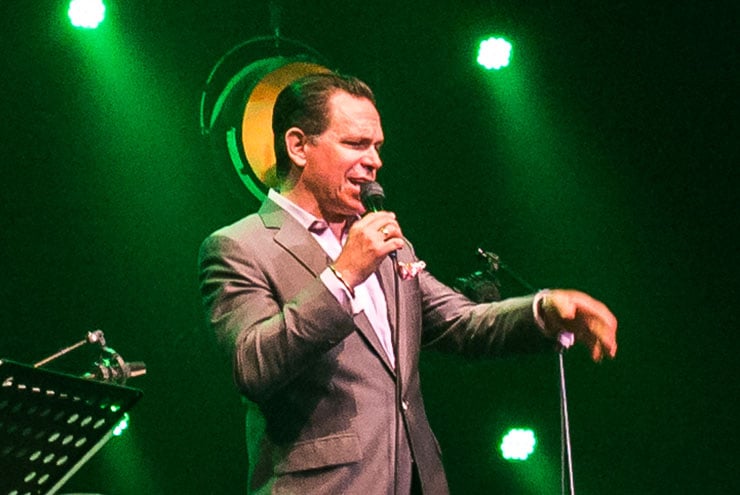
Sometimes, however, we get glimpses of a fully human life in the affirmative—things that show us what might be possible, spiritually deep, and alive. That was sort of the message delivered with glorious force and passion recently at a concert given by the great jazz singer Kurt Elling and the Strathmore Jazz Orchestra at the Strathmore Center in Maryland. It was a fantastic concert, and one that carried powerful spiritual meaning, as well as lots of joy and humor.
Elling is the premier male jazz vocalist in America. He’s been nominated for eight Grammys and won two. Elling also very plainly adores American jazz music. That seems like an obvious thing to say about a jazz singer, but in Elling’s case, it is clear that his love for it is all-consuming because it is infectious. His heart seemed to expand whenever he lovingly spoke of “this music” or of artists like Duke Ellington, Wayne Shorter, and John Scofield.
Even as so much of our culture stares into a digital AI void , the best music, Elling said, still comes from acoustic instruments, which hit you in the “right here.” When he said “here” Elling put a fist to his chest—as well as to the backside and the brain. No matter how much AI takes over, Elling was saying, we are souls. We want to live fully human lives and feel things with all of our being.
I’ve been following Elling since 2008, when I first saw him perform—and at the same location. Elling, a former divinity student at the University of Chicago, had then commingled the lyrics of the jazz standard “My Foolish Heart” with the poetry of St. John of the Cross. Seeing him do this in concert for the first time, I was seized with a kind of spiritual rapture. As the Biblical translator Stephen Mitchell once said about encountering God, it was a feeling so big that it wasn’t inside of me but I was inside of it.
In 2010 I was able to interview the singer at Blues Alley in Georgetown. This time around, in 2026, I got to meet Elling backstage before the show. He was joined by Daniel Jamieson, the conductor of the new Strathmore Jazz Orchestra.
“When I agreed to take on the role of conductor of the Strathmore Jazz Orchestra,” Jamieson said,
one of my core stipulations was that this orchestra would never function as a backup band. The musicians themselves are the heart of the project. I want this ensemble to be presented with the same artistic importance and visibility as any guest soloist we bring in. The players are the identity of this orchestra, and I am committed to building a culture that places them at the center of every performance.
There was no mistake about that at this concert as the orchestra was the beating heart of the performance.
Elling’s stylings make it more accurate to call him a musical explorer and poet than to describe him simply as a jazz singer or soloist, . Early in his career he would dependably sing standards like “My Foolish Heart,” but his arrangements were always so dynamic and absorbing that “singer” just didn’t capture it. Moreover, from the beginning he was capable of creating lyrics to sublime effect in numbers like “A New Body and Soul.” In addition to his jazz offerings, he is a member of the band Superblue, which is more funk than jazz and has done fantastic “guilt pleasure” covers of songs by ELO and even AC/DC. His new record, In the Brass Palace, is a full big band recording with a cover of Joe Jackson’s “Steppin’ Out” and interpretations of songs by John Scotfield and Wayne Shorter.
“It’s just further growth,” he says about the new record. “I’ve always been in love with singing in big bands. And I’m in a position where I have a catalogue of charts that deserve to be heard. There’s not turn in the road, just manifestation of further possibilities.”
Incredibly, Elling remembered our first interview and the fact that I was curious, like he is, about spiritual themes in music. Elling’s father was a Lutheran minister and musician, and in 2010 Elling told me, quoting Rainer Maria Rilke, that he preferred to “live the questions” than adhere to “any dogmatism,” although he has “great respect for the Ecclesia.” I then told Elling about a spiritual experience I had at one of his shows and asked him if he had ever felt something similarly transcendent on stage.
Yes, he replied, at virtually every moment he performs he feels it. Elling said that we are already “living in the eternal”—that the things we are doing here in this life are a part of the timeless.
“What we have here in this moment is really already eternal,” he said. “Whether we experience it or not is a matter of our own spirit self-discipline, our self-awareness, our outlook on life. But if the eternal is truly eternal then it is already happening … I kind of take for granted that I am having a transcendent experience on stage every time.”
Now, in 2026, where is his spiritual path?
In as much as music is broadcasting information that is extra-logical, there is more information coming to people than merely notes and words and harmonies and rhythms. There can’t help but be information of the spirit, of the spirits of the room, of the intention of the music. It’s already happening if the music is of quality and of purpose. My intention in music and lyric writing is to continue to explore stories that speak of that realm, ideas that overflow their boundaries into that realm, and to use the music as much as I can to encourage myself and my bandmates and the audience to collaborate in whatever ecstasy is possible in the moment.
As I discovered during my other experiences here with Elling, at the Strathmore, he is brilliantly alive. I can’t name another performer who is as comfortable with an audience or in his own skin as much as Elling appears to be.
Ellling has also always been very funny. He recalls his girlfriend’s father’s verdict on one of his shows – “words, so many words” – and notices when one of the band members, in fact the “artist in residence,” wanders in casually from the side of the stage, almost missing his cue. “I guess artists in residence really means he lives here,” Elling quipped. “He’s got an apartment offstage and he’s doing laundry.”
It’s one of those fully human moments that AI can never capture. One of the greatest things about jazz, especially as popular music these days becomes more digitized and predictable, is that great jazz still has to contain the human element to be recognized as jazz—it’s basically a defining feature.
On Elling’s great live recordings you can hear the audience reacting, as well as the musicians grunting, yelping, and reacting to things in the moment. All of this is as much a part of the music as the notes themselves. It’s music that, as Roger Daltrey once said of The Who, has blood running and pumping though its veins. Elling ended the show with “My Foolish Heart.” As happened the first time I heard it, I felt transported. Beautiful, spiritual, and literate art that celebrates American music is alive and well.
Leave a Reply