
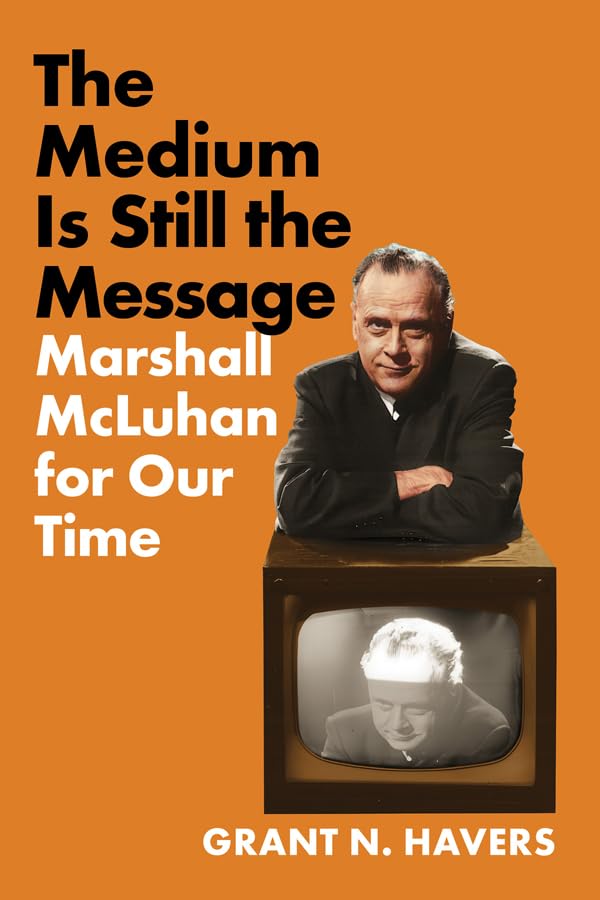
The Medium is Still the Message: Marshall McLuhan for Our Time
by Grant Havers
Northern Illinois Press and NIU Press
206 pp., $31.95
Grant Havers’s biography of Canadian thinker Marshall McLuhan (1911-1980) should be an eye-opener for those who still cling to false notions about Havers’s subject. Identified with such concepts or slogans as the “medium is the message” and “the global village,” McLuhan has been widely seen as a herald of a future happy age of global electronic communications. A longtime fixture at the University of Toronto who lectured on the communications revolution and its implications, McLuhan, if read carefully, warned about where the media revolution would lead unless properly channeled.
McLuhan was an admiring reader of G. K. Chesterton and Hillaire Belloc, and while studying at Cambridge University, he came to champion the Distributist program for local government advocated by his favorite Catholic writers. McLuhan also notably converted to Catholicism, and later in Canadian politics he took a stand against the legalization of abortion and the rise of the cultural left. According to McLuhan, Western societies entered terra incognita during the communications revolution, starting with the invention of the radio. Instead of creating a “global society,” the advance of communications has worked against individual identity while fashioning a new tribal society. Moreover, “the reach of the media is so extensive that they can now control the content of the environment.”
The global village, as defined by McLuhan, consists of those who accept the same collective reality in what has become a “postliterate age.” Those hooked on the media no longer read, certainly not with care. Instead, they receive alternating truths electronically. In this “postliterate tribalism” toward which Western societies are now steadily marching, loyalties are formed through loyalty to a news source and its celebrities. The media have also created “tribal chieftains” around which fan bases form, and those who gravitate toward these iconic figures imagine themselves to be emotionally on the same wavelength, even if they have never met.
In the “literate age,” which centered on the act of reading, a bond was formed involving the reader and what he chose to focus on. Havers views such an experience as a relatively conservative one. No matter the nature of the printed content, it at least prioritized thinking individuals. During the bourgeois age before the rise of electronic media and the “continuing dissemination of information,” reading books was an act of individual learning and judgment. No such experience can be derived from what the media now distills and diffuses as “truth.”
McLuhan was heavily influenced by another University of Toronto professor, Harold Innis, who taught economics but pioneered the study of communications. According to Innis, print media shows a “tendency toward preserving history and tradition,” even if these media can be diverted toward other purposes. Electronic media, by contrast, are intrinsically “space-oriented” in such a way that they manufacture facts while flooding the listener or viewer with instantaneous images, which is deceptively designated as “information.”
McLuhan, who was a student of scholastic thought, also reached back to Aristotle and his notion of causality to explain how electronic media differed from older sources of learning. This super-modern invention lacks a “formal cause” as that term is defined in Aristotle’s Metaphysics. Unlike books, electronic communications operate without giving us a clear idea of what defines their essence. The media can produce words and images, so that people become addicted to its operation, and whatever it transmits becomes true for them, at least for as long as they remain captivated by the highlighted message. This is a continuing, deliberate activity but one that serves no other function than flooding us with images and words.
McLuhan also warns against trying to understand the operation of the media by looking back to an earlier stage in communications and treating what came later merely as a refinement of an earlier invention. This “rearview mirror” approach does not do justice to the magnitude of the transformation taking place. The internet is not a more advanced form of radio or television but something far more transformative in terms of changing human relations and the acquisition of information.
Havers is to be commended for making sense of an author whom I have never enjoyed reading because of his diffuse writing style and his tendency to jump from one subject to another. McLuhan’s work also became intertwined with attention-grabbing catchphrases, and this kept me from taking his insights seriously. But his work sheds light on how the contemporary media affect us. Mediacrats have constructed a postliterate tribal society, which is perceptible throughout the Western world. Instead of the transmission of news, we have cascading “facts” coming from “journalists” who revel in their media celebrity. The medium truly has become the message, and each tribal community chooses its own tribal chieftain remotely.
Leave a Reply