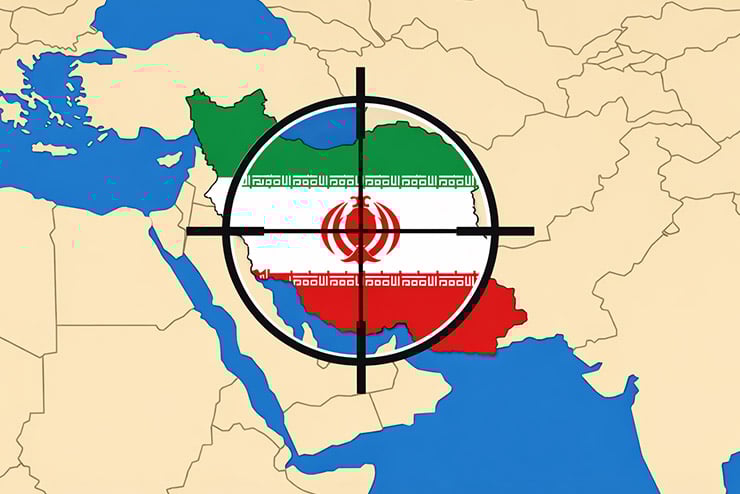
With Operation Epic Fury in its third week, at the time of writing, it is essential that President Trump clearly define objectives and bring this conflict to a resolution within the next several weeks.
It is beyond dispute that Iran’s nuclear program, drones and ballistic missile stockpiles, naval vessel inventory, and its network of regional proxies have been seriously degraded. If the attacks continue with the same or similar intensity for another month, President Donald Trump will be able to declare victory and terminate the operation in mid-April.
It is advisable to wrap it up within this time frame for four main reasons. Come Easter, there may not be enough targets of value left in Iran to strike; the U.S. and Israeli reserves of precision munitions will need restocking; and global markets will need assurance that oil and gas supply chains will return to normal sometime soon. Last but not least, Trump’s decision to bring the conflict to a speedy conclusion should reflect increasing pressure on his administration ahead of the upcoming midterm elections in November.
Defining “victory” as something less than outright regime change in Tehran will be necessary. Expert opinion, both in the region and in the U.S., is increasingly inclined to view the regime’s collapse as highly unlikely. Evidence does not support the notion that air strikes could spark an uprising leading to regime change. The Shi’ite uprising against Saddam Hussein, which followed the Gulf War ceasefire in March 1991, ended in disaster. Encouraged by the regime’s perceived weakness, Shi’ite rebels seized control of Basrah and Karbala, but were brutally crushed by Saddam’s Republican Guard in April 1991.
A significantly weakened Iran, unable to seriously threaten regional stability for a decade or even longer, would be a good enough outcome to claim victory, without risking a quagmire, mission creep, massive westward refugee flows, a power vacuum, or civil war. Fortunately, the administration is not committed to the objective of outright regime change. President Donald Trump quickly walked back his demand for Iran’s “unconditional surrender” on Mar. 6, and more restrained military objectives were restated.
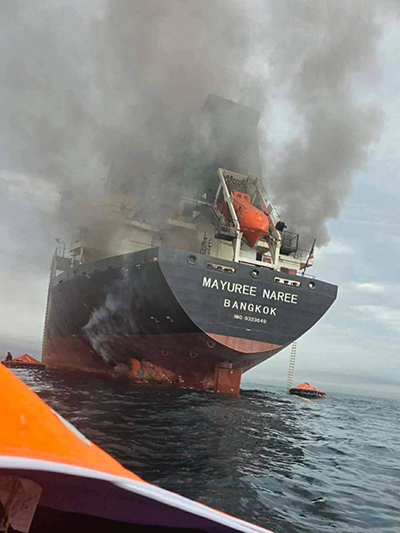
the Royal Thai Navy shows
Thai cargo ship, Mayuree
Naree, that was struck
and set ablaze in the Strait
of Hormuz Wednesday,
March 11, 2026.
(Royal Thai Navy via AP)
It is an even bet that if the threat to regime survival is removed, Iranian leaders will see the wisdom of returning to the regular modus operandi of transactional diplomacy, Trump style. They will be chastised and surly, to be sure, but more amenable to compromise. On March 12, Iranian President Masoud Pezeshkian laid out terms for ending the war with the United States and Israel in what could be a sign of de-escalation. Pezeshkian said he had spoken with his counterparts in Russia and Pakistan and confirmed “Iran’s commitment to peace.”
Israel claims the collapse of the Iranian regime as a strategic objective, and this may present a gap between official U.S. and Israeli positions—a potential public relations problem. It is essential for Trump to define the war’s strategic objectives and control the overall narrative. This may entail enforcing a ceasefire and compelling Israel to observe it. Neither Netanyahu nor the Israeli lobby should be permitted to shift the goalposts. Come what may, Israel cannot and will not continue the war alone.
The Israeli government might feign indignation over the Iranian regime’s survival while secretly welcoming the prospect. As an astute Italian analyst, Giuseppe De Ruvo, noted recently in the Roman geopolitical magazine Limes, Iran is the perfect enemy of the Jewish state:
It allows Jerusalem to provide itself with an ideological and military counterweight on which to vent its internal contradictions, since the Persian threat unites the sentiments of religious and secular Zionists, the intelligence services, and the Armed Forces. Tehran’s enriched uranium has never been an existential threat to Israel. Rather, it is its life insurance, acting as a useful safety valve… Israel against Iran is what prevents Israel against Israel… The long-term strategic and structural fact that should guide (and has historically guided) Israel’s actions is therefore the following: the Islamic Republic must not die. It must be constantly weakened, slapped, kept below the nuclear threshold. Cutting the grass is all well and good. But it must not and cannot lead to a definitive victory.
In other words, making Iran unassailable does not serve Israeli interests. This unassailability can be achieved either by the ayatollahs actually building the Bomb, or by Tehran becoming a U.S. client, as it had been under the Shah. Seen from the vantage point of Israel’s strategic calculus, these two outcomes would be almost equally bad. Either way, it is desirable to keep the U.S. actively engaged as long as possible.
President Donald Trump is well-positioned not to be goaded into yet another open-ended Middle Eastern war, despite past allusions to possible boots on the ground. The regime now headed by the junior Khamenei may wish to draw the U.S. into a long war of attrition, but Moscow and Beijing appear uninterested. Without them—specifically without their money and advanced weapons—Tehran has no realistic chance of pulling it off.
The Russians and the Chinese have reacted to the attack on Iran cautiously and (in Russia’s case) with notable verbal moderation. China is traditionally loath to project its power beyond its own strategic periphery. In addition, Beijing’s energy situation is precarious. China has increased Iranian supplies in recent months, securing buffer stocks for a few months. However, its dependence on Gulf hydrocarbons makes it among the world’s most exposed countries should the crisis drag on or worsen.
For his part, Vladimir Putin is keen not to offend Trump, whose benevolent impartiality he needs in resisting the assorted European hawks ganging up against him in Ukraine. Moscow’s restrained reaction led some observers to conclude that the Kremlin was distancing itself from its putative Iranian ally. Moscow issued a formal condemnation and a call for a return to the negotiating table within a multilateral framework; such a response sounded like a sign of caution and detachment, if not outright disengagement.
This interpretation was supported by precedents in Syria and Venezuela, where Moscow’s official stance was not followed by direct intervention aimed at preventing an unfavorable political and strategic outcome. Focused on Ukraine and reluctant to engage in direct, frontal intervention elsewhere, Russia now calibrates its assistance to others based on their internal stability and the perceived strategic importance of the theater. In Venezuela, Russian involvement had remained limited and predominantly technical, conditioned by geographic distance and the lack of structured military cooperation.
It seems clear that Iran will remain relatively isolated in the weeks ahead, certainly enough to preclude any hopes of being propped up by Russia (let alone China), as the “Collective West” has propped up Ukraine since February 2022. This affords President Trump the opportunity to end the war on terms that leave Iran seriously, if not permanently, crippled. Effectively shunned by the major Eurasian land powers, unable to count on any help from its regional clients, and loathed by its Arab neighbors, who are subjected to the daily barrages of drones and rockets. Iranian leaders may conclude that the game is effectively up, that refusing the possibility of compromise may be more expensive than swallowing the bitter pill of compliance with American demands—however humiliating.
Continuing the war may have unintended negative strategic consequences. In 2003, George W. Bush removed Saddam Hussein, who had acted as a barrier to the Iranians spreading their influence to the west across southern Iraq and Syria to Hezbollah in southern Lebanon.
In a similar vein, if a major power vacuum is created in Iran’s stead, the main benefactor will be the resurgent, neo-Ottoman Turkey, which is a more serious nuclear aspirant than Iran has ever been, and certainly a more formidable potential foe of both Israel and America in the Greater Middle East.
It is in the American interest for President Trump to proclaim victory and end this war sometime in April, because continuing it may start yielding diminishing strategic returns. In 2003, when Bush attacked Iraq, despite the disinvestment that followed the end of the Cold War, the U.S. had well-stocked arsenals. Today, in order to wage an air war on a medium power like Iran, a third of the entire U.S. naval power and some two-fifths of its air power had to be summoned to the Gulf.
This war comes at a time when, according to the National Security Strategy released in December, the administration views fortifying the Western Hemisphere and containing China within its first island chain as strategic priorities. In terms of America’s long-term strategic priorities, husbanding resources more equitably between geopolitical pressure points around the globe is not an option—it is mandatory. ◆
Leave a Reply