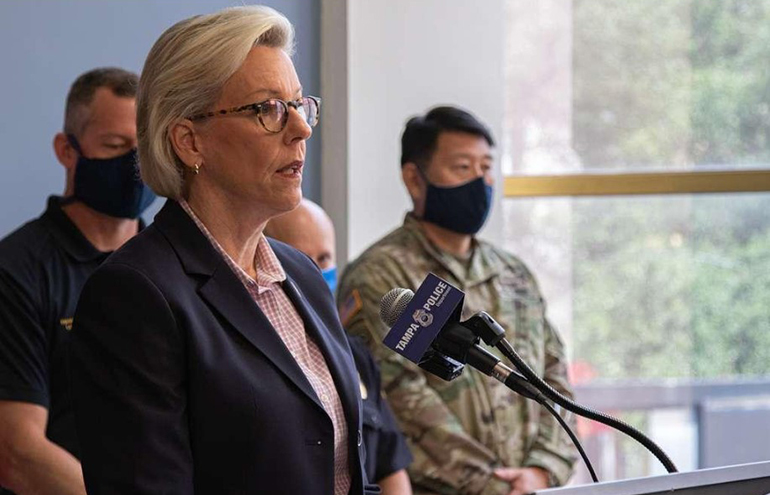
“Mayor [Jane] Castor is forcing sanctuary policies on the Tampa Police Department, which violates Florida law,” Florida Attorney General James Uthmeier posted on X earlier this month. “These policies must be reversed immediately, or there will be consequences.”
Uthmeier’s post included a letter he sent to Castor on March 11, accusing her of implementing new city law enforcement policies “prohibiting its police officers from sharing certain information with federal immigration authorities and limiting the immigration enforcement activities in which it participates.”
Tampa’s policies prohibited city cops from inquiring into or reporting to federal authorities the immigration status of any crime victim, witness, or individual requesting police services. They further prohibited officers from engaging in federal immigration enforcement, including workplace raids, traffic stops, and saturation sweeps, actions that have resulted in the detention of large numbers of illegal immigrants who have committed serious crimes beyond being illegally present in the country.
Tampa’s policies appeared to contradict Florida statutes that ban “sanctuary city” policies of any kind and require state and local law enforcement to “use best efforts to support the enforcement of federal immigration law.” They also seem to violate cooperation agreements signed by Florida law enforcement and ICE pursuant to Article 287(g) of the Immigration and Nationality Act of 1952, as amended in 1996, which provides for interservice cooperation in enforcement actions.
Castor, a Democrat who was a Republican until 2015 and elected mayor of Florida’s third-largest city four years later, began her professional life as a Tampa police officer and rose through the ranks to chief. While Florida’s Democratic Party once had a Southern “blue dog” moderate tradition, Castor, who is also Tampa’s first LGBTQ+ mayor, quickly fell into lockstep with the party’s ascendant radical progressive wing. During the COVID-19 pandemic, she required all city employees to be vaccinated unless they documented religious or medical excuses, and then required exempted employees to take weekly tests and wear N95 surgical masks on the job. During the 2021 Super Bowl, Castor issued an executive order to impose outdoor masking—a measure virtually unheard of anywhere else in Florida. In 2023, she approved Tampa’s “Climate Action and Equity Plan,” a sprawling, big-government, tax-and-spend initiative imposing “net-zero” environmental standards in line with President Biden’s Inflation Reduction Act, which, among other questionable results, failed to curb inflation.
The policies that landed Castor on Uthmeier’s radar were not her first brush with controversial law enforcement policy. Ironically, during her tenure as Tampa’s police chief, back when she was a Republican, she was accused of racially profiling blacks. Castor defended herself at the time, noting that many of the detained individuals turned out to be engaged in criminal activity, but claimed it was all a mistake when she contemplated running for mayor. Once in office, she instituted new regulations requiring police to intervene in cases of purported excessive force by fellow officers, banned the use of chokeholds, appointed a “community task force” to oversee police policies, and, for good measure, marched in a Black Lives Matter protest.
Uthmeier’s letter spelled out that Castor needed to reverse her sanctuary policies or face civil penalties “up to and including removal from office” by Florida Governor Ron DeSantis. Article IV of Florida’s state constitution, as well as separate statute, empowers the governor to suspend public officials by executive order for a variety of reasons, including “neglect of duty” and “incompetence.”
While earlier Republican governors—and other Republican leaders with similar powers—have been too timid to take action on those grounds, DeSantis has relied on them to remove elected officials, including on two occasions when he claimed they were flouting proper enforcement of state laws. He ousted Hillsborough County State Attorney Andrew Warren in 2022, after Warren publicly pledged not to prosecute violators of Florida laws restricting abortion and transgender surgeries. In 2023, DeSantis removed Orlando-area State Attorney Monique Worrell for failing to pursue prison sentences for crimes that merited them under the law. Both officials, whose campaigns were reportedly funded by groups associated with George Soros, challenged their suspensions in court. A federal judge raised First Amendment concerns but declined to reinstate Warren, who ran for reelection and lost to the DeSantis appointee who had replaced him. Florida’s state supreme court dismissed Worrell’s case, though she was reelected in 2024 and returned to office.
With clear statutory authority and strong judicial precedent behind Florida’s executive, removing public officials whose actions violate state law has proved to be solid, effective, and exemplary public policy. Over the course of 2025, Uthmeier sent similar letters to Fort Myers city councilors who refused to deputize police to participate in immigration enforcement, to Orlando Mayor Buddy Dyer when he asserted that city policy trumped participation in federal immigration enforcement, to Key West commissioners who voted to withdraw from their 287(g) agreement with ICE, and to Orange County’s mayor Jerry Demings and county commissioners for declining to transport illegals to federal detention facilities. In all cases, the recipients backed down and reversed the unlawful measures, though Demings admitted that he did so only under “protest and extreme duress.” Others might say he was simply required to obey state law.
Castor realized she had no way out. Just five days after Uthmeier’s letter, she issued a revised policy that omitted its objectionable provisions and solemnly replied to the attorney general that “the city of Tampa has no intention of violating state or federal law. We will continue to use best efforts to support the enforcement of federal immigration law, as well as state law.” Like Florida’s other imperiled Democrats, she clearly wanted to save her job and hold onto power. But if less principled or less determined Republicans were serving in Tallahassee, it is entirely possible that nobody would have even noticed Tampa’s unlawful policies, let alone called Castor out on them in the full knowledge that the law was firmly on the executive’s side and could be used to compel her to discard them.
“Florida is proud to be the Trump admin’s number one partner on immigration enforcement,” Uthmeier wrote in triumphant response to Castor’s backpedaling, “and local officials will not impede enforcement of the law!” Imagine how great America could be if other red-state conservatives would demonstrate this kind of fortitude in enforcing state and federal law.
Leave a Reply