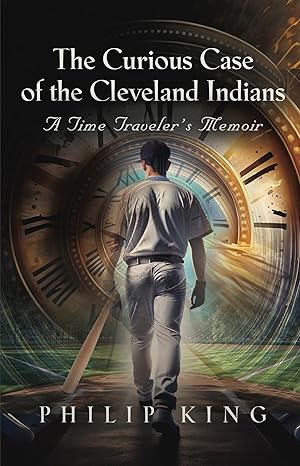
The Curious Case of the Cleveland Indians: A Time Traveler’s Memoir
by Philip King
Booklocker.com
248 pps., $17.99
Nearly 78 years have passed since Cleveland’s American League baseball franchise won a World Series. The psychological effects of this drought weigh heavily on committed fans of the “Team Formerly Known as the Indians.” Last October, one disgruntled fan placed a full-page ad in the Cleveland Plain Dealer criticizing team owner Paul Dolan for failing to surround star third-baseman José Ramirez with an adequate supporting cast. Another fan recently dealt with his frustration more creatively. He self-published a novel about going back in time to bend history in the Tribe’s favor.
Yellow Springs, Ohio-native Philip King was born in 1943, so he’s barely old enough to remember when the Indians were the reigning World Champions. He also remembers the dozen seasons following the 1948 championship season, when the Indians finished second place, usually behind the American League-leading New York Yankees. Using hindsight and modern baseball analytics, King has devised a player personnel strategy that he persuasively argues would have marginally but critically improved the team during those years.
If you want to know more about that strategy, you will have to read The Curious Case of the Cleveland Indians: A Time Traveler’s Memoir (2025). In the novel, King travels back to the autumn of 1948 and persuades the Indians’ front office to follow his advice. To find out how the fictional King pulls off time travel, you will also have to buy the book.
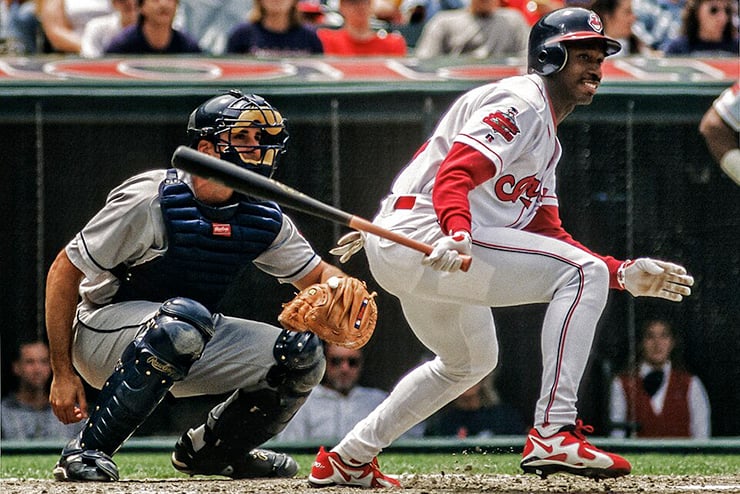
Curious Case contains its share of mistakes, not all of which can be excused even in a self-published novel. Someone who knows as much about Indians history as King does should know that the Tribe lost Game 7 of the 1997 World Series in 11 innings rather than nine, that closer José Mesa saved 46 games and had a 1.13 ERA in 1995 rather than ’97, and that second baseman Jeff Kent was traded to San Francisco well before 2002. But the book is redeemed by presenting the best argument to date for why center fielder Kenny Lofton belongs in the Major League Baseball Hall of Fame.
If the time travel elements were not strange enough, two other components of Curious Case combine to make it the weirdest book about baseball since W. P. Kinsella’s Shoeless Joe (1982). Dream sequences punctuate the text. While the dreams are mostly about baseball, they don’t really contribute to the narrative. Still, their presence can be forgiven, in part, because the author is an academic who made a career of studying dreams. Less forgivable is the author’s unironic and overt neo-Malthusianism.
Like the recently deceased biologist Paul Ehrlich, King believes that the Earth is on the brink of ecological disaster and civilizational collapse due to overpopulation. This leads to some hilariously alarmist passages in the book, including an epilogue that describes 2054 as a dystopia where baseball persists amid the misery and death. Unlike his fictional alter ego, the real-life King is a visitor from the past to the present, a visitor from the days when Ehrlich’s The Population Bomb (1968) was taken seriously.
Oddities aside, Curious Case makes one wonder about Indians history. Since 2022, those who have waited their entire lives to see the Indians win a World Series have been subjected to the cruelest of fates. Even if Cleveland wins a World Series, it will not be the “Indians” that win it.
What if State Senator Dennis Kucinich (D-Cleveland) had included a provision preventing the changing of the team’s name in the 1996 “Art Modell Law,” which restricts the activities of Ohio professional sports teams that play in taxpayer-supported stadiums?
Or what if Tribe closer Steve Olin had not died tragically in a boating accident during spring training in 1993? Would he have pitched the ninth inning of Game 7 of the ’97 World Series instead of Mesa?
Where’s a time machine when you need one?
Leave a Reply