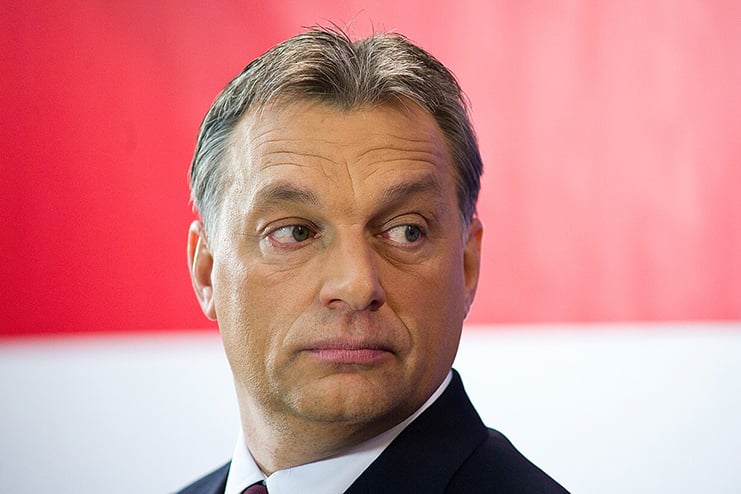
On Sunday, Hungarian Prime Minister Viktor Orbán’s governing Fidesz Party took a drubbing in national elections that gave his rival Péter Magyar’s Tisza Party over two-thirds of parliamentary seats. Orbán critics, ranging from the international left to Brussels Eurocrats to former Republican Senate Majority Leader Mitch McConnell, swooned in delight, celebrating not only the end of Orbán’s 16-year tenure but also what they hope will be the eclipse of his distinctive brand of national conservatism.
They are delusional.
First, the mere fact that Orbán was defeated in his own “illiberal democracy” is proof that he never was “autocratic,” as Hillary Clinton called his government in her celebratory X post. As Putin, Maduro, Ortega, and other real autocrats have shown in their countries’ recent sham elections, they simply do not and cannot lose at the ballot box—and certainly not with results so devastating that they hand legislative supermajorities to their opponents. If Orbán truly had been an autocrat, he would have jailed or exiled his opponents, outlawed opposition political parties, used the state apparatus to manipulate or invalidate the election results, or canceled or postponed the election, which most polling accurately predicted his party would lose.
But even with 16 years in power, he did none of these things, or anything else that stopped Tisza from defeating him in what virtually all observers have called a “free and fair” election. When Orbán lost, he promptly conceded and politely called Magyar to congratulate him before announcing that Fidesz would regroup in the hope of winning next time.
Second, Magyar’s victory was no leftist refutation of the principles guiding Orbán’s government or national conservatism generally. Until just two years ago, Magyar, who reportedly grew up with a poster of Orbán on his childhood bedroom wall, was a strong supporter and a Fidesz Party insider, long married to Orbán’s justice minister. He fell out with the leader over a major national scandal arising from a pardon granted by Hungary’s Orbán-aligned president to a politically connected child sex offender. The revelation led to the resignation of both the president and Magyar’s by-then ex-wife, who has since accused him of domestic abuse, blackmail, and treason. It was the scandal, not fundamental ideological disagreement, that motivated Magyar to start Tisza and campaign against Fidesz on an anti-corruption platform.
During the campaign, Magyar advocated pro-business economic growth, law and order, traditional social and cultural values, continuing non-involvement in the war in Ukraine, a pragmatic approach to relations with Russia and China, the preservation of strict border controls, and a nationally popular but EU-defying ban on migrants that in some respects exceeds even Orbán’s zeal. All of these points either resemble or align with Fidesz policies that, in turn, match and have been inspired by internationally recognized principles of national conservatism. Magyar’s campaign rhetoric also closely corresponds to the voting records of Tisza members elected in 2024 to the European Parliament, where they virtually always vote with Fidesz on issues of national importance to Hungary and about half the time on everything else.
In the immediate realm of Hungarian politics, Magyar’s anti-corruption and pro-growth message obviously resonated more. But combined with the parliamentary seats Fidesz retained, the top two national parties now hold 193 of the Hungarian parliament’s 199 seats. All six of the remaining seats went to the “Our Homeland” Party, which is even further to the right. The only significant leftist opposition, a social democratic party founded in 2010 to oppose Orbán, received just 1.1 percent of the vote and lost all 15 of the parliamentary seats it had held since 2022.
Third, Orbán’s national conservative model in Hungary remains a durable blueprint for the international new right. When Orbán entered office in 2010, his new brand of populist right-wing government was untested, very much alone, and new. He wasn’t merely the only game in town or even the only game in Europe—he was the only game in the world. Today, just over a decade and a half later, freely elected parties with similar ideas and leaders are in power in over 20 other countries: Italy, Finland, Croatia, Switzerland, the Czech Republic, Slovakia, Serbia, North Macedonia, Georgia, Israel, India, Japan, Argentina, Chile, Paraguay, Ecuador, Costa Rica, El Salvador, Honduras, Panama, and of course the United States.
In recent contests, national conservatives only narrowly lost in Brazil, Poland, Slovenia, and the Netherlands. Moreover, they made considerable gains in other countries with little or no history of conservative populism. On the very same day as Fidesz’s defeat in Hungary, a national conservative candidate topped first-round balloting in Peru’s 2026 presidential election. Polling for elections to be held within the next three years suggests future national conservative advances and possible victories in France, Germany, Austria, and the United Kingdom, among other places. Hungary may have rejected its pioneering national conservative leader after his long incumbency, but the movement he started is far from finished.
Leave a Reply